Key Takeaways
- 1Format matters less than formulation - both work if the product is properly dosed and tested
- 2Gummies win on compliance (taste, habit formation) and oral absorption advantages
- 3Capsules win on dose flexibility (higher doses per serving) and fewer additives
- 4Always prioritize fruiting body extract and third-party testing regardless of format
- 5For daily cognitive/wellness use, gummies have a compliance advantage most people underestimate
Quick Answer
Both mushroom gummies and capsules can be effective when properly formulated. Gummies offer better compliance (easier to take daily), potentially faster initial absorption through oral mucosa, and precise per-unit dosing. Capsules typically allow higher doses per serving and avoid added sugars. The most important factor isn't format - it's whether the product contains adequate doses of fruiting body extract with third-party testing.
Mushroom Gummies vs Capsules: A Complete Comparison
The mushroom gummies vs capsules debate comes up constantly in supplement communities, and for good reason. You've decided you want the benefits of functional mushrooms - lion's mane for focus, reishi for sleep, cordyceps for energy - but now you're staring at two different delivery formats with wildly different marketing claims. Which one actually works better?
Here's the honest answer: format matters far less than most people think, but it's not irrelevant either. Both gummies and capsules can deliver effective doses of mushroom extract to your body. The differences lie in absorption pathways, compliance rates, dosing flexibility, ingredient profiles, and cost efficiency.
This guide breaks down every meaningful difference between the two formats so you can make an informed choice based on your actual situation - not marketing hype from either side.
How Each Format Delivers Mushroom Extract
Gummies: The Oral Absorption Pathway
When you chew a mushroom gummy, absorption begins immediately. The chewing process breaks down the gummy matrix, releasing mushroom extract compounds that begin absorbing through the oral mucosa - the membrane lining your mouth and under your tongue. This is the same pathway that makes sublingual supplements fast-acting.
The process works in stages:
- Chewing phase - mechanical breakdown releases active compounds into saliva
- Oral mucosa absorption - some water-soluble compounds (including certain beta-glucans and polysaccharides) begin absorbing directly through mouth tissue
- Salivary enzyme contact - amylase and other enzymes begin breaking down the gummy matrix further
- Stomach absorption - remaining extract reaches the stomach for standard digestion
- Intestinal absorption - final phase of nutrient uptake in the small intestine
The key advantage here is that compounds absorbed through the oral mucosa bypass first-pass liver metabolism. This means they enter your bloodstream more directly, potentially preserving more of the active compounds in their original form. For mushroom extracts specifically, this matters for water-soluble beta-glucans and certain terpenes.
Capsules: The Gastric Dissolution Pathway
Capsules take a more traditional route. You swallow the capsule, it travels to your stomach, and gastric acid dissolves the capsule shell (typically within 15-30 minutes for standard gelatin capsules, longer for vegetarian cellulose capsules). Only then does your body begin processing the mushroom extract inside.
The capsule pathway:
- Swallowing - capsule travels to stomach intact
- Shell dissolution - gastric acid and enzymes break down the capsule shell (15-45 minutes depending on type)
- Powder release - mushroom extract powder is released into stomach acid
- Gastric processing - stomach acid and pepsin begin breaking down the extract
- Intestinal absorption - nutrients absorbed primarily through the small intestine
This pathway works perfectly well - it's how most oral supplements are delivered. The potential downside is that all compounds must survive the acidic stomach environment before reaching absorptive tissue. Some compounds are sensitive to low pH, though mushroom beta-glucans are generally stable across a wide pH range.
Head-to-Head Comparison
| Factor | Gummies | Capsules |
|---|---|---|
| Absorption onset | Faster (oral mucosa begins immediately) | Slower (15-45 min for shell dissolution) |
| Dose per unit | 500-1000mg typical | 500-1500mg typical |
| Daily compliance | Higher (people enjoy taking them) | Lower (pill fatigue is real) |
| Taste | Pleasant (flavored) | Neutral to unpleasant if opened |
| Added ingredients | Sugars, flavoring, pectin/gelatin | Minimal (shell + flow agents) |
| Cost per mg extract | Higher (more ingredients per unit) | Lower (simpler formulation) |
| Storage requirements | Heat-sensitive (can melt/stick) | Stable in most conditions |
| Vegan options | Available (pectin-based) | Available (cellulose shells) |
| Dose flexibility | Fixed per gummy | Easy to adjust (take more/fewer) |
| Allergen concerns | Check for common allergens in flavoring | Typically fewer allergen risks |
For a broader look at what makes mushroom gummies effective, our evidence review covers the research behind why both formats can deliver real results when properly formulated.
The Compliance Factor: Why This Matters More Than Absorption
Here's the factor that most comparison articles ignore, and it's arguably the most important one: compliance - whether you actually take the supplement every day.
Functional mushrooms work cumulatively. Lion's mane doesn't produce noticeable cognitive effects after one dose. Reishi doesn't reset your sleep architecture in one night. These compounds build up in your system over weeks, supporting gradual biological changes. Miss multiple days and you're resetting the clock.
Research on supplement adherence consistently shows:
- Approximately 50% of people stop taking capsule-based supplements within 3 months
- Taste and enjoyment are among the top predictors of long-term supplement adherence
- Habit stacking (attaching a supplement to an existing routine) works significantly better when the supplement is enjoyable
- Gummy supplements show measurably higher adherence rates than capsules in multiple consumer studies
This isn't trivial. A theoretically perfect capsule formula that you forget to take 4 days a week delivers zero benefit. A gummy formula with slightly lower dosing that you take enthusiastically every morning delivers compounding benefits month after month.
For people who already have a strong pill-taking routine - taking medications, for example - this advantage matters less. But for people new to supplementation or those who struggle with consistency, the compliance advantage of gummies is substantial and often underestimated.
If you're exploring mushroom supplements for the first time, our guide on the best mushroom gummies for beginners covers how to start with a format and dosing approach designed for long-term consistency.
Absorption Differences: What the Science Actually Shows
Gummy Absorption Advantages
The oral mucosa absorption pathway gives gummies a genuine edge for certain compounds. Sublingual and buccal (cheek) absorption is well-established in pharmacology - it's why nitroglycerin tablets are placed under the tongue rather than swallowed.
For mushroom extracts specifically:
Water-soluble beta-glucans - These large polysaccharide molecules can begin absorption through oral tissue, though the extent depends on molecular weight and concentration. Smaller beta-glucan fragments absorb more readily through the oral mucosa.
Terpenes and terpenoids - Compounds like ganoderic acids (reishi) and cordycepin (cordyceps) have some lipophilic character that supports mucosal absorption. The extended oral contact time during chewing increases exposure.
Hericenones - The neurologically active compounds in lion's mane are relatively small molecules that can cross mucosal membranes. Oral absorption may deliver these compounds more intact to the bloodstream.
The practical significance: you're likely getting faster onset of some effects and potentially higher bioavailability of certain compounds with gummies. The magnitude of this advantage is difficult to quantify precisely because few studies have directly compared mushroom gummy vs capsule bioavailability with blood sampling.
Capsule Absorption Characteristics
Capsules aren't at a disadvantage across the board:
Controlled release - Some capsule formulations use delayed-release or enteric coatings to deliver extract directly to the small intestine, bypassing stomach acid entirely. This can be advantageous for acid-sensitive compounds.
Higher dose tolerance - Because capsules dissolve gradually, they can deliver higher doses without the stomach discomfort that might occur with a large bolus dose released all at once.
Consistent delivery - Capsule dissolution is predictable and uniform. Gummy absorption can vary based on how thoroughly you chew, how long the gummy stays in your mouth, and individual differences in oral mucosa permeability.
Fiber-bound compounds - Some mushroom compounds are bound to insoluble fiber that requires full gastric processing to release. These wouldn't absorb through oral mucosa regardless of format.
The bottom line on absorption: gummies likely have a modest advantage for initial absorption speed and potentially bioavailability of certain water-soluble and small-molecule compounds. Capsules offer more predictable, consistent delivery. Neither advantage is large enough to override other factors like dosing and quality.
Dosing Precision and Flexibility
Gummies: Fixed but Precise
Each gummy contains a specific, measured amount of extract. When a product says "500mg lion's mane extract per gummy," every gummy in the bottle should contain very close to 500mg. This is verified through quality control testing during manufacturing.
Advantage: You know exactly what you're getting with each unit. No measuring, no variation, no guesswork. This is particularly valuable for people who want consistent daily dosing without thinking about it.
Limitation: The dose is fixed. If the standard dose is one gummy (500mg) and you want 750mg, you'd need to take one and a half - not practical. You're locked into multiples of whatever the per-gummy dose is.
For people interested in precise daily protocols, this fixed-dose approach actually works well. You take one or two gummies at the same time each day, and your dosing is automatically consistent.
Capsules: Flexible but Variable
Capsules offer more granular dose control. Most capsules contain 500-750mg, and you can easily take one, two, or three to reach your target dose. Some people even open capsules to take partial doses, though this makes the powder harder to consume.
Advantage: Easy to scale up or down. Starting low and increasing gradually is straightforward. You can take different doses on different days if your protocol calls for it.
Limitation: More units means more chances to forget or skip. And people who adjust their dose frequently may not get consistent enough exposure for cumulative effects to build.
For high-dose protocols (2000mg+ daily), capsules are generally more practical. Taking four gummies daily is fine; taking six or eight can feel excessive. Meanwhile, three large capsules handles the same dose.
Ingredients and Additives
What's in a Typical Mushroom Gummy
Beyond the mushroom extract itself, gummies require:
- Gelling agent - pectin (plant-based) or gelatin (animal-derived)
- Sweetener - sugar, tapioca syrup, or sugar alternatives like monk fruit or stevia
- Flavoring - natural fruit flavors, citric acid for tartness
- Color - typically fruit/vegetable concentrates or natural colorants
- Coating - sometimes citric acid or carnauba wax for texture
A quality gummy minimizes these additional ingredients while still being enjoyable to eat. The best brands use minimal sugar (2-3g per gummy), natural flavoring, and pectin over gelatin for broader dietary compatibility.
Does the sugar matter? At 2-3g per gummy, you're consuming about the same sugar as a single blueberry. Unless you're on a strict ketogenic diet or managing diabetes, this is nutritionally negligible. If you're taking two gummies daily, that's 4-6g of sugar - less than what's in a single strawberry.
What's in a Typical Mushroom Capsule
Capsules are simpler:
- Shell - gelatin or HPMC (vegetarian cellulose)
- Flow agent - rice flour, magnesium stearate, or silica (helps powder flow during manufacturing)
- Mushroom extract powder - the active ingredient fills most of the capsule
That's it. Fewer ingredients, simpler formulation, fewer potential allergen concerns. For people who are sensitive to sweeteners, flavoring agents, or specific gelling agents, capsules present fewer variables to worry about.
However, "fewer ingredients" doesn't automatically mean "better." The flow agents in capsules (particularly magnesium stearate) have their own controversy in the supplement community. Some researchers have raised concerns about magnesium stearate reducing tablet dissolution rates, though the evidence is mixed and doses used in supplements are very small.
Cost Per Milligram Analysis
Let's look at the real economics. Taking current market prices from reputable brands:
Premium mushroom gummies (lion's mane focus):
- 60 gummies per bottle: $35-45
- 500mg extract per gummy
- Cost per 1000mg: $1.17-1.50
Premium mushroom capsules (lion's mane focus):
- 120 capsules per bottle: $30-40
- 500mg extract per capsule
- Cost per 1000mg: $0.50-0.67
Capsules win on pure cost-per-milligram by a meaningful margin - roughly 40-55% cheaper for equivalent extract amounts. This makes sense: gummies require more ingredients, more complex manufacturing (cooking, molding, coating), and more expensive packaging (humidity control).
But cost-per-milligram isn't cost-per-result. If you take capsules 5 days a week because you forget or skip them, your effective cost per consistent dose is higher than gummies you take 7 days a week. A $45 bottle of gummies that lasts 30 days with perfect adherence delivers better value than a $30 bottle of capsules that lasts 45 days because you skip a third of your doses.
For a detailed look at the best options on the market right now, our best mushroom gummies 2026 roundup breaks down pricing, dosing, and ingredient quality across leading brands.
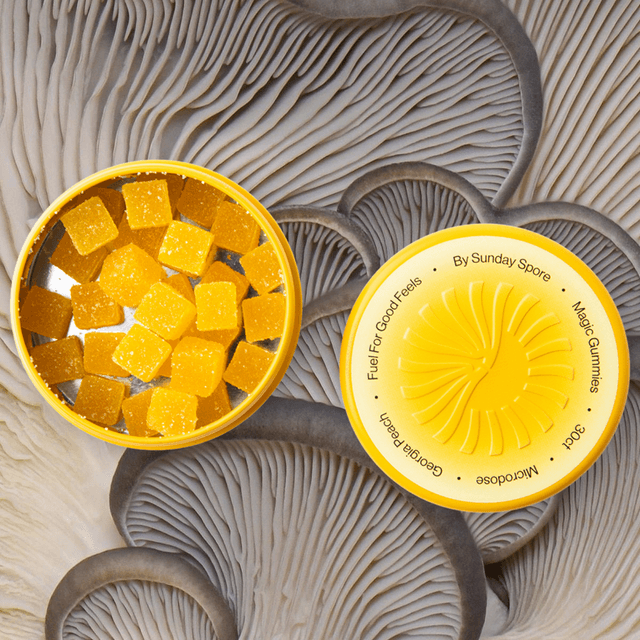
Precision Dosed
Every Sunday Spore gummy is lab-verified for precise, consistent dosing — no guessing, no scales, no batch variation. Just take one and go about your day.
If you're ready to start microdosing...
Sunday Spore Microdose — precision-dosed mushroom gummies. Lab-tested, exact dosing, ships discreetly.
When Gummies Are the Better Choice
Gummies make more sense when:
You're building a new daily habit. If mushroom supplementation is new for you, gummies reduce friction dramatically. There's no glass of water needed, no pill-swallowing mechanics, no unpleasant experience. You associate the habit with something enjoyable, which makes it stick.
Compliance has been an issue before. If you've bought capsule supplements in the past and found half-full bottles in your cabinet months later, that's a strong signal that you need a format change. The best supplement is one you actually take.
You want precise, simple dosing. One gummy = one dose. Two gummies = two doses. No counting, no measuring, no adjusting. For daily wellness protocols where consistency matters more than dose optimization, this simplicity is powerful.
You're focused on specific compounds where oral absorption matters. If you're taking lion's mane primarily for the hericenones, or reishi for specific triterpenes, the oral mucosa absorption pathway may deliver these compounds more effectively.
You travel frequently. Gummies are easier to travel with - no pill organizers needed, no worrying about capsules opening in your bag. A small resealable pouch of gummies handles a week of travel easily.
You're interested in functional mushroom combinations. Multi-mushroom gummy formulas let you get several species in one pleasant daily serving without taking a handful of different capsules.
When Capsules Are the Better Choice
Capsules make more sense when:
You need high daily doses. If your protocol calls for 2000-3000mg of extract daily, capsules are more practical. Four to six capsules is manageable; six to ten gummies becomes excessive and expensive.
You're avoiding all added sugars. Even 2-3g of sugar per gummy may be problematic for people on strict ketogenic diets, managing blood sugar issues, or eliminating all added sugars. Capsules sidestep this entirely.
Cost is a primary concern. If budget is tight, capsules deliver significantly more extract per dollar. For long-term supplementation over years, the cost difference adds up substantially.
You already have a strong pill routine. If you take medications or other supplements daily without issue, adding mushroom capsules to an existing routine requires zero behavior change. The compliance advantage of gummies is irrelevant for people who already reliably take capsules.
You want to rotate species easily. With capsules, you can buy individual species (lion's mane, reishi, cordyceps) and adjust your daily stack as needed. This modular approach is harder with gummies, which often come in fixed blend formulations.
You have sensitivities to gummy ingredients. Pectin, citric acid, natural flavors, or sweeteners can occasionally cause issues for people with specific food sensitivities. Capsules have far fewer potential irritants.
Quality Markers That Matter for Both Formats
Regardless of whether you choose gummies or capsules, these quality markers determine whether a product actually works:
Fruiting Body Extract (Non-Negotiable)
The mushroom supplement industry has a major quality problem: many products use "mycelium on grain" instead of actual fruiting body extract. Mycelium-on-grain products are primarily rice starch with minimal active mushroom compounds. A proper product explicitly states "fruiting body extract" on the label.
This matters more than any format difference. A mycelium-on-grain capsule with 1000mg per serving may contain less actual active compound than a 500mg fruiting body gummy.
Third-Party Testing (COA)
A Certificate of Analysis from an independent lab verifies that the product contains what it claims. Look for:
- Beta-glucan content (should be 30%+ for most species)
- Heavy metal testing (lead, mercury, cadmium, arsenic)
- Microbial testing
- Active compound verification specific to the species
Any reputable brand provides COAs on their website. If you can't find them, that's a red flag regardless of format.
Adequate Dosing
Research-supported doses for the major functional mushrooms:
- Lion's mane: 500-3000mg daily of fruiting body extract
- Reishi: 500-1500mg daily of fruiting body extract
- Cordyceps: 500-1500mg daily of fruiting body extract
Check the per-unit dose on the label. If a gummy contains only 150mg of extract, you'd need four or more daily to reach a meaningful dose - which means the per-unit pricing is deceptive. Many budget gummies fall into this trap. For a deeper look at lion's mane specifically, our lion's mane gummy guide covers exactly what doses the research supports and which products deliver them.
Extraction Method
Hot water extraction is standard and effective for pulling beta-glucans. Dual extraction (hot water + alcohol) captures additional compounds like triterpenes that aren't water-soluble. The extraction method should be specified on the label or product page.
Concentrated extracts (8:1, 10:1, 20:1) mean that multiple pounds of raw mushroom were concentrated into one pound of extract. Higher concentration ratios generally indicate more potent products, but only if the starting material was quality fruiting body.
Potential Side Effects: Format-Specific Considerations
Both formats share similar mushroom-related considerations (digestive adjustment, potential interactions with medications), but there are a few format-specific notes:
Gummies:
- Sugar content may matter for blood sugar management
- Citric acid can cause minor mouth irritation if consumed in large quantities
- Pectin-based gummies are generally gentler on digestion than gelatin-based
Capsules:
- Capsule shell dissolution can occasionally cause mild nausea on an empty stomach
- Flow agents (magnesium stearate, silica) rarely cause issues but are worth noting
- Large capsules can be difficult to swallow for some people
For a complete overview of what to watch for when starting mushroom supplements, our side effects guide covers both format-specific and general mushroom supplement considerations.
Common Myths About Format Differences
"Gummies are just candy with mushroom dust"
This was somewhat true five years ago when the market was immature. Modern mushroom gummies from reputable brands contain 500-1000mg of concentrated extract per unit - equivalent to or exceeding many capsule products. The gummy format has matured significantly, and dismissing all gummies as ineffective is outdated.
"Capsules are always more potent"
Potency depends on what's inside, not what's outside. A capsule filled with mycelium-on-grain at 1000mg is less potent than a gummy with 500mg of concentrated fruiting body extract. Format tells you nothing about contents.
"Heat from gummy manufacturing destroys active compounds"
Mushroom beta-glucans and most triterpenes are thermally stable. They survive hot water extraction at boiling temperatures - the modest heat of gummy manufacturing (typically 60-80 degrees Celsius) doesn't degrade them. Hericenones and erinacines (lion's mane actives) are also stable at these temperatures.
"You can't fit enough extract in a gummy"
With modern concentrated extracts (10:1 or 20:1 ratios), a single gummy can deliver the equivalent of 5-10 grams of raw mushroom material. Technology has solved this problem - the limitation now is cost, not physics.
Making Your Decision: A Practical Framework
Rather than choosing based on theoretical absorption differences, use this practical framework:
Choose gummies if:
- You've struggled with supplement consistency in the past
- You want the simplest possible daily routine
- You value the experience of taking your supplement (taste, enjoyment)
- You're taking a standard wellness dose (500-1000mg daily)
- You're new to mushroom supplements
Choose capsules if:
- You already take pills daily without issue
- You need doses above 1500mg daily
- You're on a strict budget for long-term supplementation
- You want to customize your mushroom stack with individual species
- You avoid all added sugars
Either format works if:
- The product uses fruiting body extract
- The per-unit dose is adequate (500mg+ per serving)
- The brand provides third-party COAs
- Beta-glucan content is verified at 30%+
- You can and will take it consistently
The Bottom Line
The mushroom gummies vs capsules question has a surprisingly simple answer: the best format is the one you'll take every single day without fail.
Both formats deliver mushroom extract effectively. Both can contain adequate, research-supported doses. Both can be properly sourced and tested. The absorption differences between them, while real, are modest compared to the difference between "takes it daily" and "forgets half the time."
If you enjoy taking gummies and find yourself looking forward to your morning mushroom routine, that positive association drives consistency. Consistency drives results. Results are what matter.
For most people starting a mushroom supplement routine - especially those focused on daily cognitive support, stress management, or general wellness - gummies offer a meaningful compliance advantage that compounds over months. The slightly higher cost per milligram is offset by actually using the product you paid for.
That said, if you're an experienced supplement user with a locked-in daily routine, capsules give you more dose flexibility and better economics. There's no shame in choosing the format that fits your existing habits.
What shouldn't change regardless of format: insistence on fruiting body extract, third-party testing, adequate dosing, and consistent daily use. Get those four factors right, and both gummies and capsules will deliver the functional mushroom benefits that drew you to supplementation in the first place.
Disclaimer
This content is for educational and informational purposes only. It is not medical advice and should not substitute professional medical guidance. Always consult a qualified healthcare provider before starting any supplement. These statements have not been evaluated by the FDA. Individual results vary.
“Three weeks into a Monday/Wednesday/Friday protocol and the difference in my foc...” — Sarah
“Bought the Big Guys for a camping trip with friends. The dosing is spot-on — eve...” — Marcus
Ready to start microdosing?
Try the Sunday Spore Microdose
Precision-dosed mushroom gummies designed for your microdosing protocol. Lab-tested. Exact dosing. Everything you need to start.


FAQ
Frequently Asked Questions
Are mushroom gummies as effective as capsules?
Why choose gummies over capsules?
Why choose capsules over gummies?
Can you get enough mushroom extract in a gummy?
Written by
Sunday Spore Editorial Team
Rigorously researched content from the Sunday Spore editorial team — covering mushroom science, functional wellness, and evidence-based supplementation.