Key Takeaways
- 1Reishi's triterpene compounds (ganoderic acids) modulate the HPA axis to reduce cortisol and support restful sleep
- 2GABAergic activity produces calm without the sedation or dependence risk of pharmaceutical sleep aids
- 3Beta-glucan polysaccharides train the innate immune system for better pathogen defense
- 4Dual extraction (hot water + alcohol) is essential - single-method products miss key compounds
- 5Dose 1000-1500mg of fruiting body extract 1-2 hours before bed for sleep, or split doses for all-day stress support
Quick Answer
Reishi mushroom gummies deliver the triterpene and polysaccharide compounds of Ganoderma lucidum in a convenient daily format. Triterpenes modulate the HPA axis to lower cortisol, while GABAergic activity promotes calm without sedation - making reishi the top mushroom species for sleep and stress management. Polysaccharides (beta-glucans) provide additional immune support. Take 1000-1500mg of fruiting body extract 1-2 hours before bed for best results.
Why Reishi Is Different From Other Mushroom Supplements
Most functional mushrooms are stimulating. Lion's mane sharpens cognition. Cordyceps boosts physical energy. Chaga loads you up on antioxidants.
Reishi does the opposite. It brings things down - cortisol, nervous system activation, the mental noise that keeps you staring at the ceiling at 11:30 PM. In a supplement landscape obsessed with optimization and performance, reishi is the species that tells your body it's safe to rest.
This isn't weakness. Sleep and stress management are the foundation everything else is built on. You can take all the lion's mane you want for focus, but if cortisol is elevated and you're sleeping five hours a night, none of it lands. Reishi addresses the layer underneath - the nervous system regulation that allows other supplements, habits, and health goals to actually produce results.
The Active Compounds: Triterpenes and Polysaccharides
Reishi (Ganoderma lucidum) contains two primary classes of bioactive compounds, each responsible for different benefits.
Triterpenes: The Stress and Sleep Compounds
Ganoderic acids - a family of triterpene compounds unique to Ganoderma species - are responsible for reishi's calming and sleep-supporting effects. Over 150 individual triterpenes have been identified in reishi, with ganoderic acids A, B, C, and D being the most studied.
Triterpenes work through two main pathways:
HPA axis modulation. The hypothalamic-pituitary-adrenal (HPA) axis is your body's central stress response system. When you perceive a threat - or when chronic low-grade stress keeps the system firing - the HPA axis triggers cortisol release. Ganoderic acids help normalize this response, reducing the exaggerated cortisol output that characterizes modern stress. This isn't suppression. It's recalibration. Your stress response still works when you need it. It just stops firing when you don't.
GABAergic activity. GABA is the brain's primary inhibitory neurotransmitter - the chemical signal that tells neurons to slow down. Reishi triterpenes support GABAergic pathways, producing a calming effect without the sedation, tolerance buildup, or dependence risk associated with pharmaceutical GABA-targeting drugs like benzodiazepines. You feel calm, not drowsy. Present, not foggy.
This combination - lower cortisol plus enhanced GABA activity - is why reishi is particularly effective for people whose sleep problems and anxiety are stress-driven rather than circadian. If your issue is that your body won't downshift at night, reishi addresses the cause rather than masking the symptom.
Polysaccharides: The Immune Compounds
Reishi's beta-glucan polysaccharides are among the most researched natural immunomodulators. They work by training your innate immune system - the first-response defense layer - rather than simply stimulating it.
Beta-glucans bind to receptors on macrophages, dendritic cells, and natural killer cells, essentially teaching these immune cells to identify and respond to threats more efficiently. The result is an immune system that's more capable without being overactive. This is the key distinction from simple "immune boosters" - reishi modulates the immune response up or down depending on what's needed, which is why it has research support for both immune deficiency and autoimmune conditions.
For daily immune resilience - fewer colds, faster recovery, more consistent baseline health - polysaccharide-rich reishi provides a foundation that compounds over months of consistent use. Other immune-supporting mushrooms like turkey tail and chaga work through similar beta-glucan pathways, making them natural stacking partners.
Clinical Evidence for Sleep Improvement
The sleep research on reishi is more robust than most people expect from a mushroom supplement.
A study published in the Journal of Ethnopharmacology examined adults with insomnia and found that reishi supplementation significantly improved subjective sleep quality and increased total sleep time compared to placebo. Participants reported falling asleep faster, waking up fewer times during the night, and feeling more rested in the morning.
What makes reishi's sleep mechanism notable is what it doesn't do. Unlike melatonin - which signals your circadian clock - or sedative sleep aids - which suppress central nervous system activity - reishi addresses the cortisol problem. Most adults who struggle with sleep aren't melatonin-deficient. They're cortisol-excessive. Their body produces a stress hormone spike in the evening that prevents the natural wind-down into sleep.
Reishi's triterpenes flatten that evening cortisol curve, allowing your body's natural sleep architecture to function:
- Reduced sleep latency - falling asleep faster because cortisol isn't spiking at bedtime
- Better sleep architecture - more time in deep sleep (slow-wave) and REM stages
- Fewer nighttime awakenings - less 3 AM cortisol-driven wakefulness
- No morning grogginess - because reishi doesn't sedate you, it corrects the underlying imbalance
For the full breakdown of mushroom species and sleep, including timing and what to avoid before bed, see the mushroom gummies for sleep guide.
Why Dual Extraction Matters
Here's where most reishi products fall short, and where educated consumers separate themselves from impulse buyers.
Triterpenes and polysaccharides require different extraction methods. They are not equally available in a single process:
Hot water extraction dissolves polysaccharides (beta-glucans) effectively. This is the traditional method used in Asian medicine for thousands of years - reishi tea is essentially a hot water extract. But hot water barely touches triterpenes. They're largely insoluble in water.
Alcohol extraction (ethanol) dissolves triterpenes efficiently. Ganoderic acids and other triterpene compounds require an organic solvent to break free from the mushroom's cell matrix. But alcohol extraction leaves most polysaccharides behind.
Dual extraction combines both methods, delivering the full spectrum of reishi's bioactive compounds. Any product that only uses hot water extraction is giving you immune support but shortchanging the stress and sleep compounds. Any product that only uses alcohol extraction does the reverse.
When evaluating reishi gummies, look for "dual extraction" or "double extraction" on the label. If the product only mentions one extraction method - or doesn't mention extraction at all - it's likely incomplete.
How to Dose Reishi Gummies
Dosing depends on your primary goal.
For Sleep Support (Primary Use)
1000-1500mg of fruiting body extract, taken 1-2 hours before bed.
This timing lets the triterpenes reach peak plasma levels before sleep onset. The GABAergic calming effect begins within 30-60 minutes, and the cortisol-modulating activity aligns with your body's natural evening wind-down.
Start at 1000mg for the first week. If you're not noticing a meaningful shift in sleep quality after 7-10 days, increase to 1500mg. Most people find their effective dose within this range.
For Stress Management (Daytime Use)
500-1000mg daily, taken in the morning or split between morning and evening.
This approach provides sustained HPA axis support throughout the day. You won't feel sedated - the GABAergic activity at this dose range promotes calm without drowsiness. Think of it as raising your stress threshold. The same situations still occur, but your physiological response is less intense and recovers faster.
For Combined Sleep and Stress Support
500mg in the morning, 1000mg in the evening.
This protocol addresses both the daytime stress resilience and the nighttime sleep quality angles. Total daily dose of 1500mg is well within researched safe ranges and reflects how reishi is used in traditional practice.
For Immune Support
500-1000mg daily, any time of day, with food.
Polysaccharide-mediated immune benefits are not time-dependent. Consistency matters more than timing. For enhanced immune protocols - during cold and flu season or periods of high stress that compromise immunity - you can stack reishi with chaga and turkey tail for broader beta-glucan diversity.
What to Look for in Reishi Gummies
Fruiting Body vs. Mycelium
This distinction matters more for reishi than for almost any other mushroom species. Reishi fruiting bodies contain dramatically higher concentrations of triterpenes than mycelium grown on grain. Since triterpenes are responsible for the stress and sleep benefits - the primary reason most people take reishi - fruiting body extract is essential.
Mycelium-on-grain products also come with a filler problem. Because mycelium can't be fully separated from its grain substrate, a significant percentage of the product by weight is starch, not mushroom. You're paying for rice powder with trace amounts of reishi.
Look for "fruiting body" explicitly stated on the label. If a product says "full spectrum" or "myceliated grain" without specifying fruiting body, it's likely mycelium-based.
Triterpene Standardization
The best reishi products are standardized to a minimum triterpene content - typically 2% or higher. This guarantees a consistent dose of the stress-modulating compounds regardless of batch variation in raw mushroom material.
Products that list only beta-glucan content (e.g., "30% beta-glucans") are optimized for immune support but may contain minimal triterpenes. For sleep and stress, triterpene standardization is the specification that matters.
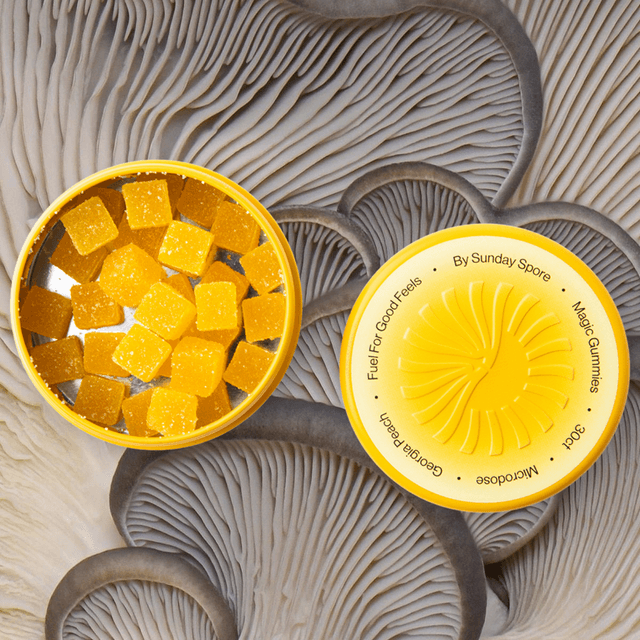
Precision Dosed
Every Sunday Spore gummy is lab-verified for precise, consistent dosing — no guessing, no scales, no batch variation. Just take one and go about your day.
If you're ready to start microdosing...
Sunday Spore Microdose — precision-dosed mushroom gummies. Lab-tested, exact dosing, ships discreetly.
Certificate of Analysis (COA)
A COA from an independent third-party lab verifies that the product contains what the label claims and is free from contaminants (heavy metals, pesticides, microbial contamination). Any reputable mushroom supplement company makes COAs available on their website or upon request.
If a company can't or won't provide a COA, move on. Mushrooms are bioaccumulators - they absorb substances from their growing environment. Testing isn't optional.
Stacking Reishi With Other Functional Mushrooms
Reishi works well as a standalone supplement, but it also integrates naturally into broader functional mushroom protocols. Each species targets different systems, and the combinations are additive rather than redundant.
Reishi + Lion's Mane
The most popular functional mushroom stack. Lion's mane supports cognitive function through NGF (Nerve Growth Factor) stimulation - focus, memory, and mental clarity. Reishi provides the stress reduction and sleep quality that allows lion's mane's cognitive benefits to actually take hold.
Protocol: Lion's mane in the morning (500-1000mg) for daytime cognition. Reishi in the evening (1000-1500mg) for nighttime recovery. Each species does what the other doesn't.
Reishi + Cordyceps
Cordyceps supports physical energy and oxygen utilization - the energizing counterpart to reishi's calming profile. This stack is particularly useful for people who want physical vitality during the day and deep rest at night.
Protocol: Cordyceps in the morning (500-1000mg) for energy. Reishi in the evening (1000-1500mg) for wind-down and sleep. Avoid taking cordyceps within 6 hours of bedtime - it's stimulating.
Reishi + Chaga + Turkey Tail (Immune Protocol)
For maximum immune support, stacking reishi with chaga and turkey tail provides beta-glucan diversity that trains different arms of the immune system. Each species contains slightly different polysaccharide structures that bind to different immune cell receptors.
Protocol: Rotate or combine all three daily - 500mg each, or emphasize one species based on seasonal needs. This is the protocol most useful during high-exposure periods.
For a comprehensive comparison of all major species, see the best mushroom gummies guide.
Timeline of Effects
Reishi is not an acute-effect supplement. It works through gradual system rebalancing. Here's what to expect.
Days 1-3: Some people notice subtle calming effects from GABAergic activity, particularly when taken before bed. Sleep onset may feel slightly easier. These early effects are real but modest - don't expect dramatic changes yet.
Week 1-2: Sleep quality improvements become more consistent. You may notice falling asleep faster, fewer middle-of-the-night awakenings, and feeling more rested in the morning. Daytime stress resilience begins to shift - not that stressors disappear, but your physiological reaction starts to soften.
Weeks 3-4: The adaptogenic effects reach meaningful levels. Cortisol patterns normalize. Sleep architecture improves - more time in restorative deep sleep and REM stages. If you track sleep with a wearable device, this is typically when the data starts showing consistent improvement.
Month 2+: Immune benefits become apparent. Fewer colds, faster recovery from minor illness, and a generally more resilient baseline. The stress and sleep benefits have fully compounded. Many long-term reishi users describe a general sense of equilibrium - less reactive, more grounded, sleeping consistently well.
If you stop: Effects gradually diminish over 1-2 weeks as the HPA axis recalibrates to its previous patterns. Reishi doesn't create dependence, but it does require ongoing use to maintain benefits.
Safety Profile and Contraindications
Reishi has one of the longest safety records of any supplement - traditional use spans over 2,000 years in Chinese and Japanese medicine, and modern clinical trials consistently report minimal side effects at standard doses.
That said, specific situations warrant caution:
Blood thinners. Reishi has mild anticoagulant (blood-thinning) properties. If you take warfarin, aspirin, or other anticoagulant medications, consult your doctor before adding reishi. The combination could increase bleeding risk.
Blood pressure medication. Reishi may lower blood pressure independently. If you're already on antihypertensive medication, adding reishi could cause blood pressure to drop too low. Monitor your levels and work with your provider.
Surgery. Discontinue reishi at least two weeks before scheduled surgery due to the anticoagulant effect. Resume after your surgeon clears you.
Pregnancy and nursing. Insufficient clinical data exists to confirm safety during pregnancy or breastfeeding. Most practitioners recommend avoiding reishi during these periods as a precaution.
Liver considerations. Rare case reports have associated high-dose reishi powder (not standardized extracts) with liver enzyme elevation. Standard-dose extracts in clinical trials have not shown this effect, but individuals with pre-existing liver conditions should monitor liver function.
For the general healthy adult population, reishi at 1000-1500mg daily is well-tolerated with no significant reported side effects.
The Bottom Line
Reishi addresses the foundation layer of health that most supplements skip over - the stress response and sleep quality that everything else depends on.
Its triterpene compounds modulate the HPA axis and support GABAergic activity for genuine calm without sedation. Its polysaccharides train the immune system for stronger, more intelligent defense. Together, these compounds make reishi the most versatile single-species mushroom supplement available.
Choose a product made from fruiting body extract with dual extraction and triterpene standardization. Start with 1000mg before bed. Give it 2-4 weeks. The sleep improvements tend to be the first thing people notice. The stress resilience and immune benefits compound from there.
For help choosing between species or building a multi-mushroom protocol, see the best mushroom gummies guide.
Disclaimer
This content is for educational and informational purposes only. It is not medical advice and should not substitute professional medical guidance. Always consult a qualified healthcare provider before starting any supplement. These statements have not been evaluated by the FDA. Individual results vary.
“Three weeks into a Monday/Wednesday/Friday protocol and the difference in my foc...” — Sarah
“Bought the Big Guys for a camping trip with friends. The dosing is spot-on — eve...” — Marcus
Ready to start microdosing?
Try the Sunday Spore Microdose
Precision-dosed mushroom gummies designed for your microdosing protocol. Lab-tested. Exact dosing. Everything you need to start.
FAQ
Frequently Asked Questions
What do reishi mushroom gummies do?
How long does it take for reishi gummies to work?
Can I take reishi gummies every day?
Are reishi gummies safe?
Written by
Sunday Spore Editorial Team
Rigorously researched content from the Sunday Spore editorial team — covering mushroom science, functional wellness, and evidence-based supplementation.