Key Takeaways
- 1Functional mushroom gummies have excellent safety profiles with no significant side effects
- 2Most safety problems come from poor-quality products - always buy lab-tested brands with COAs
- 3Start with the lowest dose and increase gradually to minimize any risk
- 4Certain mushrooms may interact with blood thinners or blood pressure medication - check with your doctor
Quick Answer
Mushroom gummies are generally safe when sourced from reputable brands with third-party lab testing. Functional mushrooms (lion's mane, reishi, cordyceps, chaga) have excellent safety profiles with minimal side effects. The key risks come from poor-quality products with contamination or mislabeling, not from the mushrooms themselves.
A Transparent Look at Mushroom Gummy Safety
We believe in honest communication about both the benefits AND the risks of mushroom products. Too many brands present mushrooms as universally harmless. While the safety profile is genuinely excellent compared to most supplements and pharmaceuticals, there are real considerations worth understanding.
Functional Mushroom Gummies: Safety Profile
Lion's Mane Safety
- Toxicity: None observed in human studies at doses up to 3g/day for 16 weeks [1]
- Common side effects: Rare. Occasional mild digestive discomfort when first starting [2]
- Drug interactions: No known significant interactions [3]
- Long-term safety: Studies up to 16 weeks show no adverse effects [1]
- Who should be cautious: People with mushroom allergies [4]
Reishi Safety
- Toxicity: Very low. Water-soluble extracts show no liver concerns in standard doses [5], [6]
- Common side effects: Digestive upset [7], dizziness (rare), dry mouth (uncommon) [8]
- Drug interactions: May interact with blood thinners (anticoagulants) [9], [10] and blood pressure medication [11]. Consult doctor if on either.
- Long-term safety: Traditional use for thousands of years [12]. Modern studies confirm safety over 12+ weeks [5], [6]
- Who should be cautious: People on blood thinners, pre-surgery (stop 2 weeks before) [9], [13]
Cordyceps Safety
- Toxicity: No toxic effects observed at standard supplemental doses [14], [15]
- Common side effects: Mild - occasional digestive issues [16]
- Drug interactions: Possible interaction with diabetes medication (may lower blood sugar) [17]
- Long-term safety: Well established in traditional use [18], and modern studies confirm it is safe [14], [15]
- Who should be cautious: Diabetics on medication (monitor blood sugar) [17]
Chaga Safety
- Toxicity: Low, but contains oxalates - excessive long-term use may stress kidneys [19], [20], [21]
- Common side effects: Rare at normal doses [22]
- Drug interactions: May interact with blood thinners and diabetes medication [22]
- Long-term safety: Safe at standard doses, though it is worth taking periodic breaks with high-dose use [19], [21]
- Who should be cautious: People with kidney disease, those on blood thinners [19], [22]
Turkey Tail Safety
- Toxicity: Very low. Used as adjunct therapy in clinical settings with excellent tolerability [23], [24]
- Common side effects: Mild digestive changes, darkened stools (harmless) [25]
- Drug interactions: No known significant interactions [25]
- Long-term safety: Extensive clinical use in Asia over decades [23]
- Who should be cautious: People with mushroom allergies [4]
Quality-Related Safety Issues
Most mushroom gummy "safety problems" are actually quality problems:
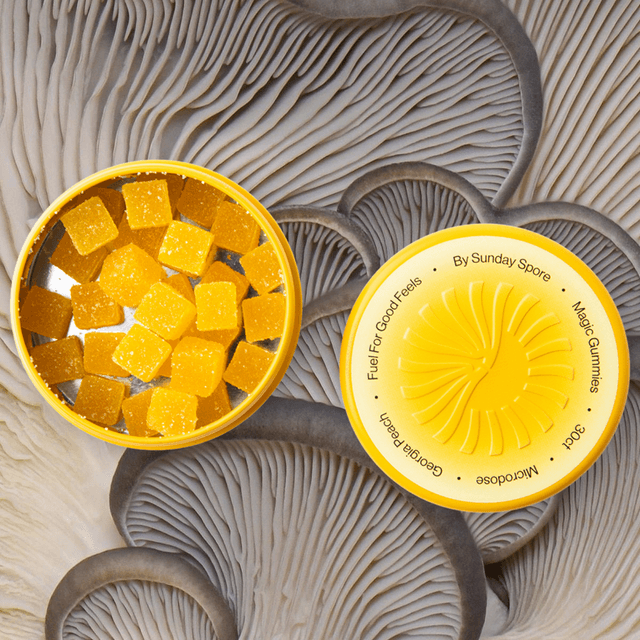
Precision Dosed
Every Sunday Spore gummy is lab-verified for precise, consistent dosing — no guessing, no scales, no batch variation. Just take one and go about your day.
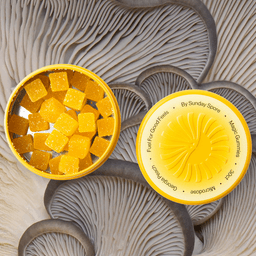
If you're ready to start microdosing...
Sunday Spore Microdose — precision-dosed mushroom gummies. Lab-tested, exact dosing, ships discreetly.
Contamination
- Heavy metals - mushrooms bioaccumulate metals from growing substrates. Without testing, you might consume lead, cadmium, or arsenic [26], [27]
- Mold/bacteria - improper storage or manufacturing introduces pathogens [28]
- Pesticides - cheap mushroom farms may use prohibited chemicals [29]
Solution: Only buy from brands with third-party COAs.
Mislabeling
- Products containing completely different compounds than labeled [30], [31]
- Dramatically different potency than stated [31], [32]
- Mycelium-on-grain products labeled as "mushroom extract" [33], [31]
Solution: Established brands with track records and lab testing.
Inconsistent Dosing
- One gummy has significantly more or less extract than the next [32]
- Makes it impossible to find your optimal dose
Solution: Brands that test batch-to-batch consistency and state exact per-gummy dosing.
Harm Reduction Principles
Regardless of which mushroom gummies you're using:
- Start with the lowest dose. Increase gradually over multiple days.
- Keep a journal. Track what you take, when, and how you feel.
- Take breaks. Cycling (5 on, 2 off) is a reasonable approach for long-term use.
- Buy tested products. This eliminates most safety concerns.
- Be honest with your doctor. They need to know what you're taking to advise you properly.
- Listen to your body. If something feels wrong, stop and reassess.
- Check for interactions. Especially if you're on blood thinners, blood pressure meds, or diabetes medication.
The Bottom Line
Mushroom gummies have one of the best safety profiles in the supplement world - particularly when sourced from reputable brands with proper testing. The main risks come from:
- Poor quality products (contamination, mislabeling, inconsistent dosing)
- Ignoring contraindications (particularly medication interactions)
- Excessive dosing (taking too much too fast)
All three are preventable with education and responsible purchasing decisions.
Disclaimer
This content is for educational and informational purposes only. It is not medical advice and should not substitute professional medical guidance. Always consult a qualified healthcare provider before starting any supplement. These statements have not been evaluated by the FDA. Individual results vary.
References (33)↓
- [1]K. Mori, S. Inatomi, K. Ouchi, Y. Azumi, and T. Tuchida, "Improving effects of the mushroom Yamabushitake (Hericium erinaceus) on mild cognitive impairment: a double-blind placebo-controlled clinical trial," Phytother. Res., vol. 23, no. 3, 2009. https://pubmed.ncbi.nlm.nih.gov/18844328/
- [2]I.-C. Li et al., "Prevention of early Alzheimer's disease by erinacine A-enriched Hericium erinaceus mycelia pilot double-blind placebo-controlled study," Front. Aging Neurosci., vol. 12, art. 155, 2020. https://pmc.ncbi.nlm.nih.gov/articles/PMC7283924/
- [3]A. Menon, A. Jalal, Z. Arshad, F. A. Nawaz, and R. Kashyap, "Benefits, side effects, and uses of Hericium erinaceus as a supplement: a systematic review," Front. Nutr., 2025. https://pubmed.ncbi.nlm.nih.gov/40959699/
- [4]M. Nakatsugawa, H. Takahashi, C. Takezawa, et al., "Hericium erinaceum (yamabushitake) extract-induced acute respiratory distress syndrome monitored by serum surfactant proteins," Intern. Med., vol. 42, no. 12, 2003. https://pubmed.ncbi.nlm.nih.gov/14714963/
- [5]N. L. Klupp, H. Kiat, A. Bensoussan, G. Z. Steiner, and D. H. Chang, "A double-blind, randomised, placebo-controlled trial of Ganoderma lucidum for the treatment of cardiovascular risk factors of metabolic syndrome," Sci. Rep., vol. 6, art. 29540, 2016. https://pmc.ncbi.nlm.nih.gov/articles/PMC4980683/
- [6]H. F. Chiu et al., "Triterpenoids and polysaccharide peptides-enriched Ganoderma lucidum: a randomized, double-blind placebo-controlled crossover study of its antioxidation and hepatoprotective efficacy in healthy volunteers," Pharm. Biol., vol. 55, no. 1, 2017. https://pmc.ncbi.nlm.nih.gov/articles/PMC6130508/
- [7]X. Jin, J. Ruiz Beguerie, D. M. Sze, and G. C. F. Chan, "Ganoderma lucidum (Reishi mushroom) for cancer treatment," Cochrane Database Syst. Rev., vol. 2016, no. 4, art. CD007731, 2016. https://pmc.ncbi.nlm.nih.gov/articles/PMC6353236/
- [8]Memorial Sloan Kettering Cancer Center, "Reishi Mushroom," Integrative Medicine: About Herbs. https://www.mskcc.org/cancer-care/integrative-medicine/herbs/reishi-mushroom
- [9]J. Tao and K. Y. Feng, "Experimental and clinical studies on inhibitory effect of Ganoderma lucidum on platelet aggregation," J. Tongji Med. Univ., vol. 10, no. 4, 1990. https://pubmed.ncbi.nlm.nih.gov/2098581/
- [10]S. W. Chan, B. Tomlinson, P. Chan, and C. W. K. Lam, "The beneficial effects of Ganoderma lucidum on cardiovascular and metabolic disease risk," Pharm. Biol., vol. 59, no. 1, 2021. https://pmc.ncbi.nlm.nih.gov/articles/PMC8409941/
- [11]H. B. Tran et al., "Hypotensive effects and angiotensin-converting enzyme inhibitory peptides of reishi (Ganoderma lingzhi) auto-digested extract," Molecules, 2014. https://pmc.ncbi.nlm.nih.gov/articles/PMC6271714/
- [12]S. Wachtel-Galor, J. Yuen, J. A. Buswell, and I. F. F. Benzie, "Ganoderma lucidum (Lingzhi or Reishi): a medicinal mushroom," in Herbal Medicine: Biomolecular and Clinical Aspects, 2nd ed. Boca Raton, FL, USA: CRC Press, 2011. https://www.ncbi.nlm.nih.gov/books/NBK92757/
- [13]M. K. Ang-Lee, J. Moss, and C. S. Yuan, "Herbal medicines and perioperative care," JAMA, vol. 286, no. 2, 2001. https://pubmed.ncbi.nlm.nih.gov/11448284/
- [14]X. Yu, Y. Mao, J. L. Shergis, et al., "Effectiveness and safety of oral Cordyceps sinensis on stable COPD of GOLD stages 2-3: a systematic review and meta-analysis," Evid. Based Complement. Alternat. Med., vol. 2019, art. 4903671, 2019. https://pmc.ncbi.nlm.nih.gov/articles/PMC6470429/
- [15]X. Shu, D. Xu, Y. Qu, et al., "Efficacy and safety of Cordyceps sinensis (Hirsutella sinensis, Cs-C-Q80) in chronic bronchitis," Front. Pharmacol., vol. 15, art. 1428216, 2024. https://www.frontiersin.org/journals/pharmacology/articles/10.3389/fphar.2024.1428216/full
- [16]B. Chen, Y. Sun, F. Luo, and C. Wang, "Bioactive metabolites and potential mycotoxins produced by Cordyceps fungi: a review of safety," Toxins, vol. 12, no. 6, art. 410, 2020. https://pmc.ncbi.nlm.nih.gov/articles/PMC7354514/
- [17]Memorial Sloan Kettering Cancer Center, "Cordyceps," Integrative Medicine: About Herbs. https://www.mskcc.org/cancer-care/integrative-medicine/herbs/cordyceps
- [18]Y. Liu, J. Wang, W. Wang, H. Zhang, X. Zhang, and C. Han, "The chemical constituents and pharmacological actions of Cordyceps sinensis," Evid. Based Complement. Alternat. Med., vol. 2015, 2015. https://pmc.ncbi.nlm.nih.gov/articles/PMC4415478/
- [19]Y. Kikuchi, K. Seta, Y. Ogawa, et al., "Chaga mushroom-induced oxalate nephropathy," Clin. Nephrol., vol. 81, no. 6, 2014. https://pubmed.ncbi.nlm.nih.gov/23149251/
- [20]O. Kwon, Y. Kim, J. H. Paek, et al., "Chaga mushroom-induced oxalate nephropathy that clinically manifested as nephrotic syndrome: a case report," Medicine (Baltimore), 2022. https://pubmed.ncbi.nlm.nih.gov/35451393/
- [21]S. Lee, H. Y. Park, Y. Park, et al., "Development of end stage renal disease after long-term ingestion of chaga mushroom: case report and review of literature," J. Korean Med. Sci., vol. 35, no. 19, art. e122, 2020. https://pmc.ncbi.nlm.nih.gov/articles/PMC7234858/
- [22]Memorial Sloan Kettering Cancer Center, "Chaga," Integrative Medicine: About Herbs. https://www.mskcc.org/cancer-care/integrative-medicine/herbs/chaga-mushroom
- [23]L. J. Standish et al., "Trametes versicolor mushroom immune therapy in breast cancer," J. Soc. Integr. Oncol., vol. 6, no. 3, 2008. https://pmc.ncbi.nlm.nih.gov/articles/PMC2845472/
- [24]C. J. Torkelson et al., "Phase 1 clinical trial of Trametes versicolor in women with breast cancer," ISRN Oncol., vol. 2012, art. 251632, 2012. https://pubmed.ncbi.nlm.nih.gov/22701186/
- [25]Memorial Sloan Kettering Cancer Center, "Coriolus versicolor," Integrative Medicine: About Herbs. https://www.mskcc.org/cancer-care/integrative-medicine/herbs/coriolus-versicolor
- [26]P. Kalac, "Trace element contents in European species of wild growing edible mushrooms: a review for the period 2000-2009," Food Chem., vol. 122, no. 1, 2010. https://doi.org/10.1016/j.foodchem.2010.02.045
- [27]J. Falandysz and L. M. Rizal, "Arsenic and its compounds in mushrooms: a review," J. Environ. Sci. Health C, vol. 34, no. 4, 2016. https://pubmed.ncbi.nlm.nih.gov/27635858/
- [28]M. Ratajczak, D. Kaminska, A. Swiatly-Blaszkiewicz, and J. Matysiak, "Quality of dietary supplements containing plant-derived ingredients reconsidered by microbiological approach," Int. J. Environ. Res. Public Health, vol. 17, no. 18, art. 6837, 2020. https://pmc.ncbi.nlm.nih.gov/articles/PMC7558626/
- [29]D. Schusterova, P. Mraz, L. Uttl, L. Drabova, V. Kocourek, and J. Hajslova, "Pesticide residues in fresh and processed edible mushrooms from Czech markets," Food Addit. Contam. Part B, 2023. https://pubmed.ncbi.nlm.nih.gov/37830121/
- [30]M. C. Ichim, "The DNA-based authentication of commercial herbal products reveals their globally widespread adulteration," Front. Pharmacol., vol. 10, art. 1227, 2019. https://www.frontiersin.org/journals/pharmacology/articles/10.3389/fphar.2019.01227/full
- [31]D.-T. Wu, Y. Deng, L.-X. Chen, J. Zhao, A. Bzhelyansky, and S.-P. Li, "Evaluation on quality consistency of Ganoderma lucidum dietary supplements collected in the United States," Sci. Rep., vol. 7, art. 7792, 2017. https://pmc.ncbi.nlm.nih.gov/articles/PMC5552695/
- [32]L. A. E. Erland and P. K. Saxena, "Melatonin natural health products and supplements: presence of serotonin and significant variability of melatonin content," J. Clin. Sleep Med., vol. 13, no. 2, 2017. https://pubmed.ncbi.nlm.nih.gov/27855744/
- [33]C. Windsor, A. E. Kreynes, J. S. Chilton, W. A. Chioffi, A. Krishnamurthy, and M. Ishii, "Comparative study of chaga (Inonotus obliquus) dietary supplements using complementary analytical techniques," Int. J. Mol. Sci., vol. 26, no. 7, art. 2970, 2025. https://pmc.ncbi.nlm.nih.gov/articles/PMC11988691/
“Three weeks into a Monday/Wednesday/Friday protocol and the difference in my foc...” — Sarah
“Bought the Big Guys for a camping trip with friends. The dosing is spot-on — eve...” — Marcus
Ready to start microdosing?
Try the Sunday Spore Microdose
Precision-dosed mushroom gummies designed for your microdosing protocol. Lab-tested. Exact dosing. Everything you need to start.
FAQ
Frequently Asked Questions
Are mushroom gummies safe to take every day?
What are the side effects of mushroom gummies?
Who should NOT take mushroom gummies?
Can you overdose on mushroom gummies?
Written by
Sunday Spore Editorial Team
Rigorously researched content from the Sunday Spore editorial team — covering mushroom science, functional wellness, and evidence-based supplementation.