Key Takeaways
- 1Functional mushroom gummies (lion's mane, reishi, cordyceps, chaga, turkey tail) are legal in all 50 states
- 2These species contain no controlled substances and are classified as dietary supplements under DSHEA
- 3Magic mushroom products remain federally illegal, though decriminalization is expanding in some cities and states
- 4Always verify third-party lab testing to confirm products contain what they claim
- 5Look for brands that comply with FDA Good Manufacturing Practices (GMP)
Quick Answer
Legal mushroom gummies contain functional species like lion's mane, reishi, cordyceps, chaga, and turkey tail - all of which are fully legal dietary supplements in all 50 US states. These functional mushrooms have no psychoactive properties and are regulated as food supplements under the DSHEA framework. Magic mushroom products containing controlled compounds remain illegal federally, though some jurisdictions have decriminalized or created regulated access programs.
Legal Mushroom Gummies: What's Actually Allowed
The market for legal mushroom gummies has exploded in the past few years, and with that growth has come a lot of confusion. Consumers want to know what they can legally buy, what the regulations actually say, and where the line falls between a legal dietary supplement and something that could get them into trouble.
Here's the straightforward answer: functional mushroom gummies - products containing species like lion's mane, reishi, cordyceps, chaga, and turkey tail - are completely legal in all 50 US states. They have always been legal. They contain no controlled substances, produce no psychoactive effects, and are classified as dietary supplements under federal law.
The confusion arises because "mushroom gummies" has become an umbrella term that covers two very different categories of products. Understanding the distinction is essential before you spend any money.
Two Categories, Completely Different Legal Status
The mushroom gummy market splits cleanly into two groups, and mixing them up is where people get confused.
Functional Mushroom Gummies (Legal Everywhere)
Functional mushrooms are species consumed for specific health benefits - cognitive support, sleep quality, energy, immune function. The major species in this category include:
- Lion's mane (Hericium erinaceus) - cognitive function, nerve growth factor stimulation
- Reishi (Ganoderma lucidum) - sleep support, stress reduction, immune modulation
- Cordyceps (Cordyceps militaris) - cellular energy, ATP production, physical performance
- Chaga (Inonotus obliquus) - antioxidant support, immune activation
- Turkey tail (Trametes versicolor) - immune system support, gut health
None of these species contain controlled substances. None produce psychoactive effects. They have been consumed as food and medicine across multiple cultures for centuries, and the modern supplement market simply delivers them in gummy format for convenience.
If you want to understand whether these functional species actually deliver real benefits, our evidence review of mushroom gummies breaks down the clinical research for each species.
Magic Mushroom Products (Federally Illegal, Limited Exceptions)
The other category includes products derived from magic mushrooms - species that contain psychoactive compounds classified as Schedule I controlled substances under federal law. These remain illegal to manufacture, sell, or possess in most of the United States, though a small number of jurisdictions have created exceptions (more on that below).
This is where the market gets murky. Some companies use ambiguous branding, psychedelic imagery, or vague product descriptions to blur the line between functional supplements and something else entirely. As a consumer, you need to understand exactly what you're buying.
The Federal Legal Framework
DSHEA: How Functional Mushrooms Are Regulated
The Dietary Supplement Health and Education Act of 1994 (DSHEA) is the primary federal law governing mushroom supplements. Under DSHEA:
- Dietary supplements do not require FDA pre-approval before going to market
- Manufacturers are responsible for ensuring product safety and accurate labeling
- The FDA can take action against products that are adulterated, misbranded, or make unauthorized health claims
- Supplements cannot claim to diagnose, treat, cure, or prevent any disease
Functional mushroom gummies fall squarely under this framework. They are food supplements, not drugs. No prescription is needed. No special license is required to sell them. Any company that follows GMP regulations can manufacture and sell functional mushroom products legally anywhere in the country.
FDA Oversight: What It Does and Doesn't Cover
The FDA does not test or approve dietary supplements before they hit shelves. This means:
What the FDA does:
- Enforces Good Manufacturing Practices (GMP) for supplement facilities
- Takes action against products with false label claims
- Can remove dangerous products from the market after reports of harm
- Monitors adverse event reports
What the FDA does not do:
- Pre-approve supplements for safety or efficacy
- Test products before sale
- Verify that what's on the label matches what's in the bottle
- Regulate dosing recommendations
This gap between what's legal and what's actually verified is exactly why third-party lab testing matters so much for consumers. The law permits the sale of functional mushroom gummies, but it doesn't guarantee quality. That responsibility falls on brands - and on you as a buyer. For a deeper dive into what makes a product trustworthy, see our mushroom gummy safety guide.
The Controlled Substances Act and Magic Mushrooms
Magic mushrooms and their primary active compounds are classified as Schedule I controlled substances under the Controlled Substances Act. This classification means they are considered to have high abuse potential, no accepted medical use, and no accepted safety profile - a classification that many researchers dispute, but which remains the law.
Federally, manufacturing, distributing, or possessing magic mushroom products is a criminal offense. This applies regardless of the form factor - whether dried whole mushrooms, capsules, chocolates, or gummies.
Which Species Are Legal Everywhere
To be completely clear: the following functional mushroom species are legal in all 50 states, with no restrictions, no prescriptions, and no regulatory barriers:
Lion's Mane
Lion's mane contains hericenones and erinacines - compounds that stimulate Nerve Growth Factor production. It has zero psychoactive properties and is sold as a food supplement worldwide. It is sometimes sold fresh in grocery stores as a culinary mushroom. There is no legal ambiguity here whatsoever. Learn more in our dedicated lion's mane mushroom gummies guide.
Reishi
Reishi has been used in traditional Chinese medicine for over 2,000 years. Its active compounds - triterpenes and polysaccharides - modulate the immune system and support sleep. It is classified as a food supplement globally and faces no legal restrictions in any US jurisdiction.
Cordyceps
Cordyceps militaris is the commercially cultivated species used in supplements. It increases ATP production at the cellular level, supporting energy and physical performance. It is a legal food supplement with no controlled compounds.
Chaga
Chaga grows on birch trees in cold climates and is rich in antioxidants, particularly superoxide dismutase. It is harvested and sold as a food product and supplement with no legal restrictions.
Turkey Tail
Turkey tail is one of the most researched medicinal mushrooms, with its polysaccharopeptides (PSP and PSK) used as adjunct therapy in clinical settings in Japan. It is a fully legal dietary supplement in every state.
For a comprehensive look at how these species compare and which products are worth buying, check our best mushroom gummies for 2026 roundup and our overview of functional mushroom gummies.
The Magic Mushroom Legal Landscape in 2026
While functional mushroom gummies face no legal barriers, the legal status of magic mushrooms is evolving - albeit slowly and unevenly.
Federal Status: Still Schedule I
At the federal level, nothing has changed. Magic mushroom compounds remain Schedule I. This means that any product containing these compounds is illegal under federal law, regardless of what any state or city has done. Federal law supersedes local regulations, though enforcement priorities vary.
Oregon: Regulated Therapeutic Access
Oregon's Measure 109, passed in 2020, created a regulated therapeutic access program for magic mushroom compounds. This is not legalization in the traditional sense - it's a regulated therapeutic framework. Key points:
- Adults 21+ can access supervised sessions at licensed service centers
- A facilitator must be present during the experience
- There is no take-home product. You cannot buy magic mushroom gummies in a dispensary
- The program launched in 2023 after a two-year regulatory development period
- This is therapeutic access, not retail legalization
Colorado: Decriminalization and Regulated Access
Colorado's Proposition 122, passed in 2022, decriminalized personal use of certain natural psychedelic compounds for adults 21+ and directed the state to develop a regulated access program (similar to Oregon's therapeutic model). Key points:
- Personal possession and use has been decriminalized for adults 21+
- Growing for personal use is permitted
- Commercial sale remains illegal outside the forthcoming regulated access program
- Healing centers (similar to Oregon's service centers) are being developed
- There are no legal retail magic mushroom gummies in Colorado
City-Level Decriminalization
Several cities have deprioritized enforcement of magic mushroom possession laws, including Denver, Oakland, Santa Cruz, Seattle, Ann Arbor, and others. These measures generally:
- Make enforcement of possession laws the lowest priority for police
- Do not legalize sale, manufacturing, or distribution
- Do not create any regulated market for products
- Apply only within city limits
What This Means for Consumers
These decriminalization and therapeutic access developments are significant for broader drug policy, but they have zero impact on functional mushroom gummies. Lion's mane, reishi, cordyceps, chaga, and turkey tail were never restricted. They are not controlled substances. The evolving magic mushroom legal landscape exists in an entirely separate regulatory space from the functional supplement market.
If you're buying functional mushroom gummies from a reputable brand, decriminalization debates are irrelevant to your purchase. Your product is legal, has always been legal, and will remain legal.
How to Verify a Product Is Legal and Safe
Legality alone doesn't mean a product is worth buying. Within the fully legal functional mushroom market, quality varies enormously. Here's how to verify that what you're purchasing is both legal and genuinely safe.
Check the Species Label
A legal, reputable mushroom gummy product will clearly state which species it contains - by both common name and Latin binomial. You should see names like:
- Lion's mane (Hericium erinaceus)
- Reishi (Ganoderma lucidum)
- Cordyceps (Cordyceps militaris)
- Chaga (Inonotus obliquus)
- Turkey tail (Trametes versicolor)
If the label is vague - saying only "mushroom blend" or "proprietary mushroom complex" without specifying species - that's a quality concern.
Verify Third-Party Lab Testing (COA)
A Certificate of Analysis (COA) from an independent laboratory confirms:
- The product contains what the label claims
- Active compound levels (beta-glucans, triterpenes) meet stated amounts
- No contamination with heavy metals, pesticides, mold, or bacteria
- No controlled substances present
Reputable brands publish COAs on their website or provide them upon request. If a company won't share lab results, that's a significant red flag.
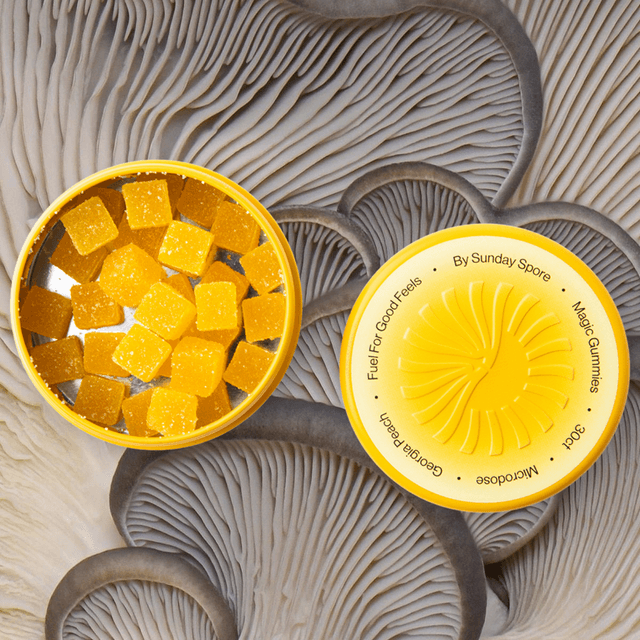
Precision Dosed
Every Sunday Spore gummy is lab-verified for precise, consistent dosing — no guessing, no scales, no batch variation. Just take one and go about your day.
If you're ready to start microdosing...
Sunday Spore Microdose — precision-dosed mushroom gummies. Lab-tested, exact dosing, ships discreetly.
Confirm GMP Compliance
The FDA requires dietary supplement manufacturers to follow current Good Manufacturing Practices (cGMP). This ensures:
- Consistent product quality batch to batch
- Proper sanitation and contamination controls
- Accurate labeling and dosing
- Proper record-keeping and quality control procedures
Look for "Manufactured in a GMP-certified facility" or "cGMP compliant" on packaging or company websites.
Check Dosing Transparency
Legal, high-quality products state the exact amount of mushroom extract per serving - not hiding behind proprietary blends. You should be able to see exactly how many milligrams of each species extract you're getting per gummy.
Red Flags: Signs a Product Might Not Be Legal
While the vast majority of mushroom gummies on the market are perfectly legal functional supplements, some products operate in a gray area - or outright on the wrong side of the law. Watch for these warning signs:
Psychedelic Marketing and Imagery
If a mushroom gummy product features:
- Trippy, psychedelic artwork on the packaging
- Language like "journey," "trip," "transcend," or "altered states"
- Claims of euphoria, visual experiences, or consciousness expansion
- Vague references to "ancient ceremonial use" combined with promises of psychoactive effects
...then you're likely looking at either an illegal product masquerading as a supplement, or a legal product using deceptive marketing to imply effects it doesn't actually produce. Either way, avoid it.
Unidentified or Obscured Ingredients
If the product label does not clearly identify which mushroom species it contains, or uses terms like:
- "Magic mushroom blend"
- "Psychedelic mushroom extract"
- "Full spectrum entheogenic mushrooms"
- "4-ACO" or other research chemical designations
...this is not a legal dietary supplement. These terms signal controlled compounds that are illegal under federal law.
Sold Only Through Unofficial Channels
Legal functional mushroom supplements are widely available through mainstream retail channels - health food stores, major online retailers, brand websites, pharmacies. If a product is only available through encrypted messaging apps, anonymous websites, or word-of-mouth networks, that's a strong indicator it contains controlled substances.
Unrealistic Price Points
Legal functional mushroom gummies typically range from $25 to $60 for a month's supply, depending on species, dosing, and brand reputation. Products priced dramatically higher ($100+ for a small quantity) with promises of psychoactive effects are likely selling something other than legal functional mushrooms.
No Lab Results Available
Any legitimate supplement brand can and will provide lab testing documentation. If a company actively avoids providing COAs, refuses to disclose their manufacturer, or has no verifiable business address - these are signs the product may not be what it claims.
State-Specific Notes
Oregon
Oregon's therapeutic access program allows supervised sessions with magic mushroom compounds at licensed service centers. This has no bearing on functional mushroom supplements, which are legal and unregulated as supplements statewide. If you're buying lion's mane or reishi gummies in Oregon, the rules are identical to any other state - no special considerations apply.
Colorado
Colorado has decriminalized personal use of natural psychedelic compounds for adults 21+ and is developing a regulated access framework for therapeutic settings. Again, this is entirely separate from the functional mushroom supplement market. Cordyceps, chaga, and turkey tail gummies are bought and sold in Colorado the same way they are in every other state - as dietary supplements requiring no special permissions.
States with Pending Legislation
Several states have introduced bills to study, decriminalize, or create therapeutic frameworks for magic mushroom compounds. These include California, Connecticut, Massachusetts, New York, and others. None of these bills affect the legal status of functional mushroom supplements, which remain legal nationwide regardless of what happens in psychedelic policy.
States with Stricter Supplement Regulations
A few states - notably California (Prop 65) and New York - have additional supplement labeling requirements. These might require specific warnings about heavy metals or additional disclosure on labels but do not restrict the sale of functional mushroom gummies. Brands selling nationwide typically comply with the strictest state requirements across all markets.
The Future of Mushroom Regulation
Several trends are shaping the regulatory environment for mushroom products in 2026 and beyond.
Increased FDA Scrutiny of Supplement Claims
The FDA has been increasing enforcement actions against supplement companies making unsupported health claims. For the mushroom gummy market, this means brands that promise specific disease treatment or prevention outcomes face greater risk of warning letters and enforcement action. Products that stick to structure/function claims ("supports cognitive function" rather than "treats Alzheimer's") remain on solid legal ground.
Standardization Push
Industry groups are working toward standardized testing protocols for mushroom supplements - particularly around beta-glucan content, which is the primary active compound class in most functional species. This could eventually lead to minimum quality thresholds that products must meet to use certain marketing claims.
Expanding Therapeutic Access for Magic Mushrooms
More states will likely follow Oregon and Colorado in creating therapeutic frameworks for magic mushroom compounds. This expansion will continue to exist separately from the functional supplement market. However, increased mainstream awareness of mushrooms broadly may drive more consumers toward legal functional products - growing the market and ideally pushing quality standards higher.
Potential for New Dietary Ingredient (NDI) Notifications
While most functional mushroom species have a long history of use that exempts them from NDI requirements, novel mushroom extracts or new processing methods could trigger FDA requests for safety documentation. This would primarily affect innovative products rather than traditional species like lion's mane and reishi.
The Bottom Line
The legal status of mushroom gummies depends entirely on what's inside them. Functional mushroom species - lion's mane, reishi, cordyceps, chaga, turkey tail - are fully legal dietary supplements everywhere in the United States. They contain no controlled substances, produce no psychoactive effects, and are regulated under the same framework as any vitamin or mineral supplement.
Magic mushroom products remain federally illegal, with limited exceptions for supervised therapeutic access in Oregon and decriminalized personal use in Colorado and some cities. These exceptions do not create a legal retail market for magic mushroom gummies.
As a consumer, your job is simple: buy from brands that clearly identify their species, provide third-party lab testing, and manufacture in GMP-certified facilities. If a product is transparent about what it contains and how it's made, you can be confident it's both legal and safe. If a product is evasive about its ingredients or marketed with psychedelic promises, walk away.
For guidance on choosing quality products within the legal functional mushroom category, see our guides on whether mushroom gummies actually work and our safety breakdown.
Disclaimer
This content is for educational and informational purposes only. It is not medical advice and should not substitute professional medical guidance. Always consult a qualified healthcare provider before starting any supplement. These statements have not been evaluated by the FDA. Individual results vary.
“Three weeks into a Monday/Wednesday/Friday protocol and the difference in my foc...” — Sarah
“Bought the Big Guys for a camping trip with friends. The dosing is spot-on — eve...” — Marcus
Ready to start microdosing?
Try the Sunday Spore Microdose
Precision-dosed mushroom gummies designed for your microdosing protocol. Lab-tested. Exact dosing. Everything you need to start.

FAQ
Frequently Asked Questions
Are mushroom gummies legal in the United States?
Do legal mushroom gummies get you high?
How can I tell if mushroom gummies are legal and safe?
What about states that have decriminalized magic mushrooms?
Written by
Sunday Spore Editorial Team
Rigorously researched content from the Sunday Spore editorial team — covering mushroom science, functional wellness, and evidence-based supplementation.