Key Takeaways
- 1Start at 500mg daily and increase to 1000-2000mg based on your goals after 1-2 weeks
- 2Always check the extract ratio - 500mg of 10:1 extract equals 5000mg of raw mushroom powder
- 3Choose fruiting body extract over mycelium-on-grain for significantly higher active compounds
- 4Take in the morning or early afternoon; lion's mane can be mildly energizing and affect sleep
- 5Daily consistency at a moderate dose beats occasional high doses every time
Quick Answer
The research-supported lion's mane dosage is 500-2000mg of extract daily. For general cognitive maintenance, 500mg daily is sufficient. For active cognitive enhancement (studying, demanding work), 1000-2000mg daily is recommended. Take lion's mane in the morning or early afternoon - it can be mildly energizing. Start at 500mg for one week, then increase to your target dose. Consistency matters more than high doses.
Why Dosing Matters for Lion's Mane
Lion's mane is one of the few natural compounds with a clear dose-response relationship for cognitive function. Take too little and you won't stimulate enough NGF (Nerve Growth Factor) production to make a difference. Take a reasonable, consistent dose and the research shows real, measurable benefits to memory, focus, and neural health.
But here's the part most articles skip: the "right" dose depends on what you're trying to accomplish, what form you're using, and how concentrated the extract is. 500mg of one product might be equivalent to 2000mg of another.
This guide breaks down the actual numbers so you can dose intelligently rather than guesswork.
Research-Supported Dose Ranges
The clinical literature on lion's mane provides a useful range. Here's what the studies have actually used:
| Study | Daily Dose | Duration | Key Finding |
|---|---|---|---|
| Mori et al. (2009) - mild cognitive impairment | 3000mg dried powder (equivalent to ~750mg 4:1 extract) | 16 weeks | Significant improvement in cognitive function scores |
| Saitsu et al. (2019) - healthy adults | 3200mg dried powder | 12 weeks | Improved cognitive function vs. placebo |
| Nagano et al. (2010) - mood and sleep | 2000mg dried mushroom cookies | 4 weeks | Reduced anxiety and depression scores |
| Li et al. (2023) - neuroplasticity | 1000mg extract | 8 weeks | Increased hippocampal BDNF markers |
The pattern: studies using raw mushroom powder tend to use 2000-3200mg because it's less concentrated. Studies using extracts use 500-1000mg. The active compound delivery is comparable.
The practical takeaway: If you're using an extract (most gummies and capsules are extracts), 500-2000mg daily covers the evidence-supported range.
Dosing by Goal
Not everyone is taking lion's mane for the same reason. Your optimal dose depends on what you're after.
General Cognitive Maintenance
Dose: 500mg extract daily
This is the "insurance policy" dose. You're not trying to supercharge anything - you're maintaining healthy NGF levels and supporting long-term brain health. Appropriate for people who are already functioning well cognitively and want to stay that way.
Best for: Adults 30+ who want to support brain health proactively. People who already have a good cognitive baseline.
Active Cognitive Enhancement
Dose: 1000-1500mg extract daily
The performance dose. This is where most of the clinical benefits show up - improved working memory, better focus during demanding tasks, enhanced learning capacity. If you're a student, a knowledge worker, or anyone who needs their brain running at full capacity, this is your range.
Best for: Students during exam periods. Professionals in cognitively demanding roles. Anyone actively trying to improve focus and memory.
Nerve Repair and Neuroprotection
Dose: 1500-2000mg extract daily
The upper range is used when the goal is supporting nerve regeneration or protecting against cognitive decline. Clinical research on mild cognitive impairment tends to use doses in this range (or equivalent raw powder amounts).
Best for: People with mild cognitive concerns. Older adults focused on neuroprotection. Individuals supporting nerve recovery (always under medical guidance).
Mood and Emotional Support
Dose: 1000mg extract daily
The studies showing lion's mane mood benefits typically fall in this range. BDNF elevation and reduced neuroinflammation - both mechanisms behind mood improvement - are well-activated at 1000mg.
Best for: People using lion's mane as part of a mood support stack. Those pairing lion's mane with reishi for emotional wellness.
Timing: When to Take Lion's Mane
Morning or early afternoon. This isn't negotiable if you're sensitive to it.
Lion's mane isn't a stimulant - it won't make you wired or jittery. But many people notice a subtle increase in mental clarity and alertness that can interfere with sleep if taken too late in the day.
Practical timing options:
- With breakfast: The simplest approach. Take your gummy or capsule as part of your morning routine. Food improves absorption of fat-soluble compounds.
- Before focused work: Some people take lion's mane 30-60 minutes before their most demanding cognitive work. This aligns with the subtle clarity effects.
- Split dosing: If you're taking 1000mg+ daily, splitting into 500mg morning and 500mg at lunch can provide more consistent levels throughout your active hours.
- Do NOT take before bed: Unlike reishi, lion's mane is an active-hours supplement.
Form Comparison: What the Milligrams Actually Mean
This is where most people get confused. "500mg" on one product label can mean something very different from "500mg" on another.
Gummies
- Typical dose per gummy: 250-500mg extract
- Extract ratio usually 8:1 to 10:1
- 2 gummies per day covers most people's needs
- Advantage: precise, consistent, easy to take daily
- Consideration: slightly lower dose ceiling per unit (you'd need 4-6 gummies for very high doses)
Capsules
- Typical dose per capsule: 500-750mg
- Wide variation in extract ratio - always check the label
- 1-2 capsules per day for standard dosing
- Advantage: higher dose per unit, no sugar
- Consideration: some people find pills harder to remember than gummies
Powder
- Dose precisely by weight using a scale
- Often sold as raw mushroom powder (1:1) - requires higher gram amounts
- Can be mixed into coffee, smoothies, or food
- Advantage: most flexible dosing, often cheapest per dose
- Consideration: taste is earthy and strong; measuring is less convenient than pre-dosed formats
Tincture
- Liquid extract, usually dropper-dosed
- Absorption may be faster than solid forms
- Dosing varies widely by concentration
- Advantage: fastest absorption, easy to add to drinks
- Consideration: taste is challenging for many people; less precise than gummies
Extract Ratios: The Number That Actually Matters
If you take away one thing from this guide, let it be this: always check the extract ratio.
An extract ratio tells you how concentrated the product is compared to raw mushroom. Here's what the common ratios mean:
- 1:1 (raw powder): No concentration. 1000mg of product = 1000mg of mushroom. You need higher doses - 2000-3000mg - to match clinical trial results.
- 4:1 extract: 1000mg of product contains the active compounds from 4000mg of raw mushroom. 750mg daily is roughly equivalent to what clinical studies use.
- 8:1 extract: Highly concentrated. 500mg delivers the equivalent of 4000mg raw mushroom.
- 10:1 extract: Maximum common concentration. 500mg equals 5000mg raw. This is what most premium gummies use.
A product advertising "3000mg lion's mane" at a 1:1 ratio is delivering roughly the same amount of active compounds as a product advertising "500mg lion's mane" at a 6:1 ratio. The milligram number alone is meaningless without the ratio.
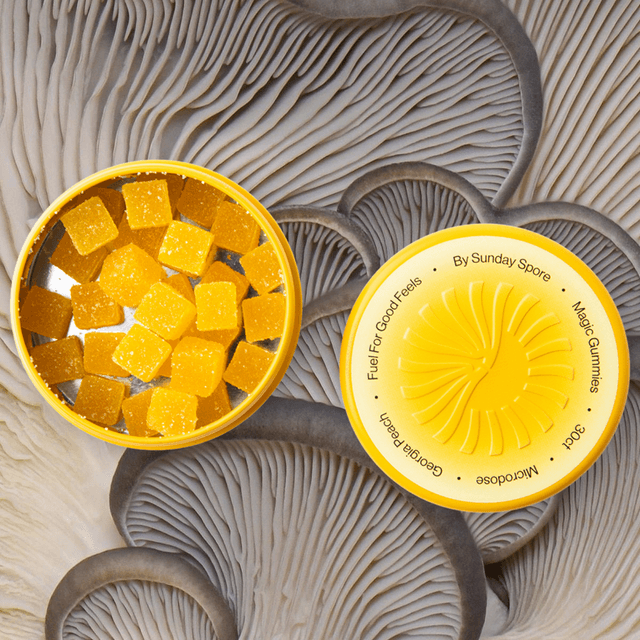
Precision Dosed
Every Sunday Spore gummy is lab-verified for precise, consistent dosing — no guessing, no scales, no batch variation. Just take one and go about your day.
If you're ready to start microdosing...
Sunday Spore Microdose — precision-dosed mushroom gummies. Lab-tested, exact dosing, ships discreetly.
Fruiting Body vs. Mycelium: What It Means for Dosing
This distinction directly affects how much you need to take.
Fruiting body (the actual mushroom): Contains the highest concentration of hericenones - the compounds that stimulate NGF production. Fruiting body extracts are what you want for cognitive benefits. At a 10:1 extract ratio, 500mg is a solid dose.
Mycelium on grain (the root-like network grown on rice or oat substrate): Contains erinacines (also NGF-stimulating, but in lower concentrations) plus a significant amount of starch from the growing substrate. Mycelium-on-grain products require substantially higher doses - often 3000mg+ - to match the active compound delivery of a 500mg fruiting body extract.
The practical rule: If the label says "fruiting body extract," you can dose at the lower ranges in this guide. If it says "mycelium" or "full spectrum" (often code for mycelium-on-grain), you may need 3-5x the dose for comparable effects.
How to Titrate Up
Starting at the maximum dose isn't necessary and isn't ideal. Your body responds better when you introduce compounds gradually.
Week 1: 500mg daily. Observe how you feel - any change in mental clarity, sleep, energy, digestion. Most people notice nothing dramatic and that's normal.
Week 2: If well-tolerated, increase to your target dose (750-1000mg for most people). Continue observing.
Weeks 3-4: Maintain your target dose. This is when cumulative NGF stimulation starts producing noticeable effects.
Week 5+: Evaluate. If you want more, increase by 250-500mg. If your current dose is working, stay there. More is not automatically better.
Stacking Lion's Mane with Other Mushrooms
Lion's mane pairs well with other species because its mechanism (neurotrophic factor stimulation) is distinct from what most functional mushrooms do.
Lion's Mane + Cordyceps (Focus + Energy)
- Lion's mane: 500-1000mg, morning
- Cordyceps: 500-1000mg, morning
- Combined effect: mental clarity with sustained physical and mental energy. The classic productivity stack.
Lion's Mane + Reishi (Brain Health + Recovery)
- Lion's mane: 500-1000mg, morning
- Reishi: 1000-1500mg, evening
- Combined effect: neuroplasticity support during active hours, cortisol reduction and deep sleep at night. Covers both the building and recovery phases of brain health.
When stacking, you don't need to increase lion's mane dosing. The standard 500-1000mg remains effective alongside other species.
Common Dosing Mistakes
Taking it sporadically. The single most common mistake. Lion's mane builds cumulative effects through sustained NGF stimulation. Three days on, four days off won't produce results. Daily consistency at a moderate dose always beats occasional high doses.
Chasing the highest milligram number. A product claiming "5000mg lion's mane" using raw mycelium powder is delivering fewer active compounds than a 500mg 10:1 fruiting body extract. Read past the marketing to the extract ratio.
Expecting immediate results. Lion's mane is not caffeine. It doesn't produce acute cognitive stimulation that you'll feel in 30 minutes. The benefits emerge over weeks as neuroplasticity compounds. If you quit at day five because you don't feel anything, you stopped before the mechanism had time to work.
Taking it before bed. The mild energizing quality can disrupt sleep in sensitive individuals. Morning dosing is safer until you know your response.
Not pairing with food. Some of lion's mane active compounds are fat-soluble. Taking it on an empty stomach may reduce absorption. A meal with healthy fats (eggs, avocado, nuts) is a good pairing.
How to Know It's Working
Lion's mane benefits develop subtly. Here's what to watch for:
Week 2-3 signals: Slightly clearer thinking during complex tasks. Less afternoon brain fog. You might catch yourself retaining details from conversations that you'd normally forget.
Week 4-6 signals: Working memory feels noticeably better. Complex reading requires less re-reading. Task switching feels smoother. The improvements feel natural, not forced.
Long-term signals (2+ months): People around you might notice before you do - improved recall, quicker problem-solving, more articulate communication. The changes integrate into your baseline cognition.
The acid test: The most reliable way to confirm lion's mane is working is to stop taking it after 6-8 weeks and see if the mental fog gradually returns within 2-3 weeks. If it does, you have your answer.
The Bottom Line
The right lion's mane dose is the one you'll take consistently. For most people using an extract, that's 500-1000mg daily, taken in the morning, for at least four weeks before evaluating results. Check the extract ratio on your product, choose fruiting body over mycelium, and prioritize daily consistency over high single doses.
For the full picture on lion's mane benefits beyond dosing, see our lion's mane mushroom gummies guide. For how lion's mane fits into a broader focus protocol, check out our mushroom gummies for focus guide.
Disclaimer
This content is for educational and informational purposes only. It is not medical advice and should not substitute professional medical guidance. Always consult a qualified healthcare provider before starting any supplement. These statements have not been evaluated by the FDA. Individual results vary.
“Three weeks into a Monday/Wednesday/Friday protocol and the difference in my foc...” — Sarah
“Bought the Big Guys for a camping trip with friends. The dosing is spot-on — eve...” — Marcus
Ready to start microdosing?
Try the Sunday Spore Microdose
Precision-dosed mushroom gummies designed for your microdosing protocol. Lab-tested. Exact dosing. Everything you need to start.

FAQ
Frequently Asked Questions
What is the standard lion's mane dosage?
When is the best time to take lion's mane?
Can you take too much lion's mane?
Does lion's mane dosage depend on the form?
Written by
Sunday Spore Editorial Team
Rigorously researched content from the Sunday Spore editorial team — covering mushroom science, functional wellness, and evidence-based supplementation.