Key Takeaways
- 1No clinical trials exist specifically for psilocybin and ADHD — current evidence is from surveys and self-reports
- 2Community members report improvements in focus, emotional regulation, and reduced 'mental noise'
- 3The Fadiman protocol (one day on, two days off) is most commonly reported for ADHD
- 4Microdosing is not a replacement for established ADHD treatments
Quick Answer
Preliminary research and community reports suggest some people with ADHD find microdosing psilocybin (50-200mg every 3 days) helps with focus, emotional regulation, and task initiation. However, no controlled clinical trials have specifically studied psilocybin for ADHD. Most evidence is anecdotal from surveys and self-reports. It's not a replacement for established ADHD treatments but may be worth discussing with a healthcare provider.
Why People with ADHD Are Looking Beyond Stimulants
If you have ADHD and you're reading this, there's a decent chance you've been through the gauntlet. You've tried Adderall, Vyvanse, Ritalin, maybe Strattera. Some of them worked — until they didn't. Some came with side effects that felt like trading one problem for another: appetite gone, sleep wrecked, personality flattened, heart racing at 2 AM.
You're not alone in that experience. Roughly 30% of adults prescribed stimulant medication for ADHD discontinue within the first year, often citing side effects, rebound crashes, or a feeling that the medication manages symptoms without addressing the underlying cognitive patterns. And for the subset of people who don't respond to stimulants at all — estimated at 20-30% of ADHD patients — the options narrow quickly.
This is the context in which microdosing psilocybin has entered the conversation. Not as a miracle cure (it isn't), and not as a replacement for proper treatment (it shouldn't be), but as something people are genuinely exploring and reporting on. Here's what we actually know.
This article is for educational purposes only. It does not constitute medical advice. ADHD is a neurodevelopmental condition that benefits from professional treatment. Never discontinue prescribed medication without medical supervision. Psilocybin remains a controlled substance in most jurisdictions.
What the Research Actually Shows
Let's be direct: there are no randomized controlled trials studying psilocybin specifically for ADHD. None. Zero. If anyone tells you "studies prove microdosing cures ADHD," they're either misreading the research or selling you something.
What we do have falls into a few categories:
Survey and Self-Report Data
Dr. James Fadiman and Sophia Korb have collected self-report data from over 1,800 microdosers since 2010. Their data, while not a clinical trial, represents the largest systematic collection of microdosing experiences. Among respondents who self-identified as having ADHD, commonly reported improvements included:
- Sustained attention on mundane tasks
- Reduced emotional reactivity
- Better task initiation (the "just start" problem)
- Quieter internal monologue ("less mental noise")
- Improved working memory during dose days
Hutten et al. (2019) published survey results in Psychopharmacology examining motivations and reported outcomes among microdosers. A notable subset reported using microdosing specifically for attention and focus issues, with most reporting subjective improvement.
The Default Mode Network Connection
This is where the research gets more interesting, even though it's indirect. Imperial College London's Psychedelic Research Centre — led by Dr. Robin Carhart-Harris — has published extensively on how psilocybin affects the brain's default mode network (DMN).
The DMN is the brain network active during mind-wandering, rumination, and self-referential thought. In people with ADHD, the DMN shows atypical connectivity patterns — it doesn't deactivate properly during tasks that require focused attention, essentially competing with task-positive networks. This is part of why you can be staring at a spreadsheet while your brain is planning dinner, replaying a conversation, and composing a hypothetical argument simultaneously.
Psilocybin, even at sub-perceptual doses, appears to modulate DMN activity. Carhart-Harris's team has shown that psilocybin reduces the dominance of the DMN and increases connectivity between brain networks that don't normally communicate well. In theory, this could address one of the neurological underpinnings of ADHD attention difficulties.
But "in theory" is doing heavy lifting in that sentence. The DMN research was conducted with full psychedelic doses, not microdoses. Whether sub-perceptual amounts produce meaningful DMN changes remains unproven.
The Neuroplasticity Angle
Research from Dr. David Olson's lab at UC Davis has shown that psychedelics — including psilocybin's active metabolite, psilocin — promote structural and functional neural plasticity. They increase dendritic growth, synaptogenesis, and spinogenesis in prefrontal cortex neurons. This is notable because ADHD involves prefrontal cortex underactivation.
A 2023 study published in Cell Reports demonstrated that even low doses of psychedelic compounds could promote neuroplasticity in cortical neurons. This provides a biological mechanism by which microdosing could theoretically improve executive function — but again, we're connecting dots between separate findings, not citing direct evidence.
What the Community Reports
While waiting for clinical trials, a substantial community of people with ADHD has been experimenting with microdosing and sharing results. Here are the consistent themes:
Focus and Task Initiation
The most commonly reported benefit is reduced friction around starting tasks. People describe it as the difference between "I should do that thing" (followed by three hours of not doing it) and actually beginning. This isn't the laser-locked, tunnel-vision focus of Adderall — it's described more as a gentle reduction in the resistance between intention and action.
Emotional Regulation
Many people with ADHD experience rejection sensitivity dysphoria (RSD) and emotional dysregulation as core symptoms, not just attention issues. Community reports frequently mention improved emotional stability — being able to receive criticism without spiraling, handling frustration without an outburst, and maintaining more even emotional states throughout the day.
Reduced Mental Noise
The ADHD brain often runs multiple background processes simultaneously. Microdosers report a quieting of this constant chatter — not silence, but a reduction from a dozen simultaneous radio stations to maybe two or three. Several describe it as their brain feeling "less crowded."
What People Don't Report
Equally important is what's typically absent from community reports: microdosing doesn't appear to help much with time blindness, organizational systems, or deeply ingrained habits. These are structural ADHD challenges that likely require behavioral strategies regardless of any substance.
Protocols People Use for ADHD
Two protocols dominate the ADHD microdosing community:
The Fadiman Protocol
Schedule: One day on, two days off (e.g., Monday dose, Tuesday and Wednesday off, Thursday dose)
This is the most widely used protocol overall and the most commonly reported among ADHD microdosers. The two off-days prevent tolerance buildup (psilocybin tolerance develops rapidly) and allow integration of any subtle shifts in cognition or mood. Many people report that "afterglow" effects on the day after dosing are actually when they feel the most focused.
Typical ADHD dose range: 50-150mg dried mushroom equivalent. Many in the community report that ADHD brains benefit from the lower end of the microdosing range — just enough to notice a subtle shift in executive function without any perceptual changes.
The Stamets Stack
Schedule: Four days on, three days off
Paul Stamets, the mycologist, proposed combining psilocybin with lion's mane mushroom (a legal nootropic with its own evidence base for nerve growth factor promotion) and niacin (vitamin B3, theorized to enhance distribution). Some ADHD microdosers prefer this protocol because the consecutive dose days provide a more sustained baseline shift.
The evidence for the synergistic effects of this specific combination remains theoretical. Lion's mane has its own research base for cognitive support (Mori et al., 2009), and some people with ADHD report taking it daily regardless of their psilocybin protocol.
Timing Considerations
Most ADHD microdosers dose in the morning, typically with or shortly after breakfast. Dosing too late in the day can interfere with sleep — and poor sleep worsens ADHD symptoms significantly, creating a counterproductive cycle.
Important Considerations and Honest Limitations
Precision Dosed
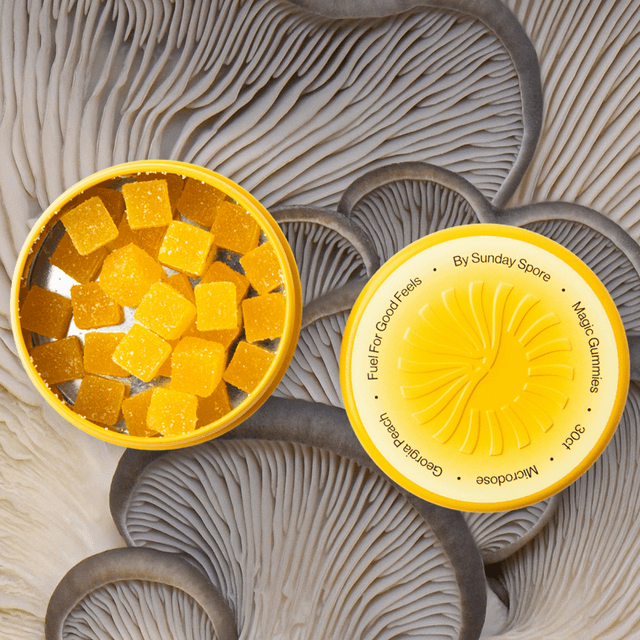
Every Sunday Spore gummy is lab-verified for precise, consistent dosing — no guessing, no scales, no batch variation. Just take one and go about your day.
If you're ready to start microdosing...
Sunday Spore Microdose — precision-dosed mushroom gummies. Lab-tested, exact dosing, ships discreetly.
The Placebo Effect Is Real
The largest controlled microdosing study to date — Szigeti et al. (2021), published in eLife — used an innovative self-blinding design. Participants prepared their own microdoses and placebos, and couldn't reliably tell which was which. The study found that psychological outcomes improved in both groups, and participants couldn't distinguish microdose from placebo above chance levels.
This doesn't mean microdosing "doesn't work." It means expectation effects are powerful, and some portion of the benefits people report may come from the ritual, the intention-setting, and the belief that they're doing something helpful. For ADHD specifically, even a reliable placebo effect that improves task initiation has practical value — but intellectual honesty requires acknowledging this.
SSRI and Medication Interactions
Many people with ADHD also take SSRIs, SNRIs, or other psychiatric medications for co-occurring anxiety or depression. Psilocybin and SSRIs both act on the serotonin system. SSRIs significantly blunt psilocybin's effects, and there's a theoretical (though poorly documented) risk of serotonin syndrome with concurrent use. Never combine these without explicit medical guidance.
Stimulant medications (amphetamines, methylphenidate) work on the dopamine/norepinephrine system and are less likely to interact pharmacologically with psilocybin — but there is essentially no research on this combination. The absence of documented interactions is not the same as evidence of safety.
Legal Status
Psilocybin remains a Schedule I controlled substance federally in the United States. Oregon has legalized supervised psilocybin therapy, and Colorado has decriminalized possession and is building a regulated therapeutic framework. Several cities have deprioritized enforcement. But in most places, possession is still illegal. Know your local laws.
It's Not for Everyone
Some people with ADHD report that microdosing increases anxiety, particularly on dose days. Others find it amplifies their tendency toward hyperfocus — which can be useful or problematic depending on what captures their attention. A small number report no noticeable effects at all after months of consistent use.
ADHD presents very differently across individuals. What works for someone with primarily inattentive type may not work for someone with combined type. There is no universal ADHD experience, and there shouldn't be an expectation of a universal response to microdosing.
If You Decide to Try Microdosing
After weighing the evidence and limitations, some people decide that microdosing is worth exploring alongside their existing ADHD management strategies. If you're one of them, the single biggest practical challenge you'll face is dose consistency.
ADHD and microdosing is a particularly unforgiving combination when it comes to dosing variability. Too little and you notice nothing. Too much and you're trying to focus on a quarterly report while the wall texture is unusually fascinating. The margin between "sub-perceptual benefit" and "perceptual distraction" is narrow, and it needs to be the same every time you dose.
This is the core problem that pre-dosed gummies solve. Each gummy contains a precise, lab-measured amount — no weighing, no guessing, no batch-to-batch variability. For a protocol that depends on consistent sub-perceptual dosing every three days, that precision isn't a luxury. It's the difference between a reliable routine and an unreliable experiment.
Whatever format you choose, keep a journal. Track your ADHD symptoms specifically — not just "I feel good" but "I initiated the project I've been avoiding" or "I handled that interruption without losing my train of thought." Specific tracking over 4-6 weeks gives you actual data to evaluate, rather than relying on vague impressions.
The Bottom Line
Microdosing psilocybin for ADHD sits in a frustrating middle ground: there's enough signal from community reports and adjacent neuroscience to suggest something real might be happening, but not enough clinical evidence to make definitive claims. The honest answer to "does microdosing help ADHD?" is: some people report it does, we have plausible biological mechanisms for why it might, and we need proper clinical trials to know for certain.
If you're exploring this path, do it with clear expectations, consistent tracking, and ideally in conversation with a healthcare provider who's open to the discussion. Your ADHD is real, your frustration with existing options is valid, and you deserve honest information — not hype — as you evaluate your options.
Sources & References
- Fadiman, J. & Korb, S. (2019). Might Microdosing Psychedelics Be Safe and Beneficial? An Initial Exploration. Psychopharmacology.
- Hutten, N.R.P.W. et al. (2019). Motives and Side-Effects of Microdosing With Psychedelics Among Users. International Journal of Neuropsychopharmacology, 22(7), 426-434.
- Carhart-Harris, R.L. et al. — Imperial College London Psychedelic Research Centre — research on psilocybin and the default mode network.
- Olson, D.E. et al. (2023). Psychedelics promote neural plasticity through the activation of intracellular 5-HT2A receptors. Cell Reports.
- Ly, C. et al. (2018). Psychedelics Promote Structural and Functional Neural Plasticity. Cell Reports, 23(11), 3170-3182. (UC Davis, Olson Lab)
- Szigeti, B. et al. (2021). Self-blinding citizen science to explore psychedelic microdosing. eLife, 10, e62878.
- Mori, K. et al. (2009). Improving effects of the mushroom Yamabushitake (Hericium erinaceus) on mild cognitive impairment. Phytotherapy Research, 23(3), 367-372.
Note: This article cites published research for educational context. Inclusion of a study does not imply endorsement of its conclusions or guarantee of similar outcomes.
Disclaimer
This content is for educational and informational purposes only. It is not medical advice and should not substitute professional medical guidance. Always consult a qualified healthcare provider. Psilocybin is a controlled substance in most jurisdictions — know your local laws. Individual results vary.
“Three weeks into a Monday/Wednesday/Friday protocol and the difference in my foc...” — Sarah
“Bought the Big Guys for a camping trip with friends. The dosing is spot-on — eve...” — Marcus
Ready to start microdosing?
Try the Sunday Spore Microdose
Precision-dosed magic mushroom gummies designed for your microdosing protocol. Lab-tested. Exact dosing. Everything you need to start.

FAQ
Frequently Asked Questions
Can microdosing replace ADHD medication?
What dose do people with ADHD typically use?
How long before noticing effects on ADHD symptoms?
Written by
Alex Nakamura
Biochemistry degree. Translates complex mycology and pharmacology into accessible guides.