Key Takeaways
- 1Microdosing enhances both idea generation (divergent thinking) and idea refinement (convergent thinking)
- 2Schedule dose days on your most important creative workdays for maximum impact
- 3Stack daily lion's mane with your microdose protocol for short-term and long-term creative gains
- 4Flow states become more accessible with microdosing — set up your creative environment before onset
- 5Creativity requires input — feed your brain with diverse experiences to give the enhanced connectivity material
Quick Answer
Research shows microdosing mushroom gummies can enhance creativity through two mechanisms: increased divergent thinking (generating novel ideas) and improved convergent thinking (refining solutions). Studies find microdosers score higher on creativity assessments, report enhanced flow state access, and show increased connectivity between brain regions that don't normally communicate. Lion's mane supports creative cognition through neuroplasticity, while microdose protocols directly enhance creative ideation.
Creativity Isn't Magic — It's Neuroscience
Creativity feels mysterious. A melody arrives while you're in the shower. A design concept clicks at 2 AM. A sentence writes itself after hours of staring at a blank page. But neuroscience has demystified much of what happens during creative breakthroughs, and that understanding reveals exactly why certain mushroom compounds enhance the process.
Creative thinking isn't a single skill. It's the interplay of two distinct cognitive modes:
Divergent thinking — generating multiple novel ideas, making unexpected connections, exploring possibilities without judgment. This is the brainstorming phase, the improvisation, the moment when a painter sees three different directions for a composition.
Convergent thinking — evaluating options, refining solutions, synthesizing ideas into coherent output. This is the editing phase, the selection, the moment when the writer chooses the right word from twenty alternatives.
Great creative work requires both. And mushroom compounds affect both — through different but complementary mechanisms.
How Your Brain Creates: The Default Mode Network
The Default Mode Network (DMN) is a set of interconnected brain regions that activate when you're not focused on external tasks — daydreaming, mind-wandering, imagining futures, reflecting on the past. It's your brain's "background processing" system.
Here's what matters for creativity: the DMN is where novel associations form. When your mind wanders, the DMN connects ideas from different memory systems, draws parallels between unrelated concepts, and generates the raw material for creative insight.
But the DMN doesn't work in isolation. Creative breakthroughs happen when the DMN communicates with the Executive Control Network (focused attention) and the Salience Network (deciding what's important). In most people, these networks operate in relatively rigid patterns — they take turns rather than collaborating.
This is where microdosing enters the picture.
Microdosing and the Creative Brain
What the Research Shows
Neuroimaging studies reveal that magic mushrooms, even at sub-perceptual doses, increase functional connectivity between brain regions that don't normally communicate. Specifically:
- Cross-network communication increases — the DMN, Executive Control, and Salience networks become more integrated rather than operating in isolation
- Rigid connectivity patterns loosen — habitual neural pathways become less dominant, allowing novel connections
- Entropy increases (in a good way) — the brain operates in a slightly less predictable state, which correlates with creative insight
A study from Leiden University measured divergent and convergent thinking in microdosers using standard creativity assessments. The results were striking: participants scored significantly higher on both types of creative thinking after microdosing compared to baseline. They generated more novel ideas (divergent) and found more optimal solutions (convergent).
Separately, a large-scale observational study published in Nature Scientific Reports found that microdosers reported enhanced creativity, increased openness, and greater curiosity compared to non-microdosing controls — and these effects persisted on non-dosing days.
The Serotonin 2A Connection
The active compound in magic mushrooms works primarily through serotonin 2A receptors. When these receptors are activated — even at very low levels during microdosing — they promote a cascade of downstream effects relevant to creativity:
- Increased BDNF expression (Brain-Derived Neurotrophic Factor) — supports the formation of new neural connections
- Reduced DMN rigidity — allows the mind to wander more productively rather than cycling through habitual patterns
- Enhanced glutamate signaling — increases cortical excitability, making the brain more responsive to novel inputs
- Temporary ego relaxation — at sub-perceptual doses, this manifests as reduced self-criticism and less attachment to existing ideas
That last point is worth emphasizing. A huge portion of creative block isn't about lacking ideas — it's about an inner critic that kills ideas before they develop. Microdosing appears to quiet that critic without impairing the evaluative thinking needed to refine ideas later.
Lion's Mane: The Neuroplasticity Foundation
While microdosing provides acute creative enhancement, lion's mane builds the infrastructure that makes creative thinking easier over time.
Lion's mane stimulates Nerve Growth Factor (NGF) production — the protein your brain needs to form and strengthen neural connections. More connections mean more potential pathways for associative thinking. The brain with denser, more varied neural connections is a brain that can draw from a wider library of associations.
This is creative cognition at the structural level. Lion's mane doesn't produce a creative insight on Thursday afternoon. It builds a brain that has more creative capacity over weeks and months of consistent use.
Research supports this: lion's mane supplementation improves cognitive flexibility — the ability to shift between different concepts and perspectives. Cognitive flexibility is one of the strongest predictors of creative performance in laboratory and real-world settings.
Protocols for Creatives
The Creative Workday Protocol
The most practical approach for working creatives — writers, designers, musicians, developers — is to align microdose days with your highest-leverage creative sessions.
Structure:
- Dose day (creative work): Microdose in the morning, then dedicate the day to generative creative work — brainstorming, composing, sketching, writing first drafts
- Day 2 (integration/editing): No dose. Use the residual openness for refining and editing work generated on dose day
- Day 3 (execution/admin): No dose. Handle non-creative tasks, logistics, planning
This follows the Fadiman Protocol schedule (one on, two off) but intentionally maps it to creative workflow. Dose days become your most productive creative sessions because you're combining enhanced ideation with dedicated creative time.
The Stacking Protocol for Sustained Creative Output
For creatives who want both acute enhancement and long-term cognitive support:
Daily (every day):
- Lion's mane: 500-1000mg in the morning — builds neuroplasticity foundation
- Cordyceps: 300mg in the morning (optional) — sustained mental energy for long creative sessions
Protocol days (1-3x per week):
- Microdose gummy — taken in the morning alongside lion's mane
This combination addresses creativity at multiple timescales: microdosing for immediate ideation enhancement, lion's mane for long-term neural infrastructure, and cordyceps for the sustained energy that creative marathons demand.
Timing Matters
Creative work and microdosing have a timing relationship that's worth understanding:
Morning dose + creative work within 1-4 hours: This is the sweet spot. Effects peak around 60-90 minutes post-dose, and the enhanced connectivity and reduced self-criticism make this the ideal window for generative work.
Afternoon editing on dose days: By mid-afternoon, the acute effects have softened. Many creatives find this transition ideal for shifting into convergent mode — evaluating the morning's output, making editorial decisions, refining rough ideas into polished work.
Evening after dose days: Don't schedule creative work here. Wind down. Let the brain integrate. Some of the best creative insights arrive the morning after a dose day, during that first cup of coffee when yesterday's ideas have had time to consolidate.
Precision Dosed
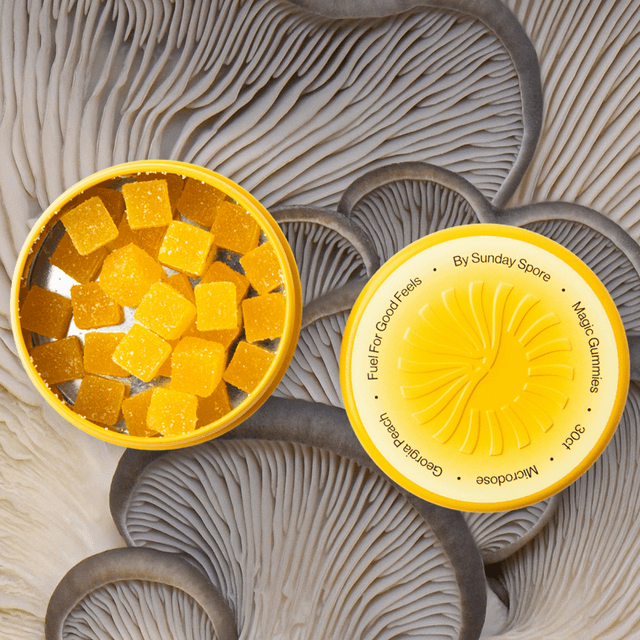
Every Sunday Spore gummy is lab-verified for precise, consistent dosing — no guessing, no scales, no batch variation. Just take one and go about your day.
If you're ready to start microdosing...
Sunday Spore Microdose — precision-dosed mushroom gummies. Lab-tested, exact dosing, ships discreetly.
Flow States: Where Mushrooms and Creativity Peak
Flow — that state of total immersion where time disappears and your best work seems to happen effortlessly — is the holy grail for creatives. And microdosers consistently report easier and more frequent access to flow states.
This makes sense neurologically. Flow states are characterized by:
- Transient hypofrontality — reduced activity in the prefrontal cortex (your inner critic quiets down)
- Increased cross-network connectivity — the same pattern microdosing promotes
- Enhanced pattern recognition — connections between concepts happen faster
- Reduced self-monitoring — you stop evaluating every decision and just create
Microdosing doesn't guarantee flow. But it appears to lower the threshold — making it easier to drop into flow when conditions are right (clear intention, appropriate challenge level, minimal distraction).
The practical implication: on dose days, set up your creative environment before the effects kick in. Clear your desk, close email, have your tools ready. When the enhanced connectivity arrives, you want to channel it into creation rather than spending it deciding what to work on.
Common Mistakes Creatives Make
Dosing Too High
The most common error. At true sub-perceptual doses, you feel sharper, more connected, more open. Push the dose slightly higher, and you cross into territory where focus scatters. Ideas come too fast to capture. You feel creative but can't execute. For creative work, less is genuinely more. If you notice visual disturbances or feel "different" in a way that's distracting, the dose is too high for productive creative work.
No Structure on Dose Days
Taking a microdose and then scrolling through email or sitting in meetings wastes the enhanced state. Protect your creative time on dose days. Block the calendar. Silence notifications. This isn't a substance that forces creativity — it's one that amplifies whatever cognitive mode you're in. Be in creative mode when it kicks in.
Skipping the Functional Foundation
Relying solely on microdosing without daily lion's mane is like doing sprint intervals but never strength training. The acute sessions are powerful, but the cumulative neuroplasticity from daily lion's mane builds the creative infrastructure that makes every session — dosed or not — more productive.
Expecting Creativity Without Input
Mushroom compounds enhance the brain's ability to connect and recombine ideas. But they can't create from nothing. If you haven't been reading, observing, experiencing, and absorbing raw material, there's less for the enhanced connectivity to work with. Feed the machine. The best creative microdosers are voracious consumers of diverse inputs.
A Note on Legal Status
This article discusses magic mushrooms for educational purposes. Their legal status varies by jurisdiction and is evolving. We don't encourage breaking any laws. If you're in a jurisdiction where magic mushrooms aren't legal, the lion's mane + cordyceps functional stack still provides meaningful support for creative cognition through entirely legal, non-psychoactive means.
For a comprehensive breakdown of what's legal and where, see our legal mushroom gummies guide.
The Creative Stack: Summary
For non-psychedelic creative support:
- Lion's mane (500-1000mg daily) + cordyceps (300mg daily)
- Legal everywhere, safe for daily use, builds long-term creative infrastructure
For protocol-based creative enhancement:
- Lion's mane (500-1000mg daily) + microdose protocol (1-3x per week on creative days)
- Align dose days with your most important creative work
- Start with the lowest dose and increase only if needed
The universal rule: Consistency beats intensity. A regular practice — whether functional mushrooms daily or a structured microdose protocol — will produce better creative results than sporadic high-effort sessions.
The Bottom Line
Creativity isn't some fixed trait you either have or don't. It's a cognitive process running on neural hardware that can be optimized. Mushroom compounds — both functional and microdose — target the specific mechanisms underlying creative thinking: neuroplasticity, cross-network connectivity, reduced self-criticism, and enhanced pattern recognition.
The creatives getting real results aren't chasing some psychedelic muse. They're building consistent practices that enhance their brain's creative infrastructure and then showing up to do the work.
For the full science behind microdosing benefits, including creativity, see our magic mushroom microdosing benefits review. For practical focus protocols that complement creative work, check out mushroom gummies for focus. And if you're new to microdosing, start with our how to microdose mushrooms guide.
Disclaimer
This content is for educational and informational purposes only. It is not medical advice and should not substitute professional medical guidance. Always consult a qualified healthcare provider. Psilocybin is a controlled substance in most jurisdictions — know your local laws. Individual results vary.
“Three weeks into a Monday/Wednesday/Friday protocol and the difference in my foc...” — Sarah
“Bought the Big Guys for a camping trip with friends. The dosing is spot-on — eve...” — Marcus
Ready to start microdosing?
Try the Sunday Spore Microdose
Precision-dosed magic mushroom gummies designed for your microdosing protocol. Lab-tested. Exact dosing. Everything you need to start.

FAQ
Frequently Asked Questions
Does microdosing actually improve creativity?
What's the best protocol for creative work?
Which mushroom is best for creativity?
Can functional mushrooms (non-psychedelic) boost creativity?
Written by
Alex Nakamura
Biochemistry degree. Translates complex mycology and pharmacology into accessible guides.