Key Takeaways
- 1Microdosing has the strongest evidence for direct mood improvement among all mushroom approaches
- 2Lion's mane builds emotional resilience through BDNF; reishi removes the stress load dragging mood down
- 3Combine all three pathways — microdose, lion's mane, and reishi — for the most comprehensive support
- 4Exercise, sleep, and social connection amplify mushroom-based mood benefits significantly
- 5Mushroom gummies support mood over time — they are not a replacement for professional mental health care
Quick Answer
Multiple mushroom species support mood through distinct mechanisms: microdosing promotes neuroplasticity and serotonin 2A receptor activation (strongest evidence for mood improvement), lion's mane supports emotional resilience through BDNF production, and reishi reduces the cortisol-driven mood disruption that accompanies chronic stress. Research shows microdosing produces significant mood improvements within 2-4 weeks, while functional mushrooms provide subtler, cumulative mood stabilization.
The Mood-Brain Connection
Mood isn't just a feeling. It's the output of multiple interacting neurobiological systems — serotonin signaling, neuroplasticity, the stress response, inflammation, and the gut-brain axis all converge to produce your day-to-day emotional state. When one or more of these systems falls out of balance, mood suffers.
This is why "just think positive" doesn't work for persistent low mood. The hardware matters.
Three systems are particularly relevant to understanding how mushroom gummies support mood:
Serotonin and neuroplasticity. Serotonin isn't just a "happy chemical" — it regulates how flexibly your brain processes emotional information. When serotonin pathways are functioning well, you can experience difficult emotions without getting stuck in them. When they're disrupted, the brain defaults to rigid, repetitive patterns: rumination, hopelessness, emotional flatness.
The HPA axis and cortisol. Your hypothalamic-pituitary-adrenal axis governs the stress response. Chronic stress keeps cortisol elevated, which literally damages the hippocampus (memory and emotional regulation center) and suppresses BDNF production. The result: your brain loses its ability to adapt, and mood deteriorates.
BDNF — the mood protein. Brain-Derived Neurotrophic Factor supports neuron survival, growth, and new connections. BDNF levels are consistently lower in people with depression and anxiety. Anything that raises BDNF tends to improve mood over time.
Different mushroom species target different points in this system. That's what makes a multi-species approach compelling.
Three Pathways to Mood Support
Pathway 1: Microdosing — Serotonin 2A Activation
Microdosing has the strongest direct evidence for mood improvement among all mushroom-based approaches.
The mechanism is well-characterized: sub-perceptual doses of magic mushrooms activate serotonin 2A receptors, which triggers a cascade of downstream effects — increased neuroplasticity, enhanced emotional processing, and reduced default mode network (DMN) rigidity. The DMN is the brain network responsible for self-referential thought. When it becomes hyperactive and inflexible, the result is rumination — the hallmark of depression and low mood.
Key research:
- A 2022 Nature Scientific Reports study tracked 953 participants and found microdosers showed significant improvements in depression and anxiety scores compared to non-microdosing controls
- University of British Columbia research demonstrated sustained mood improvements correlating with protocol adherence over 30 days
- Imperial College London neuroimaging revealed reduced amygdala reactivity and increased connectivity between emotional processing regions
What this looks like in practice: People don't describe microdosing as making them "happy" in the way a stimulant might. They describe it as removing the stickiness from negative emotions. Bad things still happen — you just process them and move on instead of spiraling.
For a deeper dive into the full spectrum of microdosing effects, see our magic mushroom microdosing benefits guide.
Pathway 2: Lion's Mane — BDNF and Neuroplasticity
Lion's mane targets mood from a different angle entirely. Rather than directly modulating serotonin, it stimulates your brain's own growth factors — NGF and BDNF — which support the neural infrastructure that healthy mood depends on.
How this relates to mood:
- BDNF levels are consistently low in depression; lion's mane raises them
- NGF supports hippocampal health — the hippocampus is one of the brain regions most damaged by chronic stress and most responsive to recovery
- Neuroplasticity improvements make it easier for the brain to form new emotional response patterns rather than defaulting to negative ones
A 2019 study in Evidence-Based Complementary and Alternative Medicine found that participants taking lion's mane for four weeks showed significantly reduced depression and anxiety scores. The researchers attributed this to both NGF stimulation and reduced neuroinflammation.
Lion's mane mood support is subtler than microdosing. You won't feel a shift on day one. What you'll notice at week three or four is that your emotional baseline has quietly risen — you're more resilient, less reactive, more emotionally even.
For the full profile on this species, see our lion's mane mushroom gummies guide.
Pathway 3: Reishi — Cortisol and the Stress-Mood Cycle
Reishi doesn't target mood directly. It targets the stress response that destroys mood.
Chronic stress is the single biggest environmental contributor to low mood. Elevated cortisol suppresses BDNF, damages the hippocampus, disrupts sleep, and promotes neuroinflammation — every one of which degrades emotional wellbeing.
Reishi's mood-relevant mechanisms:
- Triterpene compounds modulate the HPA axis, reducing cortisol output
- GABAergic activity promotes calm without sedation
- Polysaccharides reduce neuroinflammation — an increasingly recognized driver of depression
- Sleep quality improvements (reishi is best taken in the evening) support mood through better rest
Reishi is the "remove the obstacle" approach to mood support. It doesn't push your mood up — it removes the chronic stress load that's been pushing it down.
The Research Evidence: Tier by Tier
Strong Evidence (Consistent Across Multiple Studies)
Microdosing for mood improvement — the most replicated finding in the microdosing literature. Multiple study designs, consistent effect sizes, plausible and well-characterized mechanism (serotonin 2A activation leading to neuroplasticity).
Lion's mane for BDNF elevation — confirmed in both animal and human studies. BDNF's role in mood regulation is itself strongly established.
Promising Evidence (Growing Research, Consistent Reports)
Reishi for cortisol modulation — solid mechanistic evidence and traditional use data, with modern studies confirming HPA axis effects. Less clinical trial data specifically on mood outcomes than the other two pathways.
Multi-species stacking for mood — practitioner reports are consistent and the mechanistic rationale is sound (different pathways converge on mood), but formal clinical trials on combination protocols are limited.
Early Signal (Biological Plausibility, Needs More Research)
Gut-brain axis effects — all three species have prebiotic and anti-inflammatory properties that could influence mood through the gut microbiome. This pathway is real but poorly quantified for mushrooms specifically.
Neuroplasticity: The Unifying Mechanism
The reason mushroom-based mood support is more interesting than it might first appear is that all three pathways converge on the same underlying mechanism: neuroplasticity.
Microdosing promotes it through serotonin 2A receptor activation. Lion's mane promotes it through NGF and BDNF stimulation. Reishi promotes it indirectly by reducing the cortisol that suppresses it.
This matters because depression and chronic low mood are increasingly understood as disorders of neural rigidity. The brain gets stuck — in negative thought patterns, in muted emotional responses, in pessimistic interpretive frameworks. Neuroplasticity is literally the brain's ability to get unstuck.
This is also why the effects are cumulative. You're not masking symptoms with a temporary neurochemical shift. You're building new neural pathways that represent healthier emotional defaults. Those pathways persist even when you reduce dosing.
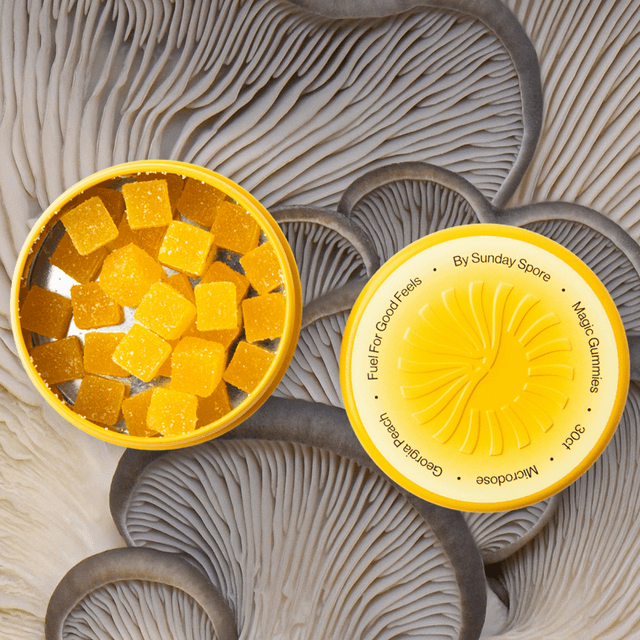
Precision Dosed
Every Sunday Spore gummy is lab-verified for precise, consistent dosing — no guessing, no scales, no batch variation. Just take one and go about your day.
If you're ready to start microdosing...
Sunday Spore Microdose — precision-dosed mushroom gummies. Lab-tested, exact dosing, ships discreetly.
Practical Protocols for Mood
The Foundation Stack (Non-Psychoactive)
For those who want mood support without microdosing:
Morning — Lion's mane: 500-1000mg
- Supports BDNF production throughout your active hours
- May take 2-4 weeks to notice mood-specific benefits
Evening — Reishi: 1000-1500mg
- Reduces cortisol load from the day
- Improves sleep quality (foundational for mood)
- Calming effects complement evening wind-down
Expected timeline: Subtle improvements at 2 weeks. Meaningful mood stabilization at 4-6 weeks.
The Comprehensive Stack (Including Microdosing)
For those comfortable with microdose protocols:
Daily — Lion's mane: 500-1000mg (morning) Daily — Reishi: 1000-1500mg (evening) Protocol days — Microdose gummy: per chosen protocol
Protocol options:
- Fadiman (1 on, 2 off): Better for people who are sensitive or new to microdosing
- Stamets (4 on, 3 off): More sustained neuroplasticity stimulation; designed to pair with lion's mane
Expected timeline: Noticeable mood shifts within 1-2 weeks. Significant, stable improvement at 4 weeks.
Realistic Expectations
Mushroom gummies for mood are not antidepressants. They don't override your neurochemistry to force a different emotional state. What they do is create the biological conditions for your brain to regulate mood more effectively.
What to expect:
- Emotional flexibility improves before "happiness" — you process difficult feelings faster instead of getting stuck
- Energy and motivation often improve alongside mood, since they share underlying pathways
- Benefits accumulate — week four is significantly better than week one
- Bad days still happen, but they feel less catastrophic and pass more quickly
What NOT to expect:
- Instant mood elevation (this isn't a stimulant or euphoric)
- Complete resolution of clinical depression without other support
- Identical results to someone else's experience — individual variation is significant
Important Disclaimers
Mushroom gummies are not a substitute for professional mental health care. If you're experiencing persistent depression, suicidal thoughts, or severe mood disruption, please reach out to a mental health professional.
If you're currently on medication for mood — SSRIs, SNRIs, MAOIs, lithium, or other psychiatric medications — do not combine them with microdose products without consulting your prescribing provider. Lion's mane and reishi have no known significant interactions with these medications and are generally safe to add.
Mushroom-based mood support works best as one component of a broader approach that includes quality sleep, regular exercise, social connection, and professional support when needed.
Lifestyle Factors That Amplify Mushroom Mood Benefits
Your neurobiological environment determines how effectively mushroom compounds can do their work. These factors either amplify or undermine the effects:
Exercise — Aerobic exercise independently raises BDNF. Combined with lion's mane, the neuroplasticity effect is synergistic, not just additive. Even 20 minutes of brisk walking on days you take your gummies makes a measurable difference.
Sleep — Neuroplastic changes consolidate during deep sleep. If your sleep is poor, the new neural pathways promoted by mushroom compounds don't fully form. Reishi's evening calming effects support this directly.
Sunlight exposure — Morning light exposure supports serotonin production, which works synergistically with microdosing's serotonin 2A effects.
Social connection — Oxytocin released during positive social interactions potentiates the mood benefits of all three pathways. Isolation undermines them.
Journaling — Particularly useful with microdosing. Noting your emotional state daily accelerates self-awareness, which helps you recognize and build on positive changes.
The Bottom Line
Mushroom gummies support mood through multiple, complementary mechanisms. Microdosing offers the most direct and well-researched mood improvement. Lion's mane builds the neural infrastructure for long-term emotional resilience. Reishi removes the chronic stress burden that drags mood down.
The most effective approach combines multiple species targeting different pathways, paired with lifestyle practices that amplify the biological effects. Give it four to six weeks of consistent use before evaluating results.
For more on the anxiety-specific side of these benefits, see our mushroom gummies for anxiety guide. For a closer look at microdosing mechanisms, check out our magic mushroom microdosing benefits overview.
Disclaimer
This content is for educational and informational purposes only. It is not medical advice and should not substitute professional medical guidance. Always consult a qualified healthcare provider. Psilocybin is a controlled substance in most jurisdictions — know your local laws. Individual results vary.
“Three weeks into a Monday/Wednesday/Friday protocol and the difference in my foc...” — Sarah
“Bought the Big Guys for a camping trip with friends. The dosing is spot-on — eve...” — Marcus
Ready to start microdosing?
Try the Sunday Spore Microdose
Precision-dosed magic mushroom gummies designed for your microdosing protocol. Lab-tested. Exact dosing. Everything you need to start.

FAQ
Frequently Asked Questions
Which mushroom is best for mood?
How does microdosing improve mood?
Can functional mushrooms replace antidepressants?
How long do mushroom gummies take to improve mood?
Written by
Alex Nakamura
Biochemistry degree. Translates complex mycology and pharmacology into accessible guides.