Key Takeaways
- 1Microdosing quiets the default mode network responsible for rumination and stress-loop thinking
- 2Unlike alcohol or sedatives, microdosing relaxes without impairing cognition or creating dependency
- 3Pair microdosing with evening reishi for a complete approach — cognitive calm plus physiological wind-down
- 4Reduced stress reactivity typically appears within 1-2 weeks of consistent protocol use
Quick Answer
Microdosing magic mushrooms provides relaxation and stress relief through three biological mechanisms: serotonin 2A receptor modulation (which calms the default mode network responsible for anxious rumination), reduced cortisol reactivity (your stress response fires less intensely), and increased neural flexibility (rigid thought patterns that fuel anxiety become more malleable). Unlike sedatives or alcohol, microdosing doesn't impair cognition — you're calm and sharp simultaneously.
Your Nervous System Is Running Too Hot
You know that feeling at the end of the day when you're physically still but your mind won't stop? You're lying on the couch but your jaw is clenched, your shoulders are up near your ears, and your brain is replaying a conversation from six hours ago while simultaneously running scenarios about tomorrow.
That's not a relaxation problem. That's a nervous system regulation problem. Your brain's stress circuits have been running at elevated baseline for so long that they've forgotten what "off" feels like.
Most relaxation solutions work around this issue. Alcohol numbs the stress signal. Benzodiazepines suppress neural activity broadly. CBD blunts the edges. Even reishi — which is genuinely useful — modulates cortisol output without addressing the cognitive patterns that keep triggering it.
Microdosing magic mushrooms does something different. It goes upstream — to the default mode network that's generating all that mental noise — and turns the volume down at the source.
The Science of Why You Can't Relax
To understand how microdosing helps with relaxation, you need to understand what's keeping you wound up in the first place.
The Default Mode Network Problem
Your brain has a circuit called the default mode network (DMN). It handles self-referential thinking — your sense of identity, your autobiographical memory, and your ability to project into the future. When it's working well, it's how you reflect, plan, and make sense of your experience.
When it's overactive — which chronic stress, anxiety, and the relentless pace of modern life all promote — it becomes a rumination machine. The DMN starts running on autopilot: replaying past mistakes, catastrophizing about future scenarios, maintaining a low-level commentary of worry that you can't seem to turn off.
This is why you can't relax. It's not that your body is tense (though it is — that's downstream). It's that your brain's self-referential circuitry is stuck in overdrive, generating stress signals even when nothing is objectively wrong.
The Cortisol Feedback Loop
The DMN's constant activity triggers your stress response (the HPA axis), which produces cortisol. Elevated cortisol makes the DMN more active. The DMN's increased activity produces more stress. More cortisol. Tighter feedback loop.
This is why "just relax" doesn't work. The instruction requires the very neural flexibility that stress has suppressed. You can't think your way out of a thinking problem.
Serotonin's Role
Serotonin — specifically the 2A receptor subtype — plays a critical role in modulating the DMN. When serotonin 2A receptors are activated, DMN connectivity decreases. The mental noise quiets. The rumination loop loosens. The gap between "stimulus" and "response" widens, giving you space to choose calm instead of react with stress.
This is exactly where magic mushroom microdoses operate.
How Microdosing Creates Genuine Relaxation
Sunday Spore Microdose delivers a sub-perceptual dose of magic mushrooms — enough to engage serotonin 2A receptors and influence DMN activity, but not enough to produce any perceptible high or altered state. You feel normal. You function normally. But underneath the surface, three things shift:
1. DMN Activity Decreases
The rumination circuit quiets. The mental replaying and scenario-spinning loses its grip. You still think about the day's events, but you process them and move on rather than looping endlessly. The background hum of low-grade anxiety that you'd stopped noticing (because it became your normal) starts to lift.
This is the most immediate effect. Many people notice it within the first few days of a protocol: "I was just... calm. Not trying to be calm. Just calm."
2. Cortisol Reactivity Drops
As DMN activity decreases, the signals triggering your stress response become less intense and less frequent. Your HPA axis starts down-regulating. Cortisol output becomes proportional to actual stressors rather than amplified by rumination.
In practical terms: your coworker's annoying email still registers, but it doesn't hijack your afternoon. The traffic still exists, but your shoulders don't climb to your ears. Stress becomes something that happens and resolves, rather than something that accumulates and persists.
3. Neural Flexibility Increases
This is the neuroplasticity piece, and it's what makes microdosing fundamentally different from every other relaxation approach. Magic mushrooms promote dendritic spine growth and increased connectivity between brain regions. Your brain literally becomes more flexible — more capable of forming new response patterns rather than defaulting to stress.
Over weeks of consistent microdosing, the rigid stress patterns that kept your nervous system locked in overdrive start to loosen. New patterns — calmer, more adaptive ones — form in their place. The relaxation becomes structural, not just chemical. It persists on off-days and builds over time.
What Microdose Relaxation Actually Feels Like
This is worth describing because it's so different from other forms of relaxation that people sometimes don't recognize it at first.
It's not the heavy, sedated calm of alcohol or benzos. It's not the fuzzy mellowness of CBD. It's not even the gentle winding-down of reishi (which is genuinely good but operates on a different mechanism).
It's more like... your brain stops generating unnecessary tension. You're fully alert, fully functional, and fully engaged — but without the background static of worry, rumination, and cortisol-driven edginess.
The best analogy people give: "It's like I'd been clenching a muscle I didn't know I was clenching, and it finally released."
Week 1-2: You notice you're less reactive. Things that would normally spike your frustration produce a smaller response. Evening wind-down happens more naturally — less lying-in-bed-thinking.
Week 3-4: Your baseline shifts. The difference isn't dramatic on any single day, but looking back over a month, you realize your default state is noticeably calmer. Friends or partners might comment before you notice it yourself — "You seem more relaxed lately."
Month 2+: This is where the neuroplastic effects really show. You're not just managing stress better — your capacity for handling challenges has genuinely expanded. Stressors that would have derailed you before are processed and released. The nervous system isn't just quieter; it's fundamentally more resilient.
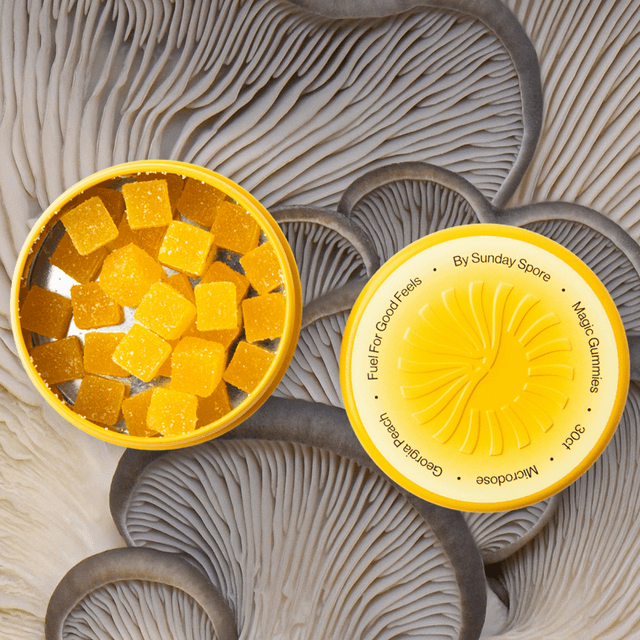
Precision Dosed
Every Sunday Spore gummy is lab-verified for precise, consistent dosing — no guessing, no scales, no batch variation. Just take one and go about your day.
If you're ready to start microdosing...
Sunday Spore Microdose — precision-dosed mushroom gummies. Lab-tested, exact dosing, ships discreetly.
Stacking: Reishi on Off-Days
We mentioned reishi earlier, and it deserves its own section here because it's the best functional mushroom complement to a microdosing relaxation protocol.
Here's why the combination works so well:
Microdosing addresses the cognitive and emotional roots of stress — rumination, DMN overactivity, rigid anxiety patterns. It works through serotonin 2A receptors and promotes neuroplasticity.
Reishi addresses the physiological machinery of stress — HPA axis regulation, cortisol output, GABAergic support, and sleep architecture. It works through triterpenes and polysaccharides.
Different pathways. Different targets. Complementary effects.
A practical protocol might look like:
- Dose days (e.g., Monday): Sunday Spore Microdose in the morning. Reishi 500mg in the evening.
- Off-days (Tuesday, Wednesday): Reishi 500-1000mg in the evening.
- Repeat cycle.
On dose days, microdosing handles the mental side while reishi supports physiological wind-down. On off-days, reishi maintains the calm baseline while your brain integrates the neuroplastic changes from the microdose.
Over time, you build relaxation from both directions: the brain learns new patterns (microdosing), and the body's stress machinery recalibrates (reishi). The result is more robust than either approach alone.
Why This Is Different From Every Other Relaxation Option
| Approach | Mechanism | Cognitive Impact | Dependency Risk | Builds Resilience? |
|---|---|---|---|---|
| Microdosing magic mushrooms | Serotonin 2A + DMN quieting + neuroplasticity | Enhanced | None | Yes — structural neural changes |
| Reishi | HPA axis + GABA modulation | Maintained | None | Somewhat — cortisol recalibration |
| Alcohol | GABA agonist + dopamine | Severely impaired | High | No — worsens anxiety long-term |
| Benzodiazepines | GABA-A agonist | Impaired | Very high | No — causes rebound anxiety |
| CBD | Endocannabinoid modulation | Variable | None known | Unknown |
| L-Theanine | GABA + alpha waves | Slightly enhanced | None | Minimal |
| Meditation | Attention training + DMN regulation | Enhanced | None | Yes — but requires significant practice |
Microdosing is the only approach on this list that combines zero cognitive impairment, zero dependency risk, and structural neuroplastic changes that build genuine stress resilience over time. Meditation achieves similar DMN regulation but requires years of consistent practice to produce the neural changes that microdosing initiates within weeks.
Getting Started
If stress and an overactive nervous system are what brought you here, the path forward is straightforward:
Start with Sunday Spore Microdose. A sub-perceptual magic mushroom gummy designed for daily-life integration. No impairment, no high, no disruption to your routine.
Follow a protocol. One day on, two days off. The off-days are integration days — your brain consolidates the changes. Don't skip them by dosing daily.
Add reishi for the evening. 500mg of reishi extract in the evening complements microdosing's cognitive effects with physiological stress support. It's the best functional mushroom pairing for relaxation.
Track your stress patterns. Note your reactivity, your evening wind-down quality, and your sleep. After 3-4 weeks, compare to your baseline. The shift is usually unmistakable.
Give it time. The initial signs appear in 1-2 weeks. The full nervous system recalibration takes 4-6 weeks. The neuroplastic resilience — where you're genuinely, structurally calmer — builds over months.
For a full protocol guide, see our microdosing guide. For the energy and focus side of the equation, read microdosing for energy. And for the complete picture of magic mushroom gummy benefits, see our benefits overview.
Disclaimer
This content is for educational and informational purposes only. It is not medical advice and should not substitute professional medical guidance. Always consult a qualified healthcare provider. Psilocybin is a controlled substance in most jurisdictions — know your local laws. Individual results vary.
“Three weeks into a Monday/Wednesday/Friday protocol and the difference in my foc...” — Sarah
“Bought the Big Guys for a camping trip with friends. The dosing is spot-on — eve...” — Marcus
Ready to start microdosing?
Try the Sunday Spore Microdose
Precision-dosed magic mushroom gummies designed for your microdosing protocol. Lab-tested. Exact dosing. Everything you need to start.

FAQ
Frequently Asked Questions
How does microdosing magic mushrooms reduce stress?
Is microdosing better than reishi for relaxation?
Will microdosing make me feel sedated or drowsy?
How long does it take for microdosing to help with stress?
Written by
Jordan Reeves
Former integrative health practitioner. Writes about protocols, lifestyle integration, and harm reduction.