Key Takeaways
- 1Dried mushrooms vary 2-4x in psilocybin concentration between individual specimens
- 2Gummies are homogenized — each one delivers the same dose, critical for microdosing protocols
- 3Protocol adherence is significantly easier with a pre-dosed format (no scale, no grinding, no capsule filling)
- 4Gummies mask the taste and are more discreet than carrying dried mushrooms
Quick Answer
Magic mushroom gummies offer significantly better dosing accuracy than dried mushrooms for microdosing. Dried mushrooms vary 2-4x in psilocybin concentration between caps, stems, and individual specimens — making consistent sub-perceptual dosing nearly impossible with a scale alone. Gummies are homogenized during production, meaning each gummy contains the same amount. For protocols that require consistent dosing every 3 days, gummies eliminate the biggest variable.
The Problem Nobody Talks About
You've done the reading. You've looked at the protocols. You've decided microdosing is worth trying. Great. Now you're standing in front of two options: dried mushrooms and a scale, or pre-dosed gummies. And you're thinking, "Does the format really matter that much?"
Yes. For microdosing specifically, it might be the thing that matters most.
Here's why: microdosing operates in a razor-thin margin. The entire premise is a dose small enough that you don't feel psychoactive effects, but large enough that something shifts — improved focus, elevated mood, better creative flow. That window is roughly 50-200mg of dried mushroom equivalent. Go over, and you're having an unexpected experience during your Tuesday morning stand-up meeting. Go under, and you're eating expensive placebo.
For a recreational dose, precision barely matters. Whether you eat 2 grams or 2.5 grams, you're going to have a trip. But when the difference between "working" and "not working" is measured in milligrams of actual psilocybin content, how you dose changes everything.
This article is for educational purposes only. It does not constitute medical advice. Psilocybin remains a controlled substance in most jurisdictions. Research all applicable laws in your area.
The Variability Problem with Dried Mushrooms
This is not opinion. This is chemistry.
What the Research Shows
Gotvaldova et al. (2022) published a study in the Journal of Fungi examining psilocybin and psilocin content across Psilocybe cubensis specimens. Their findings confirmed what experienced users have long suspected: psilocybin content varies dramatically — not just between different strains, but between individual mushrooms of the same strain, same batch, grown in the same conditions.
Key findings:
- Psilocybin content in dried Psilocybe cubensis ranges from approximately 0.2% to 0.8% by weight
- That's a 4x variation between the weakest and strongest specimens
- Caps consistently contain more psilocybin than stems (roughly 1.3-1.7x more)
- Even within a single fruiting, individual mushrooms vary significantly
- Smaller mushrooms (aborts) often have higher concentrations by weight than large ones
Let's make this concrete. Say you weigh out exactly 100mg of dried mushroom on a precision scale. You're feeling responsible. You followed the instructions. Except:
- If that 100mg came from a weak stem: you're getting roughly 0.2mg psilocybin
- If it came from a potent cap: you're getting roughly 0.8mg psilocybin
- That's the difference between feeling absolutely nothing and potentially noticing perceptual shifts
For recreational use, this variability is a manageable inconvenience. For microdosing, where sub-perceptual precision is the entire point, it's a fundamental problem.
The Grinding Solution (and Its Limits)
The most common community workaround is grinding an entire batch of dried mushrooms into a fine powder, then either weighing out individual doses or filling capsules. This is a legitimate improvement — by homogenizing the batch, you average the psilocybin content across all caps, stems, and specimens, reducing variability within that batch.
But it doesn't solve the problem entirely:
You still don't know the actual psilocybin content. Without lab testing, you can't know whether your batch averages 0.3% or 0.7% psilocybin. You're more consistent dose-to-dose within the batch, but your absolute dose remains unknown. If your first batch was 0.6% and your next is 0.3%, your "same" 100mg dose is now delivering half the psilocybin.
Powder degrades faster. Grinding exposes more surface area to oxygen and light, accelerating the conversion of psilocybin to psilocin and eventual degradation. Properly dried whole mushrooms stored in airtight containers with desiccant maintain potency longer than powder left in a baggie.
It's time-consuming. Grinding, weighing, filling capsules (if you go that route) — it takes hours for a month's supply. Capsule-filling machines help, but it's still a process that creates friction. And anything that creates friction reduces protocol adherence.
Capsules aren't perfectly consistent either. Home capsule-filling inevitably produces variation in fill weight, especially if the powder isn't perfectly uniform in density. Professional capsule-filling machines used in supplement manufacturing are far more precise than the manual ones sold to consumers.
Why Gummies Solve the Core Problem
The difference between dried mushrooms (even ground and capsuled) and professionally produced gummies comes down to one word: homogenization.
How Gummy Production Works
When gummies are manufactured properly, the active compound is mixed into the gummy base in liquid form before the gummies are set. This means it's distributed evenly throughout the entire batch — and each gummy, cut or molded to the same weight, delivers the same dose.
Quality producers then test the finished gummies to verify consistent dosing across the batch. This is a level of precision that's simply not achievable with home preparation of dried mushrooms.
Consistency Across Batches
Because gummy production uses standardized extraction or processing methods and measures the active ingredient before mixing, batch-to-batch consistency is also far superior. Your dose in week one is the same as your dose in week twelve. For a protocol that asks you to evaluate effects over 4-8 weeks, this eliminates the most significant confounding variable.
The Protocol Adherence Factor
This is the practical argument that doesn't get enough attention.
Microdosing protocols work (to whatever degree they work) through consistent, repeated exposure over weeks. The Fadiman protocol is every three days. The Stamets protocol is four on, three off. Both require you to actually do it, on schedule, for an extended period.
With dried mushrooms, your dose-day routine looks like:
- Get out your supply
- Get out your scale (milligram precision, which costs $20-40)
- Weigh your powder
- Either eat the powder directly (unpleasant taste), mix it into food, or take a pre-filled capsule
- Clean up and put everything away
With gummies:
- Eat a gummy
This isn't trivial. Research on medication adherence consistently shows that convenience is one of the strongest predictors of whether people actually follow through on a regimen. Every additional step is a point of potential dropout. On a Monday morning when you're already running late, the gummy you can grab from a jar is the one you'll actually take. The powder you need to weigh out is the one you'll skip "just today."
Over an 8-week protocol, those skipped days compound. Inconsistent adherence produces inconsistent results, which makes it harder to evaluate whether microdosing is actually doing anything for you — and more likely you'll abandon the experiment before giving it a fair trial.
Head-to-Head Comparison
Dosing Accuracy
Dried mushrooms (whole): Highly variable, 2-4x range in psilocybin content per specimen. The least accurate method for microdosing.
Dried mushrooms (ground powder): Moderately variable. Consistent within a batch after homogenization, but absolute dose unknown without lab testing. Batch-to-batch variation remains.
Capsules (home-filled): Similar to ground powder consistency, with additional variation from imprecise capsule filling. Degrades faster in capsule form.
Gummies (professionally produced): Most consistent option. Homogenized during liquid-state production, measured active ingredient, batch-tested. Same dose every time.
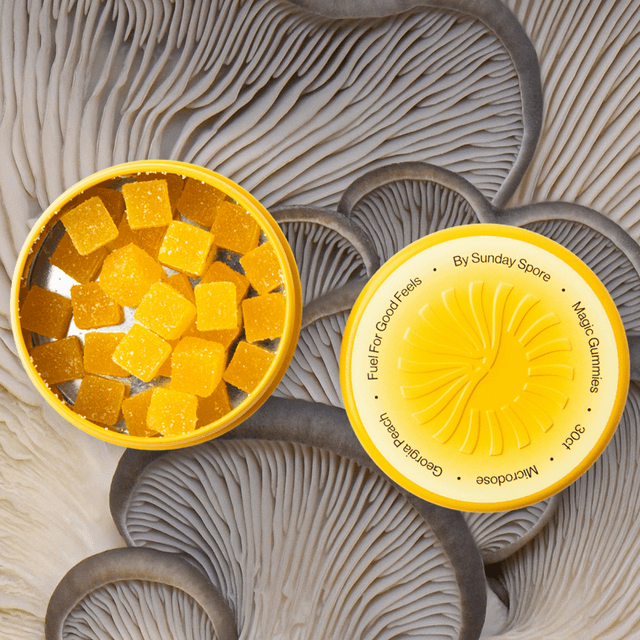
Precision Dosed
Every Sunday Spore gummy is lab-verified for precise, consistent dosing — no guessing, no scales, no batch variation. Just take one and go about your day.
If you're ready to start microdosing...
Sunday Spore Microdose — precision-dosed mushroom gummies. Lab-tested, exact dosing, ships discreetly.
Shelf Life and Storage
Dried mushrooms: 6-12 months if stored properly (airtight, with desiccant, away from light and heat). Powder form degrades faster than whole specimens. Blue bruising on whole mushrooms indicates psilocin oxidation is occurring.
Gummies: 6-12 months in original packaging. The gelatin or pectin matrix encapsulates the active compound, reducing exposure to oxygen. Less sensitive to light than dried mushrooms. No desiccant needed — just keep them cool and sealed.
Taste and Experience
Let's be honest: dried psilocybin mushrooms taste terrible. Earthy, bitter, with a texture like chewing on cardboard that got wet and then dried again. Most people either chase them with orange juice, stuff powder into capsules, or attempt various "lemon tek" preparations to mask the flavor.
Gummies taste like gummies. This might seem superficial, but unpleasant taste creates a psychological friction that compounds over time. When something tastes bad, your brain associates it with the routine, and it becomes one more thing you'd rather skip.
Discretion and Portability
Carrying dried mushrooms — even ground powder in capsules — is conspicuous. Unlabeled capsules invite questions. A bag of dried fungi is immediately recognizable.
Gummies look like gummies. They can be stored in any container, carried anywhere without drawing attention, and consumed without preparation or explanation. For people who microdose on work days (which is most microdosers), this practical discretion matters.
Cost Comparison
Dried mushrooms: Generally cheaper per dose, especially if you grow your own or buy in bulk. A standard microdose (100mg dried weight) costs fractions of a penny in raw material if home-grown, or roughly $0.50-$2.00 per dose from a supplier.
Gummies: Typically more expensive per dose — often $3-$8 per gummy depending on the producer and dosage. You're paying for the extraction, lab testing, manufacturing consistency, and convenience.
The cost premium for gummies is real. Whether it's worth it depends on how you value dosing precision, convenience, and protocol adherence. If inconsistent dried mushroom doses lead you to abandon your protocol at week three, the "cheaper" option didn't save you anything.
Quality Indicators: What to Look For
Not all gummies are created equal. If you're choosing this format, look for:
Lab testing. Reputable producers test their finished products for psilocybin content and provide that information. This is the single most important quality indicator. Without it, you're trusting their process on faith.
Consistent dosing claims. Look for specific milligram amounts, not vague descriptions. "One gummy = 100mg psilocybin mushroom equivalent" is better than "mild dose" or "one gummy."
Proper storage recommendations. Producers who care about their product specify storage conditions, expiration windows, and packaging that protects against degradation.
Ingredient transparency. You should know what's in the gummy besides the active ingredient. Quality producers use simple ingredients — gelatin or pectin, sugar or alternative sweetener, natural flavoring, and the active mushroom component.
Avoid "proprietary blends." If a producer won't tell you exactly what's in their product, that's a red flag. Microdosing requires knowing your dose. Mystifying the contents defeats the purpose.
The Bottom Line
If you're microdosing casually — trying it a few times to see what it's like, with no particular protocol or timeline — dried mushrooms work fine. Weigh them, eat them, see what happens.
But if you're approaching microdosing as a serious protocol — following Fadiman or Stamets scheduling, evaluating effects over 6-8 weeks, tracking outcomes in a journal, and trying to determine whether this actually works for you — then dosing consistency isn't optional. It's the most important variable you can control.
Gummies solve the consistency problem that dried mushrooms inherently can't. Same dose, every time, with zero preparation friction. For a practice that asks you to show up consistently for weeks, that reliability is the difference between a meaningful experiment and noise.
Sunday Spore gummies are built specifically for this use case — precise microdoses designed for protocol adherence, with lab-tested consistency and dosing you don't have to think about. Because the point isn't the format. The point is what consistent microdosing can do for your life.
Sources & References
- Gotvaldova, K. et al. (2022). Stability of psilocybin and its four analogs in the biomass of the psychotropic mushroom Psilocybe cubensis. Journal of Fungi, 8(4), 375.
- Tsujikawa, K. et al. (2003). Determination of psilocybin in hallucinogenic mushrooms by reversed-phase liquid chromatography with fluorescence detection. Journal of Chromatography A, 1007(1-2), 197-202.
- Fadiman, J. (2011). The Psychedelic Explorer's Guide: Safe, Therapeutic, and Sacred Journeys. Park Street Press.
Note: This article cites published research for educational context. Inclusion of a study does not imply endorsement of its conclusions or guarantee of similar outcomes.
Disclaimer
This content is for educational and informational purposes only. It is not medical advice and should not substitute professional medical guidance. Always consult a qualified healthcare provider. Psilocybin is a controlled substance in most jurisdictions — know your local laws. Individual results vary.
“Three weeks into a Monday/Wednesday/Friday protocol and the difference in my foc...” — Sarah
“Bought the Big Guys for a camping trip with friends. The dosing is spot-on — eve...” — Marcus
Ready to start microdosing?
Try the Sunday Spore Microdose
Precision-dosed magic mushroom gummies designed for your microdosing protocol. Lab-tested. Exact dosing. Everything you need to start.

FAQ
Frequently Asked Questions
How much do dried mushrooms vary in potency?
What about grinding and capsuling dried mushrooms?
Do gummies lose potency over time?
Written by
Alex Nakamura
Biochemistry degree. Translates complex mycology and pharmacology into accessible guides.