Key Takeaways
- 1DMT = 10-20 minutes of overwhelming intensity; psilocybin = 4-6 hours of scalable, controllable experience
- 2Psilocybin is dose-scalable (microdose to hero dose); DMT has a steep 'all-or-nothing' threshold
- 3DMT cannot practically be microdosed in smoked form; psilocybin is ideal for microdosing protocols
- 4For daily wellness, creativity, and gradual growth — mushrooms are the practical choice
Quick Answer
DMT and psilocybin are both tryptamine psychedelics but produce vastly different experiences. Smoked/vaped DMT produces an overwhelming 10-20 minute journey with complete reality dissolution — users report 'breakthrough' experiences involving entity contact and ego death. Psilocybin mushrooms produce a gentler, more gradual 4-6 hour experience that's scalable from sub-perceptual microdoses to deep journeys. For controllability, accessibility, microdosing potential, and integration into daily life, mushrooms are far more practical. DMT is better understood as an extreme tool for specific spiritual or therapeutic intentions, not a daily wellness practice.
Cousins, Not Twins
DMT and psilocybin are both tryptamines. They share a molecular backbone, they both occur in nature, and they both produce profound alterations in consciousness. Based on these similarities, it's natural to assume they're interchangeable — two flavors of the same thing.
They're not. The difference between smoking DMT and eating a mushroom is like the difference between being launched from a cannon and taking a long walk to the same destination. You might end up in similar territory, but the journey, the risks, and the practical applications are worlds apart.
This guide breaks down exactly where DMT and psilocybin mushrooms differ, why those differences matter, and which one is actually useful for different goals.
This article is for educational purposes only. It does not constitute medical advice. Both DMT and psilocybin are controlled substances in most jurisdictions. This comparison is provided for informational purposes to help readers understand the pharmacological and experiential differences between these compounds.
The Chemistry: So Close, So Different
The Shared Foundation
DMT (N,N-dimethyltryptamine) and psilocybin (4-phosphoryloxy-N,N-dimethyltryptamine) are structurally almost identical. Psilocybin is literally DMT with a phosphate group attached at the 4-position of the indole ring. In chemistry, this would be notated as 4-PO-DMT.
Both compounds primarily activate serotonin 5-HT2A receptors, which is why their effects share a family resemblance: visual enhancement, emotional intensity, shifts in self-perception, and the potential for mystical-type experiences.
The Phosphate Group Changes Everything
That one phosphate group — seemingly a minor molecular modification — creates dramatic practical differences:
Oral activity: DMT is rapidly broken down by monoamine oxidase (MAO) enzymes in the gut. Swallow pure DMT and nothing happens. Psilocybin's phosphate group protects it from this enzymatic breakdown, making it orally active. This is why you can eat a mushroom and feel its effects, but you need to smoke DMT (or combine it with MAO inhibitors, as in ayahuasca) to experience it.
Onset speed: Smoked DMT reaches the brain within seconds. Psilocybin, taken orally, takes 20-60 minutes to convert to psilocin and produce effects. This difference in onset is one of the most consequential practical distinctions between any two psychedelics.
Duration: Smoked DMT lasts 10-20 minutes. Psilocybin lasts 4-6 hours. Same molecular family, 15-20x difference in duration.
Dose-response curve: DMT has an extremely steep dose-response — a few milligrams can mean the difference between threshold effects and a full breakthrough. Psilocybin has a gradual, forgiving dose-response that allows fine-tuning from sub-perceptual microdoses all the way to profound mystical experiences.
The Experiences: Two Entirely Different Events
The DMT Breakthrough
A full-dose smoked DMT experience is, by virtually all accounts, the most intense altered state of consciousness available through any known substance. Within 10-30 seconds of inhalation, normal perception dissolves completely.
Users commonly report:
Complete reality replacement. Unlike mushrooms, where you can usually still see the room you're in, DMT at breakthrough doses replaces perceived reality entirely with a constructed visionary space — often described as hyper-dimensional, more "real" than reality, and impossible to adequately describe.
Entity contact. A remarkable percentage of DMT users report encounters with what feel like autonomous beings — described variously as jesters, elves, machine entities, geometric intelligences, or alien presences. A 2020 survey published in the Journal of Psychopharmacology by researchers at Johns Hopkins found that 72% of DMT users reported encountering such entities, and the majority described the experience as among the most meaningful of their lives.
Ego dissolution. The sense of being a separate self with a continuous personal history can dissolve completely. This can be profoundly liberating or profoundly terrifying, often both simultaneously.
Rapid return. By 10-20 minutes, the experience is over. By 30-45 minutes, you're essentially back to baseline. This rapid return is unique among psychedelics and creates its own set of challenges (discussed in the integration section below).
The Mushroom Journey
A full-dose psilocybin experience (2-5g of dried Psilocybe cubensis, or 15-30mg of pure psilocybin in clinical settings) unfolds gradually over 4-6 hours:
Onset (0-60 minutes): Subtle shifts in perception. Colors become more vivid, music sounds different, body sensations intensify. There's a gradual departure from ordinary consciousness that allows you to orient yourself.
Peak (1-3 hours): Visual distortions, emotional intensity, insights into personal patterns, potential mystical experiences. The room is still there, though it may look different. You maintain some degree of observer awareness throughout.
Integration (3-6 hours): Gradual return to baseline with lingering effects. Many people experience clarity, emotional tenderness, and contemplative openness during this phase. It's often where the most useful insights crystallize.
The key word is gradual. At every stage of a mushroom experience, you have time to adjust, breathe, and process. If things become intense, you can remind yourself that this will pass. You can talk to a sitter. You can change the music. You can open your eyes and see the real room.
DMT offers none of these safeguards. Within seconds, you're somewhere else entirely, and the only way out is through.
The Scalability Difference
This might be the single most important practical distinction between the two compounds:
Psilocybin scales across the entire spectrum of psychedelic experience:
| Dose | Experience | Practical Use |
|---|---|---|
| 25-50mg dried mushroom | Sub-perceptual (microdose) | Daily wellness, focus, creativity |
| 50-200mg | Low microdose to threshold | Subtle mood enhancement |
| 200-500mg | Museum dose | Mild perceptual enhancement, social |
| 0.5-2g | Moderate trip | Emotional processing, insights |
| 2-3.5g | Standard trip | Deep psychological work |
| 3.5-5g+ | Hero dose | Mystical/peak experiences |
Each level is accessible, distinguishable, and useful for different purposes. You can titrate your dose precisely to match your intention, setting, and comfort level.
DMT has essentially two settings: nothing and everything.
| Dose (smoked) | Experience |
|---|---|
| <15mg | Threshold — mild visuals, body sensations |
| 15-25mg | Sub-breakthrough — intense visuals but reality intact |
| 25-40mg+ | Full breakthrough — complete reality dissolution |
The jump from "interesting visual effects" to "total dissolution of perceived reality" can be just 5-10mg — a difference nearly impossible to control reliably with a pipe or vaporizer. There is no comfortable middle ground equivalent to a pleasant 1.5g mushroom experience.
Microdosing: Where Mushrooms Excel and DMT Falls Short
This is where the comparison becomes practically decisive for anyone interested in daily wellness applications.
Psilocybin is essentially ideal for microdosing:
- Orally active (no smoking apparatus needed)
- Gradual dose-response (easy to find the sub-perceptual sweet spot)
- Duration compatible with a normal day (4-6 hours, morning dosing works perfectly)
- Available in precisely dosed formats (gummies, capsules)
- Consistent effects at consistent doses
DMT is essentially impossible to microdose in smoked form:
- The dose-response curve is too steep — a few milligrams in either direction crosses the line between "nothing" and "visually impaired"
- The smoking/vaping process itself introduces inconsistency (how deep you inhale, how long you hold, how hot the vaporizer gets)
- Even if you could nail the dose, the onset is instantaneous — you go from sober to altered in seconds, which is incompatible with the "sub-perceptual throughout the day" goal of microdosing
- No pre-dosed commercial formats exist for smoked DMT
Some people have experimented with oral DMT microdosing — using very small amounts of ayahuasca or combining sub-threshold DMT with micro-amounts of MAO inhibitors. But this introduces the MAOI safety concerns (drug interactions, dietary restrictions) that make ayahuasca significantly more complicated than psilocybin. See our ayahuasca vs microdosing comparison for more on why this approach is problematic.
For anyone interested in integrating psychedelic practice into daily life, mushrooms aren't just the better choice — they're essentially the only viable choice between these two compounds.
Integration: Speed vs. Processability
The ability to integrate a psychedelic experience — to make sense of it, extract useful insights, and translate those insights into lasting behavioral change — depends heavily on how the experience unfolds.
DMT's Integration Challenge
DMT breakthroughs are famously difficult to integrate. The reasons are structural:
Speed: The experience happens so fast that there's no time for real-time processing. With mushrooms, you have hours to sit with an insight, turn it over, and begin to understand what it means. With DMT, you're given a firehose of information in minutes.
Ineffability: DMT experiences are consistently described as beyond the capacity of language. While mushroom experiences can also be hard to articulate, they typically occur within a framework of recognizable emotion and personal narrative. DMT experiences often don't — they take place in spaces and involve entities that have no reference point in ordinary experience.
Rapid return: You go from the most intense experience of your life to sitting on your couch in 15 minutes. The whiplash can be disorienting. Many DMT users describe a period of stunned silence afterward, struggling to reconcile what just happened with the mundane reality of their living room.
Memory fragmentation: The extreme intensity and speed of DMT can make it difficult to retain coherent memories of the experience. People often remember emotional tones and visual fragments but lose the narrative thread — making it hard to extract actionable insights.
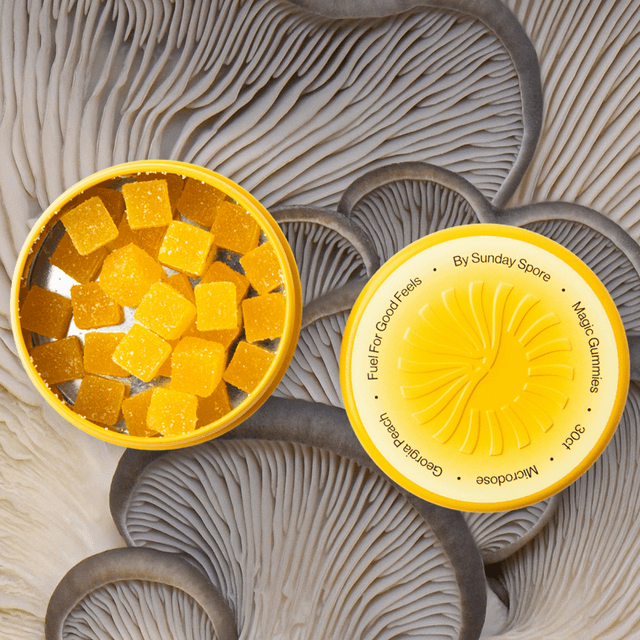
Precision Dosed
Every Sunday Spore gummy is lab-verified for precise, consistent dosing — no guessing, no scales, no batch variation. Just take one and go about your day.
If you're ready to start microdosing...
Sunday Spore Microdose — precision-dosed mushroom gummies. Lab-tested, exact dosing, ships discreetly.
Mushrooms: Built for Integration
Psilocybin experiences, by contrast, unfold at a pace that allows real-time processing:
- The gradual onset gives you time to settle in and establish a contemplative mindset
- Insights emerge over hours, not seconds, giving you time to examine them from multiple angles
- You can journal, talk to a sitter, or simply sit with a realization as it unfolds
- The 2-3 hour integration phase (as effects wane) is often the most productive period for meaning-making
- Memory retention is generally good — you can reconstruct the experience and its insights afterward
For anyone using psychedelics as tools for personal development rather than purely experiential exploration, this processability is a major advantage.
Safety Comparison
Physical Safety
Both compounds have excellent physical safety profiles in absolute terms:
- DMT: No known lethal dose. It's endogenously produced by the human body (the pineal gland, though the function is debated). The main physical risks come from the smoking apparatus (burns, inhalation of combustion byproducts) and from loss of motor control during the experience (dropping a hot pipe, falling).
- Psilocybin: No documented fatal overdose. Extremely wide therapeutic index. At microdose levels, physical effects are essentially nil.
Psychological Safety
This is where the distinction matters:
DMT's psychological risks are acute and immediate. A full breakthrough happens whether you're ready or not, and the intensity can be psychologically destabilizing for unprepared individuals. There's no way to "ease into" a DMT breakthrough the way you can start with a low mushroom dose.
Psilocybin's psychological risks are more gradual and manageable. You can start at microdose levels and incrementally increase over weeks or months, building comfort and familiarity with the compound's effects. If a mushroom dose feels too strong, you can use grounding techniques, change your environment, or simply wait — the intensity ebbs and flows over hours rather than holding at maximum for the entire duration.
For first-time psychedelic users, the safety advantage of psilocybin's gradual, scalable, controllable profile cannot be overstated.
Who Is Each Compound For?
DMT Might Be Right If You:
- Have significant psychedelic experience and specifically seek extreme states of consciousness
- Are interested in the "entity contact" or "breakthrough" phenomenon specifically
- Want a very short duration experience (can't commit hours)
- Have a specific spiritual or existential question you want to approach with maximum intensity
- Have a safe setting, a sitter, and psychological preparedness for ego dissolution
Psilocybin Mushrooms Are Right If You:
- Want a scalable tool that works across the full spectrum from microdose to deep journey
- Are interested in practical daily benefits (mood, creativity, focus, anxiety reduction)
- Value controllability and the ability to dose precisely
- Prefer a gradual, processable experience over an instantaneous overwhelming one
- Want to build a sustainable practice rather than have isolated peak experiences
- Are new to psychedelics and want to start gently
- Want something that integrates into daily life rather than interrupting it
For Most People, Most of the Time: Mushrooms
DMT is a fascinating compound with genuine therapeutic potential — ongoing research at Johns Hopkins, Imperial College, and other institutions is exploring its applications for depression, addiction, and existential distress. Extended-state DMT (continuous IV infusion) is being studied as a novel approach to psychedelic therapy.
But for the person reading this article — someone interested in practical psychedelic use for daily wellbeing — mushrooms are the answer. They're scalable, controllable, well-researched, increasingly accessible, and uniquely suited to the microdosing practice that makes psychedelics compatible with normal life.
The Practical Path Forward
If you've decided that mushrooms are your compound — and for the reasons above, most people do — the next step is simple: start a microdosing protocol with a reliable, consistent psilocybin source.
The consistency piece matters more than people realize. If you're trying to find your optimal sub-perceptual dose — that sweet spot where you notice subtle benefits without feeling altered — every variable needs to be controlled. A different potency every dose day means you're never actually running a clean experiment.
Sunday Spore Microdose gummies solve this by delivering a precise, consistent dose of psilocybin in every piece. No grinding, no scales, no potency lottery. The compound is standardized; the protocol is structured; the only variable is your brain's response over time.
DMT will always have its place as one of the most extraordinary experiences available to human consciousness. But for the daily practice of becoming a slightly better, calmer, more creative version of yourself — mushrooms are the tryptamine that was built for the job.
Sources & References
- Davis, A.K. et al. (2020). Survey of entity encounter experiences occasioned by inhaled N,N-dimethyltryptamine. Journal of Psychopharmacology, 34(9), 1008-1020.
- Strassman, R.J. (2001). DMT: The Spirit Molecule. Park Street Press.
- Nichols, D.E. (2016). Psychedelics. Pharmacological Reviews, 68(2), 264-355.
- Johns Hopkins Center for Psychedelic & Consciousness Research — ongoing research into DMT phenomenology and therapeutic applications.
- Imperial College London Centre for Psychedelic Research — extended-state DMT research program.
- Timmermann, C. et al. (2019). DMT Models the Near-Death Experience. Frontiers in Psychology, 10, 1424.
Note: This article cites published research for educational context. Inclusion of a study does not imply endorsement of its conclusions or guarantee of similar outcomes.
Disclaimer
This content is for educational and informational purposes only. It is not medical advice and should not substitute professional medical guidance. Always consult a qualified healthcare provider. Psilocybin is a controlled substance in most jurisdictions — know your local laws. Individual results vary.
“Three weeks into a Monday/Wednesday/Friday protocol and the difference in my foc...” — Sarah
“Bought the Big Guys for a camping trip with friends. The dosing is spot-on — eve...” — Marcus
Ready to start microdosing?
Try the Sunday Spore Microdose
Precision-dosed magic mushroom gummies designed for your microdosing protocol. Lab-tested. Exact dosing. Everything you need to start.
FAQ
Frequently Asked Questions
Is DMT dangerous?
Can you microdose DMT?
What's the relationship between DMT and psilocybin?
Written by
Alex Nakamura
Biochemistry degree. Translates complex mycology and pharmacology into accessible guides.