Key Takeaways
- 1Full-dose psilocybin shows 60-80% anxiety reduction in clinical cancer-anxiety studies
- 2Microdosing for anxiety requires starting lower than typical — 50mg or less to avoid triggering 'come-up anxiety'
- 3Some people experience increased anxiety on dose days initially — this usually resolves within 2 weeks
- 4The Fadiman protocol with longer rest days (1 on, 3 off) may work better for anxiety than standard 1-on-2-off
Quick Answer
Research on full-dose psilocybin shows significant anxiety reduction in clinical settings (NYU and Johns Hopkins cancer-anxiety studies showed 60-80% response rates). For microdosing specifically, evidence is mixed — some surveys report reduced anxiety while others note initial anxiety increases on dose days. The key for anxious individuals: start at a very low dose (50mg or less), use the Fadiman protocol with longer rest days if needed, dose in calm settings, and avoid combining with caffeine. Most anxiety-specific benefits emerge after 3-4 weeks of consistent practice.
Why Anxiety Requires a Different Approach
Anxiety is the number one reason people start microdosing. In the largest survey study to date — Vince Polito and Richard Stevenson's 2019 analysis of microdosers — anxiety reduction topped the list of reported benefits. Community forums overflow with testimonials about microdosing dissolving years of chronic worry.
But here's what those success stories often leave out: anxiety is also the most commonly reported side effect of microdosing, especially in the first two weeks.
This isn't a contradiction. It's a signal that anxiety requires a more thoughtful approach than other microdosing goals like creativity or focus. Get the protocol wrong, and you can temporarily make things worse. Get it right, and the research suggests genuine, lasting relief.
This guide covers what the science actually shows, why anxious brains need a specific protocol, and how to navigate the first few weeks without white-knuckling through unnecessary discomfort.
This article is for educational purposes only. It does not constitute medical advice. If you're experiencing severe anxiety, panic attacks, or anxiety that significantly impacts your daily functioning, please consult a mental health professional. Microdosing is not a substitute for professional treatment.
What the Research Shows
Full-Dose Psilocybin: Strong Evidence
The most robust evidence for psilocybin and anxiety comes from full-dose clinical studies, primarily in cancer patients experiencing existential distress:
Johns Hopkins (2016): Researchers led by Roland Griffiths administered a single high dose of psilocybin (22mg/70kg) to 51 cancer patients with life-threatening diagnoses. At 6-month follow-up, 83% showed clinically significant decreases in anxiety. At the 4.5-year follow-up published in 2020, approximately 60% of participants still met criteria for clinically significant anxiolytic response — from a single session.
NYU Langone (2016): Stephen Ross and colleagues found that a single psilocybin dose produced immediate and sustained anxiety reduction in cancer patients. Approximately 60-80% showed clinically significant improvement, with effects lasting at least 6 months.
Imperial College London (2023): The team led by Robin Carhart-Harris has been mapping psilocybin's effects on the brain's Default Mode Network — the neural circuitry that drives rumination and anxious future-thinking. Their imaging studies show that psilocybin temporarily disrupts the DMN's rigid patterns, allowing the brain to form new, less anxious patterns of self-referential thought.
Microdosing: Promising But More Complex
The microdosing-specific evidence is less clear-cut, and intellectual honesty requires acknowledging this.
Polito & Stevenson (2019): This prospective study tracked 98 microdosers over 6 weeks. Participants reported reduced anxiety and neuroticism over time, but the study lacked a placebo control — meaning expectation effects can't be ruled out.
Imperial College placebo-controlled study (2021): This innovative "self-blinding" study found that microdosers reported improvements in anxiety and wellbeing, but placebo capsules produced similar benefits. The researchers concluded that expectation plays a significant role in reported microdosing benefits. However, they noted that some individual responders showed clear differences between active and placebo conditions, suggesting the effect is real for a subset of people.
Beckley Foundation survey (2019): Analysis of over 1,000 microdosers found that anxiety reduction was the most commonly reported benefit, but approximately 18% reported increased anxiety, usually on dose days. This subset was more likely to be using higher doses.
University of British Columbia (2022): A large observational study comparing microdosers to non-microdosers found lower levels of anxiety, depression, and stress in the microdosing group, even after controlling for demographic variables. But again — observational, not experimental.
The Honest Summary
The full-dose evidence is genuinely compelling: psilocybin appears to produce real, lasting anxiety reduction through measurable changes in brain network connectivity. The microdosing evidence is suggestive but muddied by placebo effects, self-selection bias, and small sample sizes. The placebo effect is real, and some of what people attribute to microdosing may be ritual, intention-setting, and expectation.
That said, even the skeptical researchers acknowledge that a significant subset of individuals appear to genuinely benefit beyond placebo. The question is finding out whether you're in that subset — and the protocol you use matters enormously.
Why Anxious Brains React Differently
If you're microdosing for creativity or focus, a slightly-too-high dose means a pleasantly heightened afternoon. If you're microdosing for anxiety, a slightly-too-high dose can trigger a cascade of worry.
Here's why: psilocybin increases neural connectivity and sensory processing. For someone whose baseline state is calm, this increase feels like enhanced awareness and flow. For someone whose baseline includes hypervigilance, elevated threat detection, and ruminative loops, increased neural connectivity can initially amplify existing anxiety patterns before it begins to restructure them.
Think of it this way: psilocybin turns up the volume on whatever is playing. If anxiety is playing, it gets louder before the compound helps you change the channel.
This is why the standard microdosing advice — start at 100mg, follow the Fadiman protocol — isn't quite right for anxious individuals. You need a modified approach.
The Anxiety-Specific Protocol
Step 1: Start Lower Than You Think
The standard microdosing range is 50-200mg of dried psilocybin mushroom equivalent. For anxiety, start at the very bottom — or even below it.
Recommended starting dose: 30-50mg
This is lower than what most guides suggest, and that's intentional. At this level, you're unlikely to feel anything noticeable, which is exactly the point. You're giving your anxious brain time to adjust to the compound without triggering the hypervigilance response.
After one full cycle (7-10 days at this dose), if you've experienced no increased anxiety, you can consider moving to 75mg. Move up in 25mg increments, spending at least one full cycle at each level. Most anxious microdosers find their sweet spot between 50-100mg — lower than the general population's average.
Step 2: Use the Extended Fadiman Protocol
The standard Fadiman protocol is one day on, two days off. For anxiety, consider extending to one day on, three days off — at least for the first month.
The logic: anxious individuals sometimes experience mild residual effects on the day after dosing (day 2 in the standard protocol). The extra rest day ensures you're fully back to baseline before the next dose, reducing the cumulative "stacking" effect that can amplify anxiety.
Week 1-4 schedule (extended Fadiman):
- Monday: Dose day
- Tuesday-Thursday: Rest days
- Friday: Dose day
- Saturday-Monday: Rest days
After 4 weeks, if you're tolerating this well, you can experiment with the standard 1-on-2-off schedule.
Step 3: Control the Environment
On dose days, set yourself up for success:
- Morning dosing only — take your microdose within the first hour of waking, ideally with or after breakfast. An empty stomach can accelerate absorption and produce a sharper onset that triggers the "what was that?" anxiety response.
- Reduce or eliminate caffeine on dose days. This is possibly the single most important tip in this entire guide. Caffeine and psilocybin together can produce a jittery, buzzing sensation that anxious brains interpret as a threat. If you're a daily coffee drinker, switch to half-caf or tea on dose days.
- Avoid stacking with other stimulating supplements. Lion's mane, while commonly paired with psilocybin in the Stamets Stack, can increase anxiety in some people. If you're specifically microdosing for anxiety, try psilocybin alone first before adding anything else.
- Plan dose days for lower-stress activities. Don't take your microdose on the morning of a big presentation or difficult conversation. As you become more comfortable with your protocol, this becomes less important — but in the first month, remove unnecessary variables.
Step 4: Build the Container
This isn't woo. The context around your practice materially affects outcomes, and for anxious individuals, the container is everything.
Journaling: Spend 2 minutes each morning writing a brief intention — not for the microdose, but for your day. On dose days, add a note about how you're feeling at 1 hour, 3 hours, and evening. This creates data you can actually use.
Breathwork: Before taking your dose, do 3-5 minutes of slow breathing (4 counts in, 6 counts out). This activates the parasympathetic nervous system and sets a calm baseline. If anxiety emerges later in the day, return to this breath pattern.
Movement: Gentle exercise within the first 2 hours of dosing (walking, yoga, stretching) helps metabolize adrenaline and channels the increased energy productively. Avoid intense exercise until you know how your body responds.
What to Expect: The Week-by-Week Timeline
Week 1: The Calibration Phase
You probably won't feel much, and that's correct. At 30-50mg with the extended Fadiman protocol, you're only dosing twice this week. You might notice subtle shifts — slightly more vivid colors, a brief moment of spontaneous appreciation, marginally better sleep quality. Or you might notice nothing. Both are fine.
What to watch for: Any increase in anxiety on dose days. If present, reduce your dose by 10-15mg next cycle. If severe, take a week off and restart even lower, or consider that microdosing may not be your best approach.
Weeks 2-3: The Adjustment Phase
This is where most people either settle in or encounter the "come-up anxiety" that causes many anxious microdosers to quit prematurely. A mild increase in activation on dose days is normal and usually resolves by the end of week 3. If it's tolerable, stay the course.
You may start noticing small behavioral changes: slightly more willingness to engage socially, less catastrophizing about minor issues, a somewhat wider window between trigger and reaction. These changes are often more visible to people around you than to yourself.
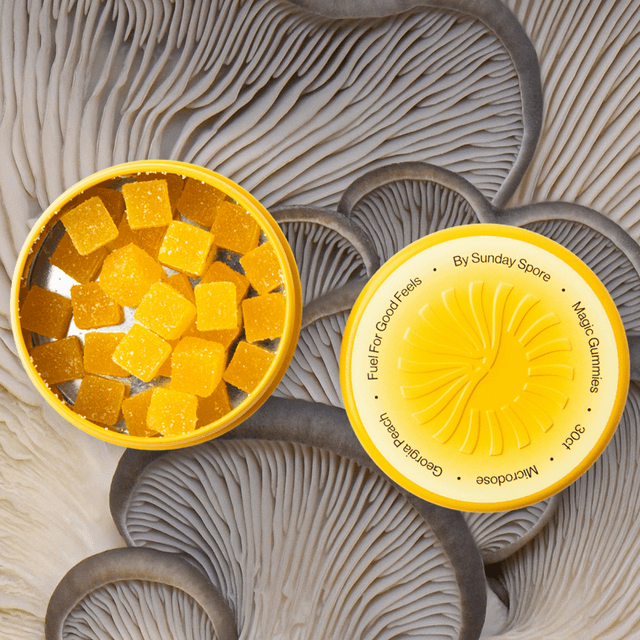
Precision Dosed
Every Sunday Spore gummy is lab-verified for precise, consistent dosing — no guessing, no scales, no batch variation. Just take one and go about your day.
If you're ready to start microdosing...
Sunday Spore Microdose — precision-dosed mushroom gummies. Lab-tested, exact dosing, ships discreetly.
Weeks 3-4: The Inflection Point
This is typically when anxiety-specific benefits begin to emerge. The mechanism isn't instant relief (that's more ketamine's profile) — it's a gradual widening of your window of tolerance. Things that would have sent you into a spiral start feeling more manageable. Not because you're numbed, but because your brain is building alternative response pathways.
Common reports at this stage: "I still felt the anxiety, but it didn't take over." "I noticed the worry thought and just... let it go." "My baseline nervousness dropped from a 6 to a 3."
Weeks 4-6: The Integration Phase
By now, you should have a clear sense of whether microdosing is working for your anxiety. The benefits should be apparent not just on dose days but on off days too — this is the crucial marker. If you only feel better on dose days, the effect may be more pharmacological than neuroplastic, and you might benefit from adjusting your protocol.
This is also when to consider whether you want to continue, cycle off for a few weeks to assess your baseline, or adjust your dose upward.
When to Stop: Recognizing Red Flags
Microdosing is not for everyone, and intellectual honesty means acknowledging when it's not working. Stop your protocol and consult a healthcare provider if:
- Anxiety consistently worsens across multiple cycles, even at the lowest dose
- Panic attacks increase in frequency or intensity
- Depersonalization or derealization occurs (feeling detached from yourself or that things aren't real)
- Sleep is significantly disrupted beyond the first week
- You feel compelled to increase your dose to achieve the desired effect (this shouldn't happen at microdose levels, and if it does, something else may be going on)
- Intrusive thoughts increase in a way that feels unmanageable
These aren't signs of failure. They're signs that your particular brain chemistry may respond better to other approaches — whether that's full-dose therapeutic psilocybin in a clinical setting, other therapeutic modalities, or medication.
The Medication Question
Let's address this directly, because if you're reading this article, there's a decent chance you're currently on anxiety medication or considering it.
SSRIs (Lexapro, Zoloft, Prozac, etc.): These work on the serotonin system, and there's a pharmacological interaction with psilocybin. SSRIs can significantly blunt psilocybin's effects, and combining them without guidance isn't recommended. If you're on an SSRI and want to explore microdosing, work with your prescriber to develop a plan. Do not abruptly stop your SSRI — the discontinuation effects can be severe.
Benzodiazepines (Xanax, Klonopin, Ativan): These do not have a direct pharmacological interaction with psilocybin, but they work on GABA receptors that may modulate psilocybin's effects. More importantly, benzodiazepine dependence is a serious medical condition, and abrupt discontinuation can be life-threatening. Never alter your benzo regimen without medical supervision.
Buspirone: Limited data, but it's a partial 5-HT1A agonist that could theoretically interact. Proceed with caution and medical guidance.
The bottom line: if medication is currently managing your anxiety, microdosing is not a reason to stop it. Some people eventually find they can taper under medical supervision as their microdosing practice takes effect — but that's a conversation with your doctor, not a decision to make from an internet article.
Building a Sustainable Anxiety Practice
The goal of microdosing for anxiety isn't to take a substance forever. It's to use a period of enhanced neuroplasticity to build new patterns that persist after you stop.
This means the practices you pair with your microdosing matter as much as the compound itself:
- Therapy or self-guided CBT during your microdosing period can be especially effective. The neural flexibility that psilocybin promotes may make cognitive restructuring stick better.
- Regular exercise amplifies the neuroplastic effects. Even 20 minutes of walking on dose days compounds over time.
- Social connection — anxiety tends to drive isolation, and microdosing often reduces social friction. Lean into this. Accept the invitation. Make the phone call.
- Mindfulness practice — even 5 minutes of meditation on rest days helps consolidate the perspective shifts that occur on dose days.
Choosing a Consistent Format
If you decide to try microdosing for anxiety, the format of your psilocybin matters more than you might think — and for anxious people, it matters a lot.
Dried mushrooms vary enormously in potency. A 50mg capsule from one batch might be equivalent to 100mg from another. For someone microdosing for focus, this inconsistency is a minor annoyance. For someone microdosing for anxiety, an unexpectedly strong dose on the wrong day can set back your entire protocol.
This is why pre-dosed formats matter. Sunday Spore gummies are formulated with a consistent, precise dose in every piece — so the 50mg you take on Monday is the same 50mg you take on Friday. When you're trying to calibrate a protocol for an anxious brain, that consistency isn't a luxury. It's the foundation that makes the whole practice workable.
Whatever format you choose, make sure you can trust the dosing. Anxiety and uncertainty are a terrible combination — and the last thing you want is uncertainty about what you're taking.
Sources & References
- Griffiths, R.R. et al. (2016). Psilocybin produces substantial and sustained decreases in depression and anxiety in patients with life-threatening cancer. Journal of Psychopharmacology, 30(12), 1181-1197.
- Ross, S. et al. (2016). Rapid and sustained symptom reduction following psilocybin treatment for anxiety and depression in patients with life-threatening cancer. Journal of Psychopharmacology, 30(12), 1165-1180.
- Polito, V. & Stevenson, R.J. (2019). A systematic study of microdosing psychedelics. PLOS ONE, 14(2), e0211023.
- Szigeti, B. et al. (2021). Self-blinding citizen science to explore psychedelic microdosing. eLife, 10, e62878.
- Carhart-Harris, R.L. et al. (2023). — Imperial College London — research on psilocybin and default mode network disruption in anxiety and rumination.
- Beckley Foundation (2019). Survey analysis of microdosing experiences among 1,000+ users.
- University of British Columbia (2022). Large observational study comparing microdosers to non-microdosers on mental health outcomes.
- Johns Hopkins Center for Psychedelic & Consciousness Research — cancer-anxiety psilocybin trials and long-term follow-up data.
Note: This article cites published research for educational context. Inclusion of a study does not imply endorsement of its conclusions or guarantee of similar outcomes.
Disclaimer
This content is for educational and informational purposes only. It is not medical advice and should not substitute professional medical guidance. Always consult a qualified healthcare provider. Psilocybin is a controlled substance in most jurisdictions — know your local laws. Individual results vary.
“Three weeks into a Monday/Wednesday/Friday protocol and the difference in my foc...” — Sarah
“Bought the Big Guys for a camping trip with friends. The dosing is spot-on — eve...” — Marcus
Ready to start microdosing?
Try the Sunday Spore Microdose
Precision-dosed magic mushroom gummies designed for your microdosing protocol. Lab-tested. Exact dosing. Everything you need to start.

FAQ
Frequently Asked Questions
Can microdosing make anxiety worse?
Should I stop my anxiety medication to microdose?
What's the best time of day to microdose for anxiety?
Written by
Alex Nakamura
Biochemistry degree. Translates complex mycology and pharmacology into accessible guides.