Key Takeaways
- 1SSRIs have 40+ years of clinical data; microdosing psilocybin has almost none from controlled trials
- 2Different mechanisms: SSRIs increase serotonin availability, psilocybin increases neuroplasticity
- 3Full-dose psilocybin therapy shows promise for treatment-resistant depression (Imperial College, Johns Hopkins)
- 4Never stop antidepressants abruptly — SSRI discontinuation syndrome is real and dangerous
Quick Answer
Microdosing psilocybin and traditional antidepressants work through fundamentally different mechanisms. SSRIs increase serotonin availability and have decades of clinical evidence but come with side effects like emotional blunting and sexual dysfunction. Psilocybin appears to increase neuroplasticity and reset default mode network activity — but microdosing specifically has limited clinical evidence. Neither is universally 'better.' The right choice depends on severity, individual response, and medical guidance.
A Necessary Preface
This article is not going to tell you to stop taking your antidepressants. That would be irresponsible, potentially dangerous, and frankly, exactly the kind of oversimplification that poisons the psychedelic conversation.
SSRIs and other antidepressants have saved lives. They continue to save lives every day. For many people, they're the difference between functioning and not functioning, between being here and not being here. Any comparison that ignores this fundamental reality isn't honest — it's propaganda.
At the same time, a growing number of people on antidepressants report significant side effects and wonder whether alternatives exist. That's a legitimate question that deserves a legitimate answer, not dismissal from one side or hype from the other.
So here's the honest comparison. Both approaches have strengths. Both have real limitations. The right choice is individual, and it's not yours to make from a blog post — it's yours to make with your healthcare provider, armed with accurate information.
This article is for educational purposes only. It does not constitute medical advice. Depression is a serious medical condition. Never discontinue prescribed medication without medical supervision. SSRI withdrawal can be dangerous and must be managed by a healthcare professional. Psilocybin remains a controlled substance in most jurisdictions.
How They Work: Two Fundamentally Different Approaches
SSRIs: Increasing Serotonin Availability
Selective serotonin reuptake inhibitors — fluoxetine (Prozac), sertraline (Zoloft), escitalopram (Lexapro), and others — work by blocking the reabsorption of serotonin in the brain. This leaves more serotonin floating around in the synaptic cleft, available to bind to receptors.
The serotonin hypothesis of depression (that depression is caused by low serotonin) is actually more complicated than the popular understanding suggests. A 2022 meta-analysis by Moncrieff et al. in Molecular Psychiatry found no convincing evidence that depression is caused by low serotonin levels. Yet SSRIs still work for many people — likely through downstream effects on neuroplasticity, inflammation, and stress response rather than simply "correcting" a serotonin deficit.
SSRIs typically take 4-6 weeks to reach full therapeutic effect. They must be taken daily. They change your baseline neurochemistry for as long as you take them, and discontinuation requires careful tapering.
Psilocybin: Neuroplasticity and Network Reset
Psilocybin works through a completely different mechanism. When you ingest psilocybin, your body converts it to psilocin, which binds primarily to 5-HT2A serotonin receptors — a different receptor subtype than what SSRIs primarily affect.
This binding triggers a cascade of effects: increased neural connectivity between brain regions that don't normally communicate, reduced activity in the default mode network (the brain's "autopilot" associated with rumination and self-referential thinking), and increased expression of brain-derived neurotrophic factor (BDNF) — essentially fertilizer for new neural connections.
The research from Imperial College London's Centre for Psychedelic Research and Johns Hopkins' Center for Psychedelic and Consciousness Research has shown that full-dose psilocybin can produce rapid, sustained antidepressant effects. Carhart-Harris et al. (2021) published a head-to-head comparison with escitalopram in the New England Journal of Medicine, finding comparable antidepressant effects over six weeks — with psilocybin performing better on secondary measures of well-being and emotional responsiveness.
But that was full-dose psilocybin therapy, with professional support, preparation sessions, and integration work. Microdosing is a different proposition entirely, and the clinical evidence specifically for microdosing and depression is substantially weaker.
The Evidence Gap: What We Know and Don't Know
Strong Evidence (Full-Dose Psilocybin Therapy)
- Carhart-Harris et al. (2021): Psilocybin vs. escitalopram for depression. Both produced comparable improvement, but psilocybin showed advantages in emotional responsiveness and social functioning.
- Davis et al. (2021), Johns Hopkins: A randomized clinical trial showing psilocybin therapy produced large, rapid, and sustained antidepressant effects in major depressive disorder. 71% of participants showed clinically significant response at four weeks.
- Goodwin et al. (2022): A phase IIb trial published in NEJM for treatment-resistant depression showing significant improvement with a single 25mg psilocybin dose.
Weak Evidence (Microdosing Specifically)
- Szigeti et al. (2021), eLife: The self-blinding study found improvements in both microdose and placebo groups with no significant difference between them.
- Polito & Stevenson (2019): An open-label observational study found microdosers reported decreased depression and stress over six weeks, but without a control group, placebo effects can't be excluded.
- Various surveys (Fadiman & Korb, Anderson et al. 2019) show self-reported improvements in mood, but surveys inherently attract positive responders and can't establish causation.
The honest summary: there's strong evidence that psilocybin does something meaningful for depression at full therapeutic doses. The evidence that microdoses produce antidepressant effects beyond placebo is genuinely unclear.
Side Effect Profiles: What You're Actually Signing Up For
SSRI Side Effects
These are well-documented from decades of clinical use:
- Sexual dysfunction in 30-70% of users — reduced libido, difficulty achieving orgasm, erectile dysfunction. Often cited as the primary reason for discontinuation
- Emotional blunting — a commonly reported feeling of being "flat," where both negative and positive emotions are dampened. You might not feel as depressed, but you also don't feel as much of anything
- Weight gain — particularly common with paroxetine and mirtazapine, but reported across SSRI classes
- Sleep disruption — insomnia or excessive drowsiness depending on the specific medication
- GI issues — nausea, especially in the first weeks
- Discontinuation syndrome — this deserves its own section (see below)
Reported Microdosing Side Effects
These are from community reports and surveys, not clinical monitoring:
- Occasional anxiety or restlessness on dose days, particularly at higher microdose ranges
- Mild nausea — typically brief, more common on an empty stomach
- Increased emotional sensitivity — experiencing feelings more vividly, which some find beneficial and others find overwhelming
- Disrupted sleep if dosed too late in the day
- Headaches reported by a small minority
What microdosing does not appear to produce: physical dependency, weight changes, sexual dysfunction, or emotional blunting. However, the critical caveat is that long-term safety data simply doesn't exist. SSRIs have been studied in millions of patients over four decades. Microdosing has been studied in hundreds of people over a few years. The absence of known long-term side effects is not evidence that there are none.
The Discontinuation Problem
This is where the comparison gets most uncomfortable, and where intellectual honesty requires acknowledging a real failing of the current psychiatric model.
SSRI discontinuation syndrome affects an estimated 56% of people who stop taking antidepressants (Davies & Read, 2019). Symptoms include electrical "brain zaps," flu-like feelings, insomnia, mood instability, dizziness, and irritability. In some cases, discontinuation effects can last weeks or months. For some people, it takes a year or more to fully taper off SSRIs — and some find the withdrawal symptoms so severe that they continue taking the medication indefinitely.
This is not a reason to never start SSRIs. It is a reason to understand what you're committing to before you begin, and to ensure that any tapering plan is supervised by a medical professional who takes discontinuation syndrome seriously.
Psilocybin does not produce physical dependence. There is no withdrawal syndrome. You can stop microdosing at any time without physiological consequences. This is a genuine advantage — but it needs to be weighed against the vastly stronger evidence base for SSRIs actually working.
What "Treatment-Resistant Depression" Means
You'll see this term throughout psychedelic research. Treatment-resistant depression (TRD) is defined as depression that hasn't responded adequately to two or more adequate trials of antidepressant medication. It affects roughly 30% of people with major depressive disorder — a staggering number of people for whom the standard approach isn't working.
This is the population where psychedelic research is most compelling. For people who have tried multiple antidepressants without adequate response, the full-dose psilocybin therapy data represents a genuine new option (where legally available). Microdosing may also hold promise for this group, though the evidence is weaker.
If your current antidepressant is working well for you — if you feel like yourself, if the side effects are manageable, if your depression is in remission — the case for switching to microdosing is weak. You have something that works. The grass is not necessarily greener.
Critical Safety Information
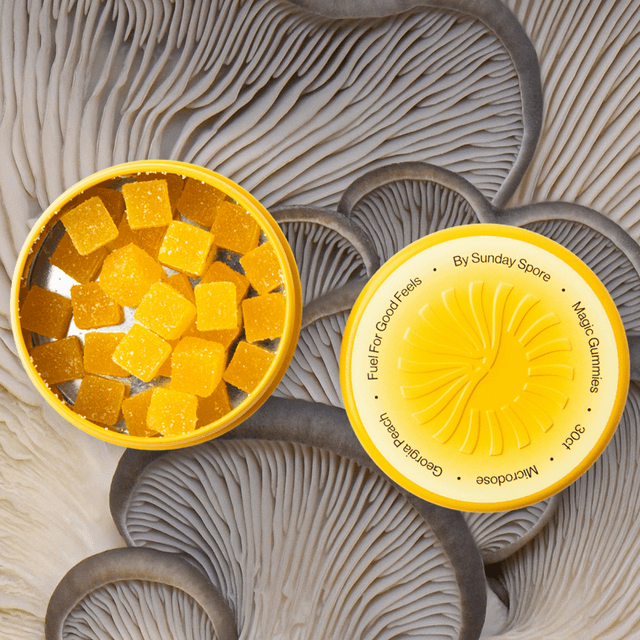
Precision Dosed
Every Sunday Spore gummy is lab-verified for precise, consistent dosing — no guessing, no scales, no batch variation. Just take one and go about your day.
If you're ready to start microdosing...
Sunday Spore Microdose — precision-dosed mushroom gummies. Lab-tested, exact dosing, ships discreetly.
Never Stop Antidepressants Abruptly
This bears repeating in bold: do not stop taking your antidepressants without medical supervision, full stop. SSRI discontinuation syndrome can be severe. The correct approach is a slow taper under professional guidance, typically reducing dose by 10% every 2-4 weeks. Some people need even slower tapers.
Stories of people flushing their Zoloft and starting microdosing the next day are genuinely dangerous to share without context. Some of those people may have done fine. Some may have experienced dangerous withdrawal. Survivorship bias makes the success stories louder than the cautionary ones.
Serotonin Interactions
Psilocybin and SSRIs both act on the serotonin system, though on different receptors. Combining them generally results in SSRIs blunting or blocking the psilocybin effects — most people on SSRIs report that microdosing simply doesn't work while they're taking their medication.
In rare cases, there's theoretical risk of serotonin syndrome (a potentially dangerous condition caused by excessive serotonin activity). While documented cases from this specific combination are extremely rare, the risk exists and should be taken seriously. MAOIs (a different class of antidepressant) pose a more significant interaction risk with psilocybin.
Severity Matters
Mild to moderate depression and severe depression are different animals. For severe depression — especially with suicidal ideation — the established evidence base for SSRIs (and other interventions like ketamine for acute suicidality) makes them the responsible first line of treatment. Experimenting with microdosing while in a severe depressive episode, without professional support, is genuinely risky.
A Balanced View: Who Might Consider What
SSRIs might be the better fit if you:
- Are experiencing severe or acute depression
- Have suicidal ideation (seek immediate help)
- Want the strongest evidence base behind your treatment
- Prefer a well-understood, regulated, and legal treatment
- Have consistent access to psychiatric care for monitoring
Exploring microdosing might make sense if you:
- Have mild to moderate depression that hasn't responded to multiple medications
- Experience intolerable SSRI side effects (particularly sexual dysfunction or emotional blunting)
- Are already stable and looking for adjunctive support (not a replacement)
- Have access to medical guidance for your exploration
- Understand and accept the limited clinical evidence
Both approaches benefit from:
- Therapy (cognitive-behavioral, psychodynamic, or other modalities)
- Lifestyle foundations (sleep, exercise, social connection, nutrition)
- Regular monitoring and honest self-assessment
- Professional guidance from someone who takes you seriously
If You Decide to Explore Microdosing
For those who've weighed the evidence, consulted with their healthcare provider, and decided that microdosing is worth exploring — whether alongside, after transitioning from, or independent of antidepressant medication — the practical reality comes down to consistency.
Depression protocols require reliable, sustained input. This is actually one thing SSRIs get right: you take the same pill at the same dose every day. There's no variability. The pharmacological input is controlled.
If you're going to give microdosing a fair trial for mood support, you need that same consistency. A precise dose, on a reliable schedule, for a minimum evaluation period. The Fadiman protocol (one day on, two off) is the most commonly used schedule for mood, with most people evaluating results after 6-8 weeks.
Pre-dosed gummies provide the consistency that a fair trial requires — same amount every dose day, no batch variability, no measuring. If you're coming from the precision of pharmaceutical dosing, this matters more than you might think.
The Bottom Line
This isn't a competition with a clear winner. SSRIs have an enormous evidence base, established safety monitoring, and legal accessibility. Psilocybin — particularly at full therapeutic doses — shows remarkable promise for treatment-resistant depression, but microdosing specifically has limited and mixed evidence.
What's clear is that the current system isn't working for everyone. Side effects are real, discontinuation is harder than advertised, and a significant minority of depressed people don't respond to available medications. Psychedelic research is opening new possibilities, and intellectual honesty requires taking that seriously while also acknowledging what we don't yet know.
The best decision is an informed one, made with professional support, based on your specific situation — not based on Reddit enthusiasm or pharmaceutical marketing. You deserve both the best established treatment and honest information about emerging alternatives.
Sources & References
- Moncrieff, J. et al. (2022). The serotonin theory of depression: a systematic umbrella review of the evidence. Molecular Psychiatry, 27, 3243-3256.
- Carhart-Harris, R.L. et al. (2021). Trial of Psilocybin versus Escitalopram for Depression. New England Journal of Medicine, 384(15), 1402-1411.
- Davis, A.K. et al. (2021). Effects of Psilocybin-Assisted Therapy on Major Depressive Disorder: A Randomized Clinical Trial. JAMA Psychiatry, 78(5), 481-489.
- Goodwin, G.M. et al. (2022). Single-Dose Psilocybin for a Treatment-Resistant Episode of Major Depression. New England Journal of Medicine, 387(18), 1637-1648.
- Szigeti, B. et al. (2021). Self-blinding citizen science to explore psychedelic microdosing. eLife, 10, e62878.
- Polito, V. & Stevenson, R.J. (2019). A systematic study of microdosing psychedelics. PLOS ONE, 14(2), e0211023.
- Anderson, T. et al. (2019). Microdosing psychedelics: personality, mental health, and creativity differences in microdosers. Psychopharmacology, 236(2), 731-740.
- Davies, J. & Read, J. (2019). A systematic review into the incidence, severity and duration of antidepressant withdrawal effects. Addictive Behaviors, 97, 111-121.
- Johns Hopkins Center for Psychedelic & Consciousness Research — clinical trials on psilocybin for major depressive disorder.
- Imperial College London Centre for Psychedelic Research — neuroimaging and clinical studies on psilocybin and depression.
Note: This article cites published research for educational context. Inclusion of a study does not imply endorsement of its conclusions or guarantee of similar outcomes.
Disclaimer
This content is for educational and informational purposes only. It is not medical advice and should not substitute professional medical guidance. Always consult a qualified healthcare provider. Psilocybin is a controlled substance in most jurisdictions — know your local laws. Individual results vary.
“Three weeks into a Monday/Wednesday/Friday protocol and the difference in my foc...” — Sarah
“Bought the Big Guys for a camping trip with friends. The dosing is spot-on — eve...” — Marcus
Ready to start microdosing?
Try the Sunday Spore Microdose
Precision-dosed magic mushroom gummies designed for your microdosing protocol. Lab-tested. Exact dosing. Everything you need to start.

FAQ
Frequently Asked Questions
Can I microdose while taking antidepressants?
Is there clinical evidence that microdosing works for depression?
What are the main side effects compared?
Written by
Alex Nakamura
Biochemistry degree. Translates complex mycology and pharmacology into accessible guides.