Key Takeaways
- 1Chaga has one of the highest antioxidant scores of any natural substance, with an ORAC value exceeding 100,000
- 2Take 500-1000mg daily as a background protective layer for cellular health and immune support
- 3Wild-harvested, birch-grown chaga is dramatically more potent than cultivated chaga due to betulinic acid content
- 4Chaga's melanin compounds provide broad-spectrum free radical protection unlike any other functional mushroom
Quick Answer
Chaga mushroom gummies deliver potent antioxidant and immune-modulating support through melanin compounds, superoxide dismutase (SOD), betulinic acid, and beta-glucan polysaccharides. With one of the highest ORAC (antioxidant capacity) scores of any natural substance, chaga neutralizes free radicals while its beta-glucans calibrate immune function. A daily dose of 500-1000mg of wild-harvested, hot water-extracted chaga provides foundational cellular protection and long-term immune resilience.
The Mushroom Nobody Notices (Until They Need It)
Lion's mane gets the headlines. Cordyceps gets the gym crowd excited. Reishi gets credit for better sleep. Chaga? Chaga doesn't have a flashy selling point. You won't feel it kick in. You won't have a eureka moment on day four.
But if you're building a functional mushroom routine designed to last - something you run for months or years - chaga is the mushroom quietly keeping the foundation solid.
Here's what most people don't think about when they take supplements: your body is constantly managing oxidative stress. Every metabolic process, every workout, every late night, every stressful meeting generates free radicals - reactive molecules that damage cells when they accumulate unchecked. Your body has built-in defenses, but modern life outpaces them.
Chaga is the most powerful natural antioxidant ever measured. Its ORAC score dwarfs every superfood you've ever heard of. And its immune-modulating beta-glucans keep your defenses calibrated without overstimulating them [1], [2].
If you're already taking lion's mane for focus or cordyceps for energy, chaga is the protective foundation that keeps your body running clean underneath those benefits.
What Makes Chaga Special: The Antioxidant Arsenal
ORAC Score and What It Means
Chaga (Inonotus obliquus) scored over 100,000 on the ORAC scale - the standard measurement for antioxidant capacity. For perspective, blueberries score around 4,600. Acai berries around 15,000. Chaga isn't in a different league. It's playing a different sport.
This score reflects chaga's ability to neutralize free radicals across a broad spectrum [3], [4], [5]. Most antioxidant-rich foods contain one or two key compounds. Chaga contains four distinct antioxidant systems working simultaneously [6].
Melanin: The Broad-Spectrum Shield
The dark pigment in chaga's exterior is a potent, broad-spectrum free radical scavenger [7]. Unlike vitamin C (which targets specific radicals), melanin absorbs a wide range of reactive oxygen species. It's the antioxidant equivalent of a full-spectrum shield rather than a targeted weapon.
Chaga's melanin concentration is unique among functional mushrooms - no other commonly supplemented species produces melanin at comparable levels. This is why the black exterior sclerotium is the most valuable part of the chaga conk [8].
Superoxide Dismutase (SOD)
SOD is an enzyme that neutralizes superoxide radicals - among the most damaging free radicals your body produces [6]. Chaga contains one of the highest natural concentrations of SOD. This enzyme is your body's own first-line antioxidant defense, and supplementing it with chaga supports cellular protection at a foundational level [9].
SOD activity declines with age [10]. Chaga supplementation helps compensate for that decline [9], which is one reason chaga has been valued in traditional longevity practices across Northern Europe and Russia for centuries [11].
Betulinic Acid: The Anti-Inflammatory Compound
Betulinic acid is absorbed from the birch trees that chaga grows on [8]. This triterpene reduces NF-kB activation - one of the master switches for inflammatory pathways [12]. Chronic low-grade inflammation amplifies oxidative damage and suppresses immune function. Betulinic acid interrupts the cycle.
This compound is also why wild-harvested birch-grown chaga is non-negotiable. Cultivated chaga never contacts birch bark, which means no betulin absorption and no betulinic acid conversion [8].
Polyphenols
Chaga's polyphenol content provides targeted free radical quenching that complements the broader mechanisms above [13], [3]. These compounds work synergistically with melanin and SOD to create layered antioxidant protection.
How Chaga Supports Immune Function
Beta-Glucan Immune Modulation
Chaga's beta-glucan polysaccharides support immune function through modulation, not simple stimulation. This distinction matters:
- Macrophage activation - your immune system's first responders become more effective at identifying and clearing threats [14], [1]
- Natural killer (NK) cell production - the specialized cells that target compromised cells maintain higher activity levels
- Cytokine balance - inflammatory signaling stays regulated rather than swinging between suppressed and overactive [1], [2]
- Gut microbiome support - chaga's polysaccharides act as prebiotics, feeding the beneficial bacteria that house much of your immune infrastructure [15], [7]
The key word is modulation. Chaga doesn't just crank up immune activity (which would be problematic for anyone with autoimmune tendencies). It helps calibrate the response - upregulating when defenses are low, maintaining balance when function is normal [2].
The Inflammation-Immunity Connection
Chronic low-grade inflammation is one of the biggest obstacles to healthy immune function. When inflammatory markers run high for extended periods, the immune system becomes dysregulated - overreacting to minor threats while underperforming against real ones.
Chaga's betulinic acid and polyphenol compounds address this directly [12], [6]. By reducing background inflammation, chaga creates a cleaner operating environment for immune cells to function in. This is why consistent chaga use over months tends to correlate with fewer minor illnesses and faster recovery - the immune system is operating in better conditions.
Neuroinflammation and Brain Health
Chaga's anti-inflammatory compounds cross the blood-brain barrier and reduce neuroinflammation directly. Chronic neuroinflammation interferes with cognitive function, suppresses BDNF production, and reduces synaptic flexibility [16].
If you're taking lion's mane for cognitive benefits, chaga complements that by keeping the neural environment clean - reducing the inflammatory background noise that can dampen lion's mane's neurotrophin effects.
Wild-Harvested vs. Cultivated: Why It Matters
This is the most critical quality factor for chaga specifically, and the difference is dramatic.
Wild-Harvested Birch-Grown Chaga
Wild chaga grows on living birch trees over 3-5 years. During that time, it absorbs betulin from the birch bark and converts it to betulinic acid. The harsh environmental conditions (chaga thrives in cold climates - Siberia, Scandinavia, Northern Canada) trigger the production of melanin and other protective compounds at high concentrations.
Wild-harvested chaga contains the full compound profile: melanin, SOD, betulinic acid, beta-glucans, and polyphenols [8], [6]. This is the chaga that traditional medicine has valued for centuries, and it's the form that matches the research.
Cultivated Chaga
Cultivated chaga is grown on grain substrates in controlled environments. It never contacts birch trees, which means:
- No betulinic acid - the anti-inflammatory triterpene requires birch bark absorption [8]
- Significantly lower melanin - the environmental stressors that trigger melanin production are absent [8]
- Reduced SOD activity - enzyme production is linked to environmental challenge
- Diluted beta-glucans - grain substrate starch inflates weight without adding active compounds [8]
If the label doesn't specify wild-harvested birch-grown chaga, assume it's cultivated and dramatically less potent.
How to Take Chaga Mushroom Gummies
Daily Dosing
- Standard dose: 500-1000mg daily
- Timing: Morning, alongside other functional mushrooms
- Consistency: Daily use for a minimum of 4-8 weeks before evaluating
- Character: Non-stimulating, non-sedating, timing-flexible
Chaga is the easiest functional mushroom to incorporate because it has no noticeable acute effects. It doesn't energize you (that's cordyceps), it doesn't calm you (that's reishi), and it doesn't sharpen your focus (that's lion's mane). It works silently in the background.
Basic Functional Mushroom Stack
Morning:
- Chaga: 500-1000mg (antioxidant and immune foundation)
- Lion's mane: 500-1000mg (cognitive support)
- Cordyceps: 500-1000mg (energy and endurance)
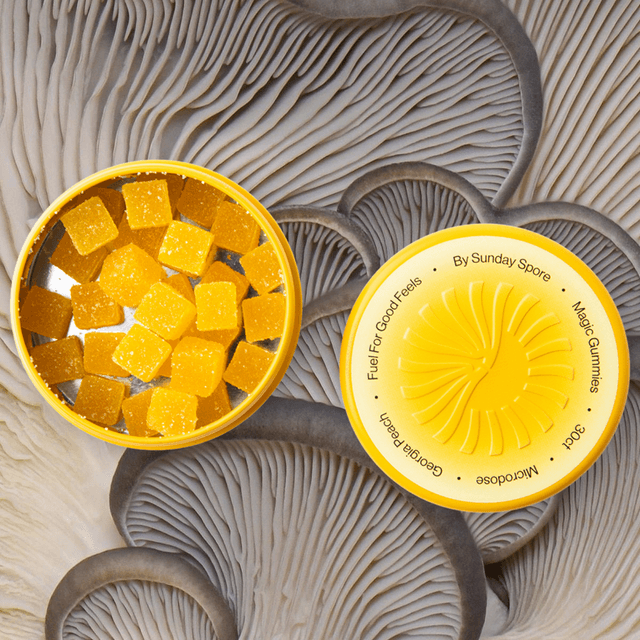
Precision Dosed
Every Sunday Spore gummy is lab-verified for precise, consistent dosing — no guessing, no scales, no batch variation. Just take one and go about your day.
If you're ready to start microdosing...
Sunday Spore Microdose — precision-dosed mushroom gummies. Lab-tested, exact dosing, ships discreetly.
Full Functional Mushroom Stack
Morning:
- Chaga: 500-1000mg (antioxidant protection)
- Lion's mane: 500-1000mg (focus and NGF)
- Cordyceps: 500-1000mg (energy)
- Turkey tail: 1000-1500mg (gut health and deep immune activation)
Evening:
- Reishi: 1000-1500mg (stress support and sleep)
Chaga slots into any functional mushroom stack seamlessly. It's not adding a new time commitment - it's adding a protective dimension to what you're already doing.
What to Look For in Chaga Products
Quality variation in chaga products is enormous. Here's what matters:
Wild-Harvested, Birch-Grown (Non-Negotiable)
If the label doesn't specify wild-harvested birch-grown chaga, the product is missing betulinic acid and has significantly lower melanin content [8]. This is the single most important quality marker for chaga specifically.
Hot Water Extraction (Minimum)
Chaga's beta-glucans require hot water extraction to become bioavailable [4]. Raw chaga powder passes through your system largely unabsorbed. Dual extraction (hot water + alcohol) captures both polysaccharides and triterpenes. Hot water alone is the minimum acceptable standard.
Melanin Content
The darker the chaga, the higher the melanin - and the stronger the antioxidant protection [8], [7]. Quality products use the sclerotium (the black exterior mass) rather than just the interior tissue.
Third-Party COA
Non-negotiable. Chaga is a bioaccumulator - it absorbs minerals from its environment [17]. Wild-harvested chaga from polluted areas can concentrate heavy metals. Reputable brands test every batch and publish Certificates of Analysis.
Timeline of Effects
Weeks 1-2: Essentially nothing noticeable subjectively. Chaga's benefits are happening at the cellular level - antioxidant compounds are reducing oxidative stress loads. Some people notice mildly improved digestion from the prebiotic effects.
Weeks 3-4: If you're paying attention, you might notice subtly improved resilience - a feeling of being less rundown despite maintaining a demanding schedule. This isn't stimulation. It's the compound result of reduced systemic inflammation and better cellular energy allocation.
Weeks 6-8: Differentiated results start showing compared to not taking chaga. Overall consistency in energy and wellbeing improves. The people around you are catching colds; you're not. Skin quality may improve as cumulative oxidative damage decreases.
Month 3+: The long game. Chaga's real value is sustained daily use over months. The cumulative antioxidant protection means less cellular damage accumulating over time - your body maintains a cleaner, more efficient operating environment for all your daily demands.
Who Should Be Cautious
Chaga is safe for most people, but a few groups should check with their healthcare provider:
- People on blood thinners - chaga may inhibit platelet aggregation [18], [19]
- People with kidney concerns - chaga is high in oxalates, which can contribute to kidney stones in susceptible individuals [20], [21], [22]. If you have a history of oxalate kidney stones, avoid chaga or discuss with your doctor
- Diabetics on medication - chaga may lower blood sugar, which could cause hypoglycemia when combined with diabetes medication [9], [19]
- Pre-surgery patients - stop chaga 2 weeks before scheduled surgery due to potential effects on blood clotting
- Pregnant or nursing - insufficient clinical data to confirm safety during pregnancy or breastfeeding
For a broader look at functional mushroom safety, see our guide on whether mushroom gummies are safe.
How Chaga Compares to Other Immune Mushrooms
Chaga fills a unique role in a functional mushroom stack. Understanding where it fits relative to the other immune-supporting species helps you build a protocol that covers all the bases.
- Turkey tail - the strongest direct immune activator with PSK/PSP compounds. Turkey tail is the offensive player; chaga is the defensive one.
- Reishi - addresses the stress-immunity connection through cortisol reduction and sleep support. Reishi handles the lifestyle factors that compromise immunity.
- Chaga (this article) - the antioxidant shield and anti-inflammatory foundation. Chaga protects the cellular environment that immune cells operate in.
- Lion's mane - primarily cognitive, but its beta-glucans provide secondary immune support.
For a comprehensive breakdown of combining these for immune health, see our mushroom gummies for immunity guide.
The Bottom Line
Chaga is the least glamorous mushroom in your functional supplement toolkit and possibly the most important for long-term health.
It doesn't sharpen your thinking. It doesn't give you more energy. It doesn't help you sleep. What it does is protect the cellular foundation that everything else depends on - neutralizing free radicals, reducing chronic inflammation, and keeping your immune system calibrated.
Start with 500mg daily of wild-harvested, hot water-extracted chaga. Take it every morning alongside your other functional mushrooms. You won't feel it working. You'll notice it six months in when your body is still running clean while everyone around you is burning out.
For help choosing quality products across all functional mushroom categories, see our best mushroom gummies guide. And for a deeper look at what the research says, check do mushroom gummies actually work.
Disclaimer
This content is for educational and informational purposes only. It is not medical advice and should not substitute professional medical guidance. Always consult a qualified healthcare provider before starting any supplement. These statements have not been evaluated by the FDA. Individual results vary.
References (22)↓
- [1]D. P. Won, J. S. Lee, D. S. Kwon, K. E. Lee, W. C. Shin, and E. K. Hong, "Immunostimulating activity by polysaccharides isolated from fruiting body of Inonotus obliquus," Mol. Cells, vol. 31, no. 2, 2011. https://pmc.ncbi.nlm.nih.gov/articles/PMC3932689/
- [2]Y.-R. Kim, "Immunomodulatory activity of the water extract from medicinal mushroom Inonotus obliquus," Mycobiology, vol. 33, no. 3, 2005. https://pmc.ncbi.nlm.nih.gov/articles/PMC3774877/
- [3]Y. Cui, D.-S. Kim, and K.-C. Park, "Antioxidant effect of Inonotus obliquus," J. Ethnopharmacol., vol. 96, no. 1-2, 2005. https://pubmed.ncbi.nlm.nih.gov/15588653/
- [4]E. Sharpe, A. P. Farragher-Gnadt, M. Igbanugo, et al., "Comparison of antioxidant activity and extraction techniques for commercially and laboratory prepared extracts from six mushroom species," J. Agric. Food Res., vol. 4, art. 100130, 2021. https://doi.org/10.1016/j.jafr.2021.100130
- [5]M. Najafzadeh, P. D. Reynolds, A. Baumgartner, D. Jerwood, and D. Anderson, "Chaga mushroom extract inhibits oxidative DNA damage in lymphocytes of patients with inflammatory bowel disease," BioFactors, vol. 31, no. 3-4, 2007. https://pubmed.ncbi.nlm.nih.gov/18997282/
- [6]E. Camilleri, R. Blundell, B. Baral, T. M. Karpinski, E. Aruci, and O. M. Atrooz, "A brief overview of the medicinal and nutraceutical importance of Inonotus obliquus (chaga) mushrooms," Heliyon, vol. 10, no. 15, art. e35638, 2024. https://pmc.ncbi.nlm.nih.gov/articles/PMC11336990/
- [7]M. A. Burmasova, A. A. Utebaeva, E. V. Sysoeva, and M. A. Sysoeva, "Melanins of Inonotus obliquus: bifidogenic and antioxidant properties," Biomolecules, vol. 9, no. 6, art. 248, 2019. https://pmc.ncbi.nlm.nih.gov/articles/PMC6628194/
- [8]C. Windsor, A. E. Kreynes, J. S. Chilton, W. A. Chioffi, A. Krishnamurthy, and M. Ishii, "Comparative study of chaga (Inonotus obliquus) dietary supplements using complementary analytical techniques," Int. J. Mol. Sci., vol. 26, no. 7, art. 2970, 2025. https://pmc.ncbi.nlm.nih.gov/articles/PMC11988691/
- [9]J. Wang, W. Hu, L. Li, X. Huang, Y. Liu, D. Wang, and L. Teng, "Antidiabetic activities of polysaccharides separated from Inonotus obliquus via the modulation of oxidative stress in mice with streptozotocin-induced diabetes," PLoS One, vol. 12, no. 6, art. e0180476, 2017. https://pmc.ncbi.nlm.nih.gov/articles/PMC5491251/
- [10]A. D. Bolzan, M. S. Bianchi, and N. O. Bianchi, "Superoxide dismutase, catalase and glutathione peroxidase activities in human blood: influence of sex, age and cigarette smoking," Clin. Biochem., vol. 30, no. 6, 1997. https://pubmed.ncbi.nlm.nih.gov/9316738/
- [11]K. A. Szychowski, B. Skora, T. Pomianek, and J. Gminski, "Inonotus obliquus - from folk medicine to clinical use," J. Tradit. Complement. Med., vol. 11, no. 4, 2021. https://pmc.ncbi.nlm.nih.gov/articles/PMC8240111/
- [12]Y. Takada and B. B. Aggarwal, "Betulinic acid suppresses carcinogen-induced NF-kappaB activation through inhibition of IkappaB-alpha kinase and p65 phosphorylation: abrogation of cyclooxygenase-2 and matrix metalloprotease-9," J. Immunol., vol. 171, no. 6, 2003. https://pubmed.ncbi.nlm.nih.gov/12960358/
- [13]I.-K. Lee, Y.-S. Kim, Y.-W. Jang, J.-Y. Jung, and B.-S. Yun, "New antioxidant polyphenols from the medicinal mushroom Inonotus obliquus," Bioorg. Med. Chem. Lett., vol. 17, no. 24, 2007. https://pubmed.ncbi.nlm.nih.gov/17980585/
- [14]C. W. Wold, P. F. Christopoulos, M. A. Arias, et al., "Fungal polysaccharides from Inonotus obliquus are agonists for Toll-like receptors and induce macrophage anti-cancer activity," Commun. Biol., vol. 7, art. 222, 2024. https://pmc.ncbi.nlm.nih.gov/articles/PMC10891174/
- [15]Y. Hu, C. Teng, S. Yu, et al., "Inonotus obliquus polysaccharide regulates gut microbiota of chronic pancreatitis in mice," AMB Express, vol. 7, art. 39, 2017. https://pmc.ncbi.nlm.nih.gov/articles/PMC5309192/
- [16]B. L. Giacobbo, J. Doorduin, H. C. Klein, R. A. J. O. Dierckx, E. Bromberg, and E. F. J. de Vries, "Brain-derived neurotrophic factor in brain disorders: focus on neuroinflammation," Mol. Neurobiol., vol. 56, no. 5, 2019. https://pubmed.ncbi.nlm.nih.gov/30117106/
- [17]P. Kalac, "Trace element contents in European species of wild growing edible mushrooms: a review for the period 2000-2009," Food Chem., vol. 122, no. 1, 2010. https://doi.org/10.1016/j.foodchem.2010.02.045
- [18]K. W. Hyun, S. C. Jeong, D. H. Lee, J. S. Park, and J. S. Lee, "Isolation and characterization of a novel platelet aggregation inhibitory peptide from the medicinal mushroom, Inonotus obliquus," Peptides, vol. 27, no. 6, 2006. https://pubmed.ncbi.nlm.nih.gov/16289471/
- [19]Memorial Sloan Kettering Cancer Center, "Chaga," Integrative Medicine: About Herbs. https://www.mskcc.org/cancer-care/integrative-medicine/herbs/chaga-mushroom
- [20]Y. Kikuchi, K. Seta, Y. Ogawa, et al., "Chaga mushroom-induced oxalate nephropathy," Clin. Nephrol., vol. 81, no. 6, 2014. https://pubmed.ncbi.nlm.nih.gov/23149251/
- [21]S. Lee, H. Y. Lee, Y. Park, et al., "Development of end stage renal disease after long-term ingestion of chaga mushroom: case report and review of literature," J. Korean Med. Sci., vol. 35, no. 19, art. e122, 2020. https://pmc.ncbi.nlm.nih.gov/articles/PMC7234858/
- [22]O. Kwon, Y. Kim, J. H. Paek, et al., "Chaga mushroom-induced oxalate nephropathy that clinically manifested as nephrotic syndrome: a case report," Medicine (Baltimore), vol. 101, no. 10, 2022. https://pubmed.ncbi.nlm.nih.gov/35451393/
“Three weeks into a Monday/Wednesday/Friday protocol and the difference in my foc...” — Sarah
“Bought the Big Guys for a camping trip with friends. The dosing is spot-on — eve...” — Marcus
Ready to start microdosing?
Try the Sunday Spore Microdose
Precision-dosed mushroom gummies designed for your microdosing protocol. Lab-tested. Exact dosing. Everything you need to start.
FAQ
Frequently Asked Questions
What makes chaga different from other immune-supporting mushrooms?
How much chaga should I take daily?
Is wild-harvested chaga really better than cultivated?
Is chaga safe to take every day long-term?
Written by
Sunday Spore Editorial Team
Rigorously researched content from the Sunday Spore editorial team — covering mushroom science, functional wellness, and evidence-based supplementation.