Key Takeaways
- 1Microdosing = sub-perceptual doses (you should NOT feel 'high') on a structured schedule
- 2Psilocybin (50-200mg) and LSD (5-15mcg) are the two main substances used for microdosing
- 3Three main protocols: Fadiman (1 on, 2 off), Stamets (4 on, 3 off), Intuitive (as-needed)
- 4Start low, track everything, give it 4-6 weeks before evaluating — patience is essential
Quick Answer
Psychedelic microdosing involves taking sub-perceptual doses (1/10th to 1/20th of a full dose) of a psychedelic substance on a scheduled protocol. The most common substances are psilocybin mushrooms (50-200mg) and LSD (5-15mcg). Key protocols: Fadiman (1 day on, 2 off), Stamets (4 on, 3 off), and intuitive (as-needed). Research suggests benefits for mood, creativity, and focus, though controlled trials show mixed results vs placebo. For beginners, psilocybin in gummy format offers the best combination of safety, dosing accuracy, and accessibility.
What Is Microdosing?
Microdosing is the practice of taking sub-perceptual amounts of a psychedelic substance — typically 1/10th to 1/20th of what would produce a full psychedelic experience — on a regular schedule. The goal isn't to trip. It's to access the neuroplastic and mood-enhancing properties of psychedelics at a level so subtle you can go about your normal day: work, parent, exercise, create.
The concept was popularized by Dr. James Fadiman, a psychologist and researcher who published The Psychedelic Explorer's Guide in 2011. Fadiman had been collecting self-reports from microdosers since the early 2000s, and his book gave the practice a name, a protocol, and a framework that turned it from a fringe experiment into a global phenomenon.
By 2026, an estimated 5-10 million Americans have tried microdosing at least once. It's discussed in boardrooms, recommended in therapy sessions, and practiced by everyone from Silicon Valley engineers to retired schoolteachers. But despite its mainstream moment, most people still have fundamental questions about how it actually works, what the science says, and how to do it properly.
This guide answers all of them.
This article is for educational purposes only. It does not constitute medical advice. Psychedelic substances carry risks and have varying legal status depending on your jurisdiction. Always consult a healthcare provider before beginning any new wellness practice, especially if you take medication or have a mental health condition.
The Substances: What People Microdose
Psilocybin Mushrooms (The Most Common)
Psilocybin mushrooms are the most popular microdosing substance worldwide, and for good reason. They have the longest track record, the most accessible supply, the gentlest learning curve, and a growing body of clinical research supporting their safety and efficacy.
How it works: Psilocybin is a prodrug — your body converts it to psilocin, which binds to serotonin 5-HT2A receptors throughout the cortex. At microdose levels, this produces subtle increases in neural connectivity, creativity, emotional openness, and cognitive flexibility without perceptual distortion.
Microdose range: 50-200mg of dried mushroom equivalent (containing roughly 0.5-2mg of actual psilocybin)
Duration: Effects last approximately 4-6 hours, with a gentle onset over 30-60 minutes
Advantages: Natural, well-researched, no addiction potential, legal in some jurisdictions, easy to dose in prepared formats, gentle onset and offset
Disadvantages: Dried mushrooms vary dramatically in potency (a problem solved by standardized products), legal restrictions in most places
LSD (Lysergic Acid Diethylamide)
LSD is the second most common microdosing substance. It offers a somewhat different profile than psilocybin — more stimulating, more analytical, longer-lasting.
How it works: LSD binds to serotonin 5-HT2A receptors (like psilocybin) but also activates dopamine D2 receptors, which gives it a more energizing, focused character.
Microdose range: 5-15 micrograms (mcg)
Duration: 8-12 hours — significantly longer than psilocybin, which is both an advantage (all-day coverage) and a disadvantage (can interfere with sleep if dosed too late)
Advantages: Longer duration, more stimulating/focused quality, extremely potent per weight (easy to transport)
Disadvantages: Illegal virtually everywhere, very difficult to dose accurately from blotter paper (requires volumetric dosing), longer duration can interfere with sleep, no natural/traditional context, harder to source reliably
Other Substances (Less Common)
Mescaline (from San Pedro or Peyote cactus): Some people microdose mescaline, reporting a warm, heart-centered quality distinct from psilocybin or LSD. However, mescaline is harder to source, has cultural sensitivity issues (peyote is sacred to Native American traditions), and has very little research supporting microdosing specifically.
DMT: Technically possible but impractical for microdosing. Smoked DMT has an extremely steep dose-response curve that makes consistent sub-perceptual dosing nearly impossible. See our DMT vs Magic Mushrooms comparison for more.
1P-LSD, 4-AcO-DMT, and other analogues: These research chemicals exist in legal gray areas and are used by some microdosers. However, they lack the safety data, traditional use history, and clinical research of psilocybin and LSD. We don't recommend starting with analogues.
Which Substance Should You Choose?
For most people, especially beginners, psilocybin mushrooms are the clear recommendation. The reasons are practical:
- Gentler, shorter duration (no risk of sleep disruption)
- More extensive safety research
- Available in precisely dosed formats (gummies, capsules)
- Legal therapeutic access in Oregon and Colorado, decriminalized in many cities
- No addiction potential whatsoever
- Traditional use history spanning thousands of years
The Protocols: How to Schedule Your Practice
A microdosing protocol is simply a schedule that determines when you dose and when you rest. The rest days are essential — they prevent tolerance, allow integration, and give you comparison data (do you feel different on dose days vs. off days?).
The Fadiman Protocol (Best for Beginners)
Schedule: 1 day on, 2 days off Cycle: Repeat for 6-8 weeks, then take 2-4 weeks off
Developed by Dr. James Fadiman based on thousands of self-reports, this is the most widely used protocol and the best starting point for most people.
| Day | Status | Notes |
|---|---|---|
| Monday | Dose day | Take microdose in the morning |
| Tuesday | Transition day | Notice any residual effects or afterglow |
| Wednesday | Rest day | Baseline — compare to dose day |
| Thursday | Dose day | Second dose of the week |
| Friday | Transition day | |
| Saturday | Rest day | |
| Sunday | Rest day | Extra rest before new week |
Why it works: The two rest days give your serotonin receptors time to reset (preventing tolerance) and give you clear baseline comparison days. The transition day often has its own subtle quality — many microdosers report that day 2 feels qualitatively different from day 1 or day 3.
The Stamets Protocol (More Aggressive)
Schedule: 4 days on, 3 days off Cycle: Repeat for 4 weeks, then take 2 weeks off
Proposed by mycologist Paul Stamets, this protocol includes a "stack" of psilocybin + lion's mane mushroom + niacin (vitamin B3). Stamets theorizes that this combination enhances neurogenesis and that niacin helps distribute psilocybin to peripheral nerve endings.
| Day | Status |
|---|---|
| Mon-Thu | Dose days (psilocybin + lion's mane + niacin) |
| Fri-Sun | Rest days |
Why some prefer it: More dose days per week may accelerate neuroplastic changes for people who tolerate psilocybin well.
Caveats: This protocol is based on Stamets' theoretical framework, not clinical trials. The 4 consecutive dose days increase the risk of tolerance development and can be too intense for anxiety-prone individuals. If you're new to microdosing, start with Fadiman. For more on anxiety-specific approaches, see our microdosing for anxiety guide.
The Intuitive Protocol (For Experienced Microdosers)
Schedule: As-needed, based on self-awareness Guidelines: No more than 3-4 dose days per week, never dose on consecutive days
Some experienced microdosers transition away from fixed schedules and dose based on how they feel. They might microdose before a creative project, skip it on weekends, or dose more frequently during demanding periods.
This is NOT recommended for beginners. Without the structure of a fixed protocol, it's too easy to dose too frequently (building tolerance), too infrequently (not establishing a practice), or to confuse the signal with noise. Spend at least 2-3 complete cycles on the Fadiman protocol before considering intuitive dosing.
The Nightcap Protocol (For Sleep)
Schedule: Microdose in the evening, 2-3 hours before bed Cycle: Follow standard Fadiman or Stamets scheduling
A small subset of microdosers report better sleep from evening dosing, particularly with psilocybin (not LSD, which is far too stimulating). This goes against conventional wisdom, but some people find that a very small dose (30-50mg) in the evening produces a calming effect that improves sleep onset and quality.
Only try this if: Morning dosing disrupts your sleep or makes you too activated during the day. Most people should start with morning dosing.
Dosing: Getting It Right
The Golden Rule: You Should Not Feel High
If you feel perceptibly altered — visual changes, giggly euphoria, thought loops, difficulty concentrating — your dose is too high. A proper microdose is sub-perceptual. You should be able to go to work, have conversations, and perform normal tasks without anyone (including you) noticing a significant shift.
The sweet spot is the dose where you wonder, "Did that even do anything?" — and then realize at the end of the day that you were slightly more focused, slightly more creative, or slightly less reactive than usual.
Psilocybin Dosing Guide
| Level | Dose (dried mushroom equivalent) | Experience |
|---|---|---|
| Ultra-low | 25-50mg | Barely noticeable; good starting point for anxiety-prone individuals |
| Low standard | 50-100mg | The most common microdosing range; subtle mood and focus enhancement |
| High standard | 100-200mg | Upper end of microdosing; some people notice mild perceptual shifts |
| Too high | 200mg+ | Likely perceptible; reduce dose |
The Potency Problem (And How to Solve It)
Here's the single biggest practical challenge with mushroom microdosing: natural psilocybin content varies enormously. Two mushrooms from the same flush can differ in potency by 300% or more. A 2022 analysis published in the Journal of Psychoactive Drugs found that psilocybin content in Psilocybe cubensis ranged from 0.14% to 1.86% by dry weight — a 13x variation.
This means that 100mg of one batch might equal 30mg or 300mg of another. For someone trying to dial in a sub-perceptual dose, this inconsistency is a serious problem.
Solutions:
- Grinding and mixing an entire batch into homogenized powder helps average out potency differences (the "lemon tek" approach to consistency)
- Pre-dosed products like gummies or capsules that are manufactured with standardized extracts solve this completely — each unit contains the same amount of psilocybin
The Science: What We Know and Don't Know
What Controlled Research Shows
Let's be straightforward about the state of the evidence: the clinical data on microdosing specifically (as opposed to full-dose psilocybin therapy) is still early, and the results are more nuanced than social media suggests.
The placebo question: The most methodologically rigorous microdosing study to date — the 2021 Imperial College self-blinding study — found that microdosers reported significant improvements in wellbeing, but participants taking placebos they believed were microdoses reported similar improvements. This doesn't mean microdosing doesn't work. It means that expectation, ritual, and intentional self-care contribute to the benefits people experience, and the drug effect alone may be smaller than people assume.
What does seem real: Multiple studies have found measurable changes in brain function at microdose levels. A 2022 neuroimaging study from the University of Zurich found that even low doses of psilocybin altered functional connectivity in brain networks associated with mood regulation. The Beckley Foundation has documented changes in brain entropy (a measure of neural complexity) at sub-perceptual doses.
The neuroplasticity mechanism: The strongest theoretical case for microdosing rests on neuroplasticity. Research from Yale (2023) showed that psilocybin promotes dendritic spine growth — the physical formation of new synaptic connections — and that this effect occurs even at low doses. If microdosing consistently stimulates neuroplasticity, the cumulative effect over weeks of practice could produce meaningful changes in brain structure and function, even if any single dose's effect is subtle.
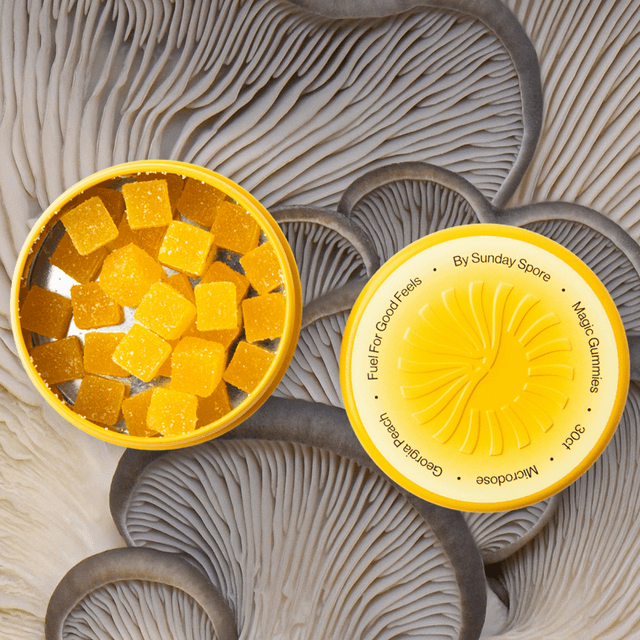
Precision Dosed
Every Sunday Spore gummy is lab-verified for precise, consistent dosing — no guessing, no scales, no batch variation. Just take one and go about your day.
If you're ready to start microdosing...
Sunday Spore Microdose — precision-dosed mushroom gummies. Lab-tested, exact dosing, ships discreetly.
The Default Mode Network
One of the most important concepts in psychedelic neuroscience is the Default Mode Network (DMN) — a network of brain regions that activates during self-referential thinking, mind-wandering, and rumination. Overactivity in the DMN is associated with depression, anxiety, and rigid thought patterns.
Full-dose psilocybin dramatically reduces DMN activity, producing the "ego dissolution" and mental flexibility that characterize psychedelic experiences. The question for microdosing is whether sub-perceptual doses produce a milder version of this effect. Preliminary imaging data suggests they might — but the effect is subtle and not yet consistently demonstrated across studies.
The Honest Bottom Line
Microdosing probably works for many people, but not entirely for the reasons they think. The combination of a genuinely psychoactive compound (even at low doses), structured intentional practice, self-monitoring, and the ritual itself creates a synergistic effect. Whether the psilocybin is contributing 20% or 80% of the benefit matters less than whether the overall practice improves your life.
Safety and Contraindications
Who Should NOT Microdose
- People with psychotic disorders (schizophrenia, schizoaffective disorder, or strong family history): Psilocybin can exacerbate psychotic symptoms. This is a hard contraindication.
- People with bipolar I disorder: Risk of triggering manic episodes. Bipolar II is a gray area — some people microdose successfully, but it requires caution and should ideally involve a psychiatrist.
- People on lithium: The combination of lithium and psilocybin has been associated with seizures. Do not combine.
- People on SSRIs (without medical guidance): SSRIs blunt psilocybin's effects and the interaction isn't fully characterized. Don't combine without discussing with your prescriber.
- People under 25: The brain is still developing. There's no microdosing safety data for young adults and theoretical reasons for caution.
- Pregnant or breastfeeding individuals: No safety data exists. Do not microdose during pregnancy or while breastfeeding.
Physical Safety
Psilocybin has an extremely high safety margin. There are no documented cases of fatal psilocybin overdose in humans. At microdose levels, physical side effects are minimal — some people report mild nausea (easily addressed by taking with food or using gummy/extract formats) or a slight headache on dose days.
Psychological Safety
At microdose levels, psychological risks are low but not zero. The most common negative experiences are:
- Increased anxiety (especially in the first 1-2 weeks, especially for anxiety-prone individuals)
- Emotional sensitivity (feeling things more deeply, which can be uncomfortable)
- Mild restlessness or overstimulation on dose days
These typically resolve with dose adjustment or time. If they persist beyond 2-3 weeks, reduce your dose or pause your protocol.
How to Start: Step by Step
Step 1: Choose Your Substance and Format
For beginners, psilocybin mushrooms in a pre-dosed format (gummies or capsules) offer the best combination of safety, consistency, and ease of use. If you're using raw mushrooms, grind an entire batch into homogenized powder and weigh out capsules with a precision milligram scale.
Step 2: Choose Your Protocol
Start with the Fadiman protocol (1 day on, 2 days off). If you're microdosing specifically for anxiety, see our anxiety-specific protocol guide for modifications.
Step 3: Start Low
Begin at 50mg (or 30mg if anxiety-prone). Take your first dose on a day when you have no major obligations or stressors — a relaxed morning at home is ideal. Note how you feel at 1 hour, 3 hours, and evening.
Step 4: Track Everything
Use a journal or app to record daily observations. At minimum, note: dose (if any), mood (1-10), energy (1-10), focus, sleep quality, and anything notable. The data becomes invaluable after 4-6 weeks when you're looking for patterns.
Step 5: Give It Time
The most common mistake is evaluating too early. Microdosing is not like taking an aspirin — you don't feel it work within minutes. The benefits emerge over weeks as cumulative neuroplastic changes reshape your baseline. Commit to one full 6-8 week cycle before deciding whether it works for you.
Step 6: Titrate Up (If Needed)
If after one full cycle at 50mg you notice nothing — not even on the tracker — try 75mg for the next cycle. Increase in 25mg increments until you find the dose where you notice subtle improvement without perceptible alteration.
Step 7: Cycle Off
After 6-8 weeks, take 2-4 weeks completely off. This serves multiple purposes: prevents tolerance, shows you what your new baseline looks like without the compound, and helps you distinguish between psilocybin effects and the effects of the other practices you've built around your protocol.
The Format Question: Why It Matters More Than You Think
The biggest practical problem with microdosing isn't the science, the protocol, or even the legality. It's consistency.
Dried mushrooms vary wildly in potency. Grinding them yourself requires a milligram scale, capsule equipment, and enough material to homogenize. Cutting blotter paper for LSD is imprecise at best. And any inconsistency in your dose undermines the entire practice — because you can't learn what works if the variable keeps changing.
This is why the move toward precisely dosed, manufactured psilocybin products has been so significant for the microdosing community. When every gummy or capsule contains exactly the same amount of psilocybin, you can actually run the experiment properly: same dose, same schedule, different days — and the patterns you observe in your journal are meaningful rather than confounded by dose variation.
Sunday Spore Microdose gummies were built specifically for this problem — accurate, consistent dosing in a format that requires zero preparation. No grinding, no scales, no capsule machines. You open the package, follow your protocol, and track your results. The compound is consistent; the only variable is you.
Building Your Practice for the Long Term
Microdosing isn't a magic pill. The people who get the most out of it treat it as one component of a broader practice that includes:
- Intentional self-reflection (journaling, meditation, or therapy)
- Physical movement (the neuroplasticity benefits of psilocybin are amplified by exercise)
- Creative engagement (microdosing opens doors, but you have to walk through them)
- Social connection (many microdosers report that the most valuable changes are relational)
- Sleep hygiene (neuroplasticity happens during sleep; protect it)
The compound creates a window of increased flexibility. What you do during that window determines the outcome. Microdose and sit on the couch watching TV, and you'll probably notice very little. Microdose and engage with the parts of your life you want to change, and the benefits compound.
Welcome to the practice. Start slow, track everything, stay honest with yourself, and give it time. The best microdosing protocol is the one you actually follow consistently — and the best dose is the one you can trust.
Sources & References
- Fadiman, J. (2011). The Psychedelic Explorer's Guide: Safe, Therapeutic, and Sacred Journeys. Park Street Press.
- Szigeti, B. et al. (2021). Self-blinding citizen science to explore psychedelic microdosing. eLife, 10, e62878.
- Beckley Foundation — research on brain entropy changes at sub-perceptual psilocybin doses.
- University of Zurich (2022). Neuroimaging study on low-dose psilocybin and functional connectivity in mood-regulation networks.
- Yale University (2023). Research on psilocybin-induced dendritic spine growth and neural plasticity.
- Polito, V. & Stevenson, R.J. (2019). A systematic study of microdosing psychedelics. PLOS ONE, 14(2), e0211023.
- Stamets, P. — theoretical framework for the psilocybin + lion's mane + niacin neurogenesis stack.
- Nichols, D.E. (2016). Psychedelics. Pharmacological Reviews, 68(2), 264-355.
- Journal of Psychoactive Drugs (2022). Analysis of psilocybin content variability in Psilocybe cubensis.
Note: This article cites published research for educational context. Inclusion of a study does not imply endorsement of its conclusions or guarantee of similar outcomes.
Disclaimer
This content is for educational and informational purposes only. It is not medical advice and should not substitute professional medical guidance. Always consult a qualified healthcare provider. Psilocybin is a controlled substance in most jurisdictions — know your local laws. Individual results vary.
“Three weeks into a Monday/Wednesday/Friday protocol and the difference in my foc...” — Sarah
“Bought the Big Guys for a camping trip with friends. The dosing is spot-on — eve...” — Marcus
Ready to start microdosing?
Try the Sunday Spore Microdose
Precision-dosed magic mushroom gummies designed for your microdosing protocol. Lab-tested. Exact dosing. Everything you need to start.
FAQ
Frequently Asked Questions
What does a microdose feel like?
How long should I microdose for?
What should I track while microdosing?
Is microdosing legal?
Written by
Alex Nakamura
Biochemistry degree. Translates complex mycology and pharmacology into accessible guides.